
The Journey of Labor.
An Overview of the Stages of Pregnancy Labor.


The journey of pregnancy labor is an incredible and unique experience that differs from every mother to another. It is a process that involves three stages. Understanding these stages can help expectant mothers prepare for childbirth and make informed decisions about their labor and delivery.
Labor, also called "parturition", is the process of delivering the baby. First starts with uterine contractions and ends with the delivery of the placenta. Labor typically begins when the fetus is full term and that is between 37 and 42 weeks of gestation. Before labor starts, pregnant woman may experience the "loss of a mucus plug" or the "rupture of the amniotic sac" they call it the "water breaking". These can trigger the onset of true labor contractions that progress in frequency, duration, and intensity. It can be felt like waves that build up and decrease in tension. These contractions cause the cervix to thin and dilate, to allow the fetus to leave the uterus. For a first-time pregnancy, it usually takes about 12 to 18 hours, while subsequent pregnancies take about half that time. However, the duration of labor can vary between pregnant women.

Labor is divided into three stages:
I. The first stage: is the longest and most challenging, lasting an average of 12 to 14 hours for first-time mothers. This stage is further divided into three phases:
- Early labor: During this phase, contractions usually last up to 20 hours, or until the cervix dilates by up to 4 centimeters.
- Active labor: This phase is presented with an increase in contractions, that vary widely in time periods. Contractions often come moderate to strong, every 2 to 3 minutes, and last 50 to 80 seconds.
- Transition: This is the most intense phase, but the shortest one. It is presented with strong contractions that may come every 1 to 2 minutes. With almost no break between them, and last around 60 to 90 seconds.
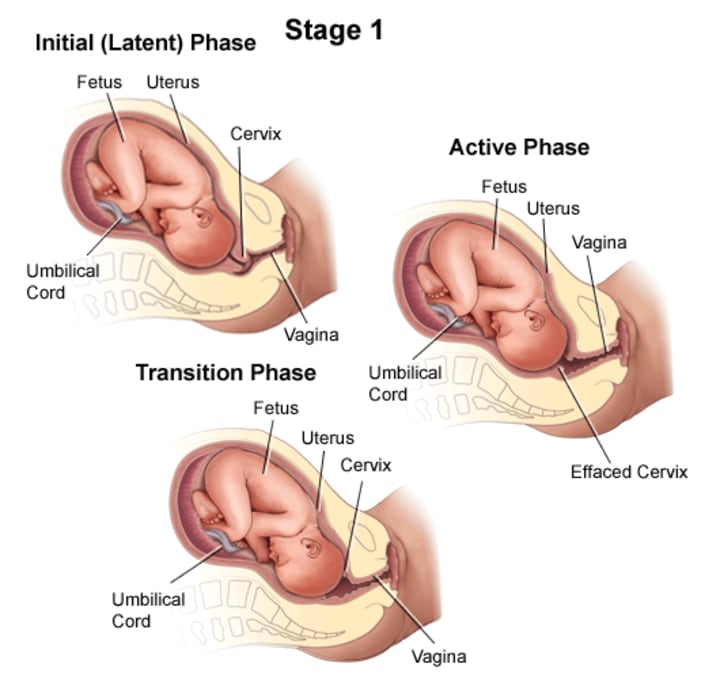
II. The second stage: Also called "pushing stage". This stage depends on the following three Ps: Power, Passenger, and Passage.
- Passage and power refer to forceful uterine contractions.
- Passenger refers to the fetus.
The relationship between the newborn's head and the bony pelvis is so critical, that human babies have developed an unfused skulls to ensure a large head and for brain development.
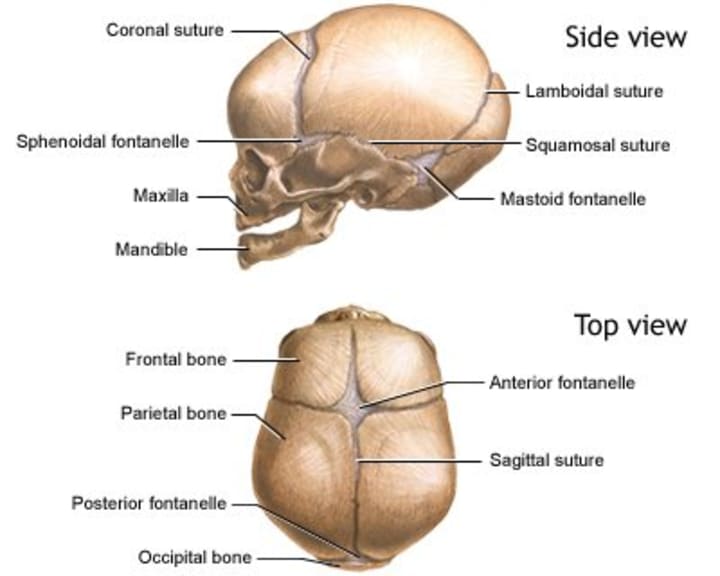
And the factors that determine the passage of the fetus with no difficulties are:
- Fetal size: is the most critical factor.
- Attitude: refers to the fetal body's flexed position.
- Fetal position: is ideal if the long axis of the fetus is along the maternal long axis. But transversal or oblique positions can delay the progression of labor.
- Presentation: is the first fetal part to descend into the pelvic inlet. And the most common and optimal presentation the vertex position. The fetus can make several positional changes which is called "cardinal movements", and it include: descent, flexion, internal rotation, extension, restitution, and expulsion.
III. The third stage: involves the placenta delivery, where the uterus contracts and the placenta separates from the wall. Then the placenta and any remnants are carefully removed to ensure a smooth and healthy delivery.
Finally, few hours after delivery, the uterus starts returning to its pre-pregnancy state and the body responds to the significant physiological changes and adaptations to the blood loss during delivery which causes contractions.
Medical disclaimer: The information provided should not be used for diagnosing or treating a health problem or disease, and those seeking personal medical advice should consult with a licensed physician. Always seek the advice of your doctor or other qualified health provider regarding a medical condition.
Here is a video for more information on this topic.
https://www.healthyparentshealthychildren.ca/im-pregnant/labour-and-birth/stages-of-labour
Keep reading
More stories from writers in Families and other communities.
From Scorned Scavenger to Culinary King:
For centuries, the humble lobster occupied a place far removed from the white tablecloths and extravagant seafood platters it now graces. It was considered a bottom-feeding scavenger, a protein source fit only for the poor, indentured servants, and even…prisoners. Its transformation from societal reject to the ultimate culinary indulgence is a testament to the power of effective marketing, a fascinating socio-economic journey fueled by ingenuity, perception shifts, and a healthy dose of chance.
By Wilson Igbasi6 days ago in Families
Wait, is it okay not to go home for the Holidays?
Kids these days are choosing to stay home rather than see their parents or their other family members for the holidays. I found it a bit absurd and tried to explain that it is important to bond with family, because you don’t know when you'll see them again, until someone called me out for not having visited my family in over 20 years.
By stephanie borgesa day ago in Families
Rachel Reviews: Lunch Tales: Teagan by Lucille Guarino
Well, I did enjoy this! Sometimes, all you need is just great storytelling and this is what Lucille Guarino delivers here. There's no big message to this book; it's just about folks and families, living their lives and coping with everything that's being thrown at them and finding their way. But when it's done well, like it is here, then you have characters to whom you can relate, tension which leaves you rooting for a better outcome, attraction which has your heart racing and an urge, as a reader, to see the characters happy with the people with whom they belong.
By Rachel Deeming4 days ago in BookClub


Comments
There are no comments for this story
Be the first to respond and start the conversation.