pregnancy
Growing your family, one baby bump at a time. All about the ups and downs of nature's 9 month miracle.
Postpartum Care
When a child is born, the newest mother has two big important jobs now. Take care of that little new baby and take care of herself. Every baby is different and so is every mother. Every mother’s recovery looks different based on how they delivered, how they are as a person, and many different factors.
By Rich Burton2 days ago in Families
Modern Abortion Procedures: Separating Facts from Fear. Content Warning. AI-Generated.
Modern Abortion Procedures: Separating Facts from Fear Few healthcare topics are surrounded by as much emotion, debate, and misinformation as abortion. Opinions are loud. Headlines are dramatic. Social media is overwhelming. But behind all the noise lies something much more important: medical facts.
By Eve Surgical Center4 days ago in Families
Why Care Should Feel Human—Not Clinical. Content Warning. AI-Generated.
Healthcare isn’t like scrolling a screen or clicking a button. It isn’t transactional, sterile, or impersonal. Healthcare is human — and when someone comes to us during an emotional, sometimes vulnerable moment, we believe the way they are treated should reflect that.
By Eve Surgical Center4 days ago in Families
Navigating Relationships with Emotional Intelligence
Relationships are the very fabric of our lives, weaving together our experiences, shaping our identities, and providing a profound sense of connection. Yet, they are also incredibly complex, often fraught with misunderstandings, heartbreak, and the bewildering question: "Why do relationships fail?" It's a question that echoes in countless hearts, hinting at deeper psychological currents beneath the surface.
By Being Inquisitive7 days ago in Families
The Power of Presence
When “Good Parenting” Became a Feeling In modern parenting conversations, “good” has increasingly come to mean emotionally warm, verbally affirming, and immediately comforting. A good parent is expected to soothe distress quickly, validate feelings consistently, and minimize discomfort whenever possible. These traits are treated as obvious indicators of healthy parenting, reinforced by cultural messaging, therapeutic language, and social reward structures. When a child feels better in the moment, the parenting decision is assumed to have been correct, and when discomfort persists, the decision is often framed as a failure of care rather than a necessary part of development.
By Peter Thwing - Host of the FST Podcast8 days ago in Families
The Silent Rooms: Life Without Children
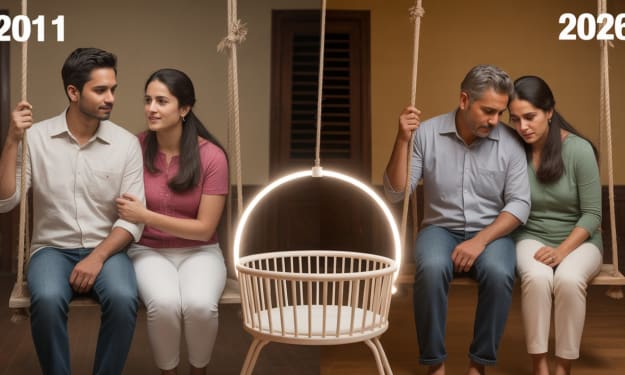
By Hazrat Umer A True Story of Marriage, Hope, and the Empty Cradle I got married in 2011. It was a year filled with the kind of joy that is hard to put into words. Like every young man, I had dreams. I remember sitting with my wife in our new home, talking about the future. We didn't just talk about our careers or our travels; we talked about the children we would one day hold in our arms. We imagined the sound of tiny feet running down the hallway. We even thought about names. In 2011, the world felt like it was at our feet, and the promise of a big, happy family felt like a certainty.
By Hazrat Umer21 days ago in Families
What Fathers Uniquely Provide
The Error of Treating Parenting Roles as Functionally Identical Modern parenting theory often begins with the assumption that mothers and fathers are largely interchangeable, differing only in style or temperament. From this view, any deficits in one parent can be compensated for by the other through increased emotional effort, sensitivity, or presence. Parenting becomes a question of intention and quantity rather than function and role. This assumption is appealing because it aligns with cultural preferences for symmetry and fairness, but it collapses under closer examination of developmental outcomes.
By Peter Thwing - Host of the FST Podcast22 days ago in Families
"These Children Come Here to Grow Us Up"
I wrote the beginning of this in 2023. When I put my youngest son on the special education preschool bus last school year, I smiled and waved at a tiny girl usually wearing pink. She sometimes returned that smile and said "hi". Later, I helped in my autistic son's classroom and discovered other funny things about the little girl: she always lost her shoes (or took them off), she loved dumping everything out, and she could be stubborn and yell "no!" when you asked her to put it away.
By Eileen Davis22 days ago in Families
Mexico surrogacy laws (2025): the Supreme Court rules people keep missing, in plain English. Content Warning. AI-Generated.
Surrogacy in another country can feel… unreal. One minute it’s hope. Next minute it’s spreadsheets. Clinics. Flights. Contracts. Then suddenly it’s, “Wait—who is listed as the parent?” and “Can the baby leave the country?” and “Is this even allowed back home?”
By Dan Toombs28 days ago in Families