
The Eldest
The silent weight of strength no one sees, until it’s too late.

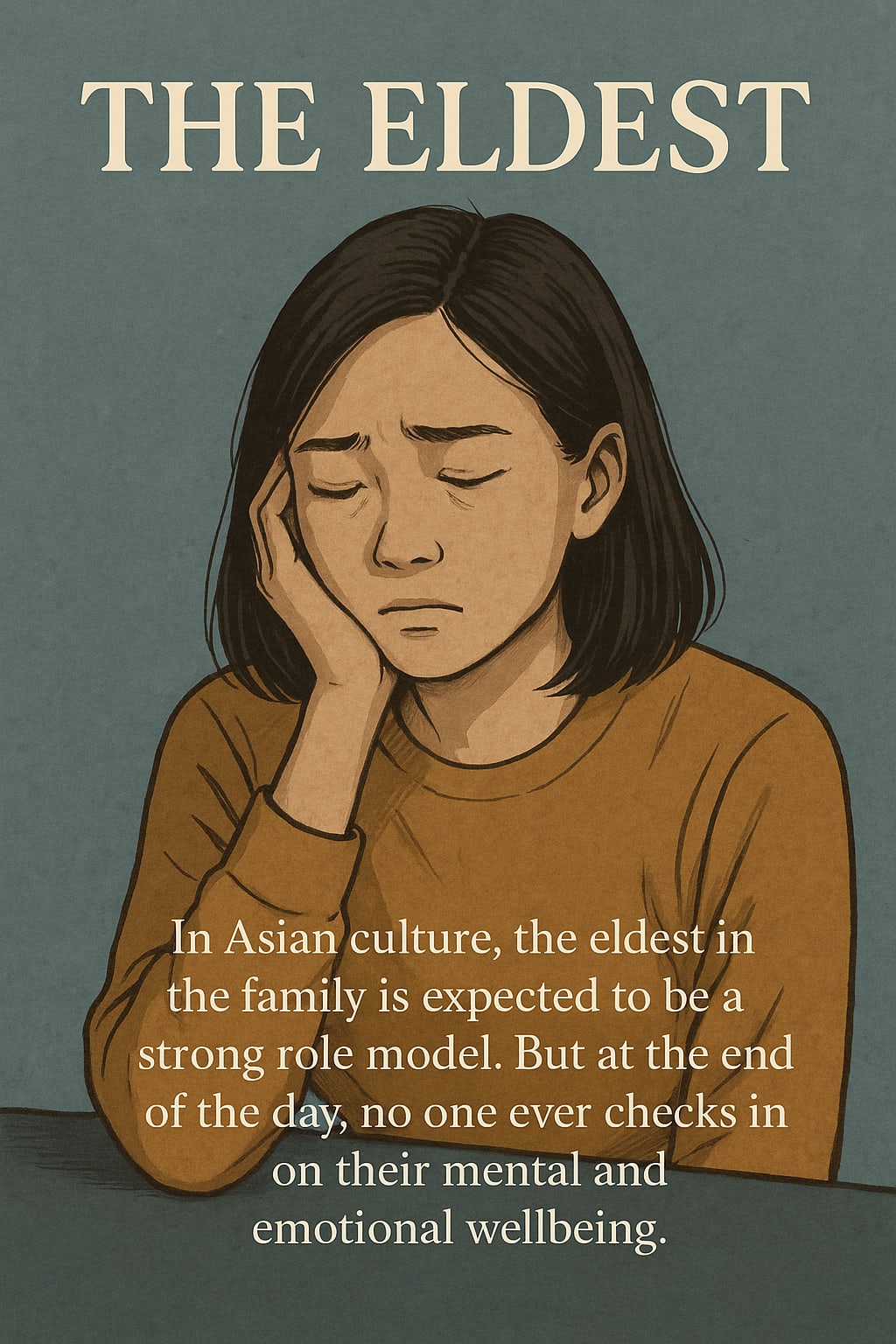
In many Asian families, there is a quiet, unspoken truth: the eldest child does not get to be tired. They do not get to complain, break down, or fall apart. They are the torchbearers, expected to be strong, responsible, and endlessly self-sacrificing.
Mei Ling was the eldest in her family.
From the moment she could walk, expectations followed her like shadows. When her younger brother threw tantrums, she was told to be patient. When her sister struggled in school, she was expected to tutor her. When her parents fought, she stepped in, a child mediator trying to stitch peace into silence.
At 34, Mei Ling had a stable job, lived independently, and took care of her aging parents financially. On the outside, she was doing well. Everyone said so, her colleagues, her relatives, even her family. “Mei Ling is so capable,” they would boast. “She’s our pride.”
But no one ever asked how Mei Ling was coping.
No one noticed the deepening circles under her eyes. No one asked why she’d stopped painting, a hobby that once brought her joy. No one heard the quiet sobs that sometimes escaped in the middle of the night, or the tightness in her chest that had become constant.
She smiled at every family dinner, organized birthday celebrations, sent out festive red packets, and helped her siblings when they were in trouble. But beneath the smile was a storm she had no words for, because in her culture, the eldest is not allowed to break.
“Be strong,” her mother often said. “If you fall, who will your siblings look up to?”
So she never fell. At least, not where anyone could see.
The thing about carrying everyone else’s weight is, eventually, it breaks your back. And that’s what happened to Mei Ling, quietly, invisibly, tragically. One ordinary Thursday evening, she didn’t come home. Her phone stopped ringing. Her texts stopped coming.
And then the family received the letter.
It wasn’t angry. It wasn’t bitter. It was full of love, but also pain, the kind of pain that came from years of silent suffering. Mei Ling had been battling depression for a long time, but never told anyone. She felt she couldn’t. She felt her role as the eldest didn’t allow her to appear weak.
Her words were clear, heart-wrenching:
“I carried everything, hoping someone would notice I was drowning. But no one did. I never wanted to leave, but I didn’t know how to ask for help without disappointing all of you.”
Too late, her family realised the depth of her struggle. Guilt flooded their hearts. Regret filled every corner of the home she once held together. And there was no turning back.
This story isn’t fiction for many families. In countless Asian households, the eldest child is raised to be the caregiver, the protector, the example. But rarely the one who gets protected.
What we forget is, the strongest people are still people. They have limits. They have emotions. They need rest, support, love, and space to be vulnerable.
Checking in on the eldest child, or anyone in your life who seems strong, is not weakness. It’s wisdom. A simple, “Are you okay?” or “Do you want to talk?” can be life-saving. Not every struggle is visible. Not every cry for help is loud.
Asian culture is rich with respect, tradition, and family values. But we must evolve. We must learn that true strength is not in enduring silently, but in allowing ourselves to be human.
Mei Ling’s story reminds us: love must be proactive. Don’t wait until it’s too late.
Check in. Ask. Listen.
Because no title, not even “the eldest”, should cost someone their peace, their voice, or their life.
About the Creator
Keep reading
More stories from Arun Cleetus and writers in Families and other communities.
Threads of Midnight
Grandma Lian always swore that black brought only sorrow. “Funeral color,” she’d mutter, pushing the ebony scarf to the back of the cupboard whenever Mei tried to wear it. Traditions, she’d say, kept the family safe, just as they had in her Hakka village, long before planes and phones stitched continents together.
By Arun Cleetus6 months ago in Families
Christmas Abroad: Celebrating the Holidays Without Family
I moved to South Korea in 2017. I was twenty-two years old and excited to start my career as an English Second Language Teacher. With a Bachelor's degree and six hundred dollars in my bank account, I set off for Busan.
By Kera Hollowabout a month ago in Families
DEEP HEIGHTS
I Love How He Loves Me GRACELLA NOV 19, 2025 (Just a Devotional): I am left in a sweet place here and had a wonderful time with my Lord, as I always do. But this was different. Unspeakably different. It is not really something I can share, because it is just one of those things that belongs to you; if you know what I mean.
By Kadee Grace6 days ago in Families

Comments
There are no comments for this story
Be the first to respond and start the conversation.