
Snow White is the Worst Story For Your Children
The damaging psychological effects of a problematic fairy-tale

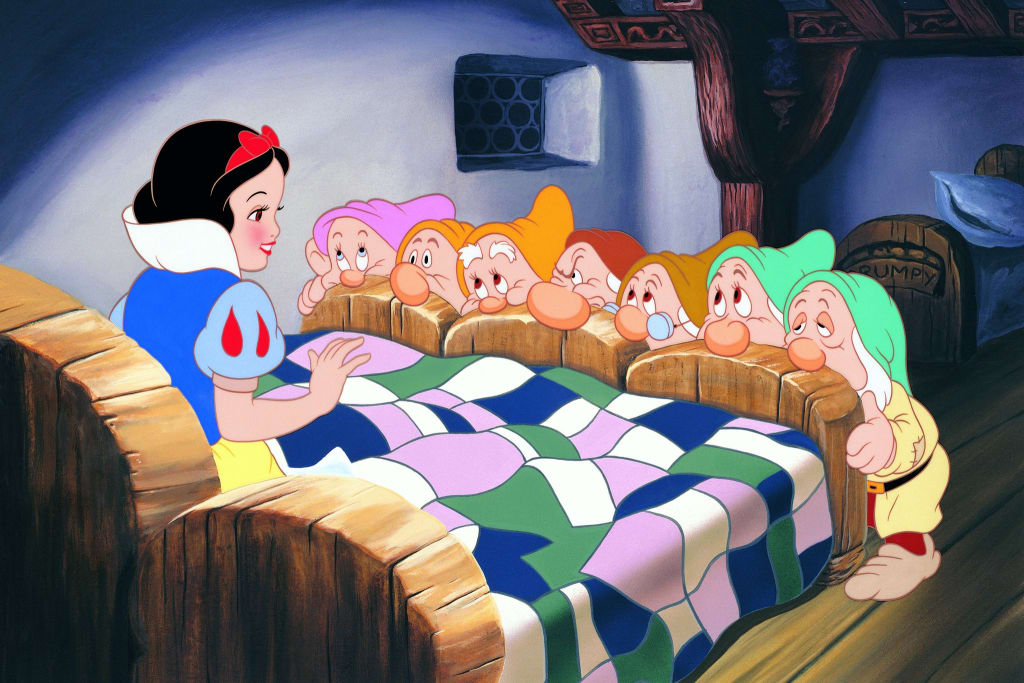
Imagine walking into your home after a tiring day at work. After hours of fending off the most obnoxious people, nothing is more revitalizing than catching up with the wonderful things your kids have been up to. I am sure that your horror will know no bounds if, during the day someone has force-fed your children the most ridiculous of ideas. Ideas such as beauty equals whiteness or girls need men to save them or that boys are welcome to kiss unconscious women. And this is just the tip of the iceberg. In the 21st century, Snow White and Seven Dwarves offers many problematic messages which are not the best psychological assortment for the children. Which is probably why it is time to rethink this legendary fairytale.
At its outset, Snow White represents a girl's journey to conquer something that haunts all children - the fear of abandonment. To answer this scathing concern, the story reassures the infantile reader that good people need not be worried about abandonment. Because wherever they are, their goodness will ensure that they are surrounded by well-wishers. Prominent child psychologist, Bruno Bettelheim notes that the story has survived for so many centuries because of its ability to reassure its reader. Even in the 21st century, the psychological fears that surround children remain largely unchanged. However, the means to deal with them are not akin to the times when the Grimm Brothers recorded this story. Perhaps in a closely-knit German village of the 19th Century, an orphaned child might survive on her kindness, but in the concrete jungles of the modern era, that's simply not the case. Modern children (especially young women) need to be reminded that they can thrive in this world on the strength of their own skills. Skills that do not require being attractive enough to catch the eye of a rich prince or looking pitiful enough to melt the hearts of a few dwarf-men.
Keira Knightley and Kristen Bell, actresses who have worked in Disney movies, recognize the harmful impacts Snow White poses to their children in the #MeToo era. They have banned Snow White for their children because of its problematic depiction of consent. Though the by-laws to the Queen's spell does include the by-law of love's first kiss waking Snow White to life, it is problematic if Prince Charming simply assumes that role to himself. In most versions, he has never met Snow White before and the Disney flick gives him barely half a meeting before she is 'exiled'. So, technically he just sees a pretty damsel-in-distress who's been sleeping in a coffin for one year and kisses her out of the blue. Celebrating his kissing Snow White, not to mention the resurrecting powers given to it, sends the wrong message to a reader who is barely beginning to develop their moral compass. It sends the wrong message which empowers men to initiate intimacy in heterosexual relationships even without the consent of their partners. A fact highlighted in the study conducted by NYU which found that a majority of young boys aged 5–11 believe that women need men to protect them.
On a more subliminal reading, Snow White reinforces a deeply racist perception of beauty. While Queen's interrogative, "Who's the fairest of all" sounds extremely harmless, it is known to induce a severe inferiority complex in the readers of color. Charu Uppal, an eminent cultural theorist conducted a series of interviews with a series of girls in the Global South. When these girls were asked to draw a princess, more than 95% of them imagined princesses with white skin. Interestingly none of them could imagine a princess which wore the traditional dress of their culture and has caricatures depicting the European regalia. Though Snow White alone is not entirely responsible for this but as one of the most famous fairy-tales around the world, it contributes significantly to the racist perception which forces young minds to accept whiteness as a pre-requisite for beauty. The people who are reading Snow White today will become adults in an ever more globalized world. And it would be extremely unjust to them if they are made to believe things that do align with our vision for a shared future - equality.
Okay, so Snow White is sexist and racist, but what can we do about the problem? For starters, we can change the story. Although the fairytales we read today seem to be canonical works set in stone, they actually have had fluid plot-lines for centuries with each storyteller bringing in their own version. Over the years, a lot of sections have seen the editorial snip because of their problematic content. For example in the Grimms' version of Snow White, the queen practices cannibalism and there are allusions to necrophilia in Prince Charming's last-minute-kiss-of-true-love. To make matters worse, it also features a rather lengthy ending where the queen is made to dance in red-hot shoes until she drops dead. I am sure that these segments would have been shocking for the parents of the previous century and that's why most modern retellings of Snow White do not include them. Therefore, if parents of today, choose to view sexist and racist overtones as harmful, there is nothing stopping us to do away with them as a society. In fact, some recent adaptations such as Snow White and Hunstman(2012) have down away with the sexism to feature their heroine joining the Hunstman to incite an all-out uprising against the Queen.
Now, of course, every child who reads Snow White does not automatically become racist or sexist. There are millions of people who grew up binging on such fairytales and turned out to be the finest of people. However, it is important to note that body-image issues and the ensuing inferiority which are on the rise amongst teenagers since the advent of social media. It is harrowing to see thousands of young people fall through the cracks just because they can not see themselves for the exceptional people they truly are. We must leave no stone unturned in sending out body-positive, gender-sensitive, and race-inclusive messages to save them from losing self-esteem and save as many lives as we can. As childhood is the blank canvas where such strokes need to be made, we have to be absolutely economical with what messages we want the kids to imbibe. And stories like Snow White, in their current form, are definitely not helping at all.
About the Creator
Keep reading
More stories from Shourya Agarwal and writers in Families and other communities.
3 Hidden Messages You Missed in Harry Potter
No one can deny that Harry Potter commands an unprecedented fanfare with its followers. Walk into any bookstore and you will find a voracious reader hungrily prodding through the stacked copies of Rowling’s finest. The Wizarding World’s charm only gets grander with a cinematic adaptation that further entranced millions. Such a massive fan-following begs the obvious question: what makes Harry Potter so special? When Potterheads were asked the reasons for their undying love for the franchise, a majority of them pointed towards the work’s stellar world-building. And that they feel drawn into an enchanting universe that just seems too real to be not true. As if a sprinkle of Floo-Powder is all that separates them from a whole world of magic.
By Shourya Agarwal5 years ago in Geeks
Wise~Guys
— Look Behind what's in Front of You ~ Make Good Choices — Hey, So how you Doin'..! Made~Men — Mobster Movies romanticise a distinctive, elegant appearance, impeccable attire style, along with the 'Families' expressive lingo. Making their 'Bones' gave them Panache — with vintage fedoras, tailored pin-striped suits, mirror-polished wing-tip shoes adorned with tassels; with their 'Gun Moll' gorgeous dates on their arms.
By Jay Kantor23 days ago in Families
The Kind-Hearted Friend
In a lush forest, there lived a troop of monkeys. Among this troop were two young monkeys who were notorious for their mischievous behavior. Their constant pranks and antics had even exhausted their parents, who often scolded them for their wildness. In the same forest, there was a young giraffe, a gentle and innocent creature, known for his simplicity and good nature. One day, while grazing on the green grass, the young giraffe wandered into a part of the forest where the mischievous monkey duo was busy plucking leaves and fruits from the trees to eat.
By Sudais Zakwana day ago in Families
So You Decided To Become a Nurse Practitioner:
So you decided to become an "Advanced Practice" nurse. Congratulations!... is what I would say if this was a good idea. Grad school? In this economy? What were you thinking? Likely it was something along the lines of either 1) “I've seen these other chucklefucks do it— Why can't I?” or even 2) “I've got a nice career, I should shake it up. I miss feeling like I have no clue what I'm doing.”
By Sandor Szabo7 days ago in Fiction



Comments
There are no comments for this story
Be the first to respond and start the conversation.