
Navigating the Hormonal Highway: A No-Nonsense Guide to IVF Medications
Diving into IVF meds? It's like turning your body into a baby factory on steroids—needles, hormones, and hope. This chat unpacks the shots, sides, and stats with zero fluff. Ready to laugh through the pokes? Let's go.


If you’re embarking on an In Vitro Fertilization (IVF) journey, you’ve likely encountered the "medication mountain."
It’s often the most daunting part of the process—a dizzying array of injections, pills, and patches, each with a specific name, timing, and purpose. It can feel less like a fertility treatment and more like memorizing a pilot’s pre-flight checklist.
But what if we reframe this?
These aren't just drugs; they are precision tools that allow fertility specialists to transform a complex biological lottery into a controlled, optimized mission to create life.
To truly understand why IVF relies so heavily on medication, we need to look at the process not as a natural event, but as a meticulously orchestrated project.
Syncing the Clocks
Before the true stimulation begins, many protocols start with an often-overlooked step: pretreatment, typically using birth control pills. This might seem counterintuitive—taking contraceptives when you are trying to conceive—but it is a critical strategic move.
In IVF, we can’t afford that kind of spontaneity.
This is the "System Reset" button. It standardizes the timing, quieting the ovaries so that when the real work begins, every follicle starts its growth phase at the exact same moment.
This synchronization is paramount for a successful egg retrieval, ensuring a high yield of mature eggs.
Phase 1: Multi-Bloom Garden
The first major category of drugs aims for a single goal: stimulating the ovaries to produce multiple eggs, not just the single egg released in a typical natural cycle.
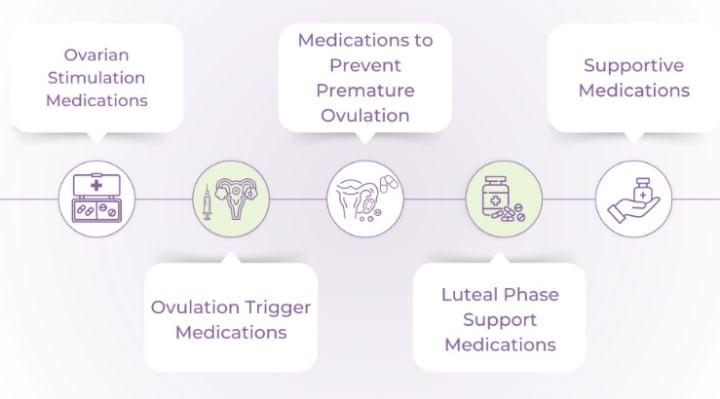
These are the Ovarian Stimulation Medications, primarily containing Follicle-Stimulating Hormone (FSH)—often branded as Gonal-F, Follistim, or Bravelle—and sometimes Luteinizing Hormone (LH), found in medications like Menopur.
In a natural cycle, your body uses its limited resources to nurture one dominant follicle—one beautiful, singular bloom. When you introduce FSH and LH drugs, you are essentially pouring "super-fertilizer" onto the field.
Suddenly, all the resting follicles wake up and begin to grow simultaneously, resulting in a multi-bloom garden of potential eggs.
This process is critical because not every egg retrieved will be mature, not every mature egg will fertilize, and not every fertilized egg will develop into a viable embryo. Higher egg numbers lead to a greater chance of having a healthy embryo for transfer.
Phase 2: The Trigger
Once the follicles are growing, the next challenge is preventing the body from ruining the mission by ovulating too early. In a natural cycle, a surge of LH triggers the immediate release of the egg.
In IVF, the eggs must stay put until the doctor is ready to retrieve them.
This is where the GnRH agonists (Lupron) and antagonists (Ganirelix or Cetrotide) act as the "Gatekeepers."
These medications manage the hormones from the pituitary gland, preventing that premature LH surge. They hold the gate shut, ensuring the eggs remain safe inside their follicles until they reach optimal maturity.
Then comes the most precisely timed shot of the entire cycle: the Ovulation Trigger Medication. Typically containing human chorionic gonadotropin (hCG)—meds like Ovidrel, Pregnyl, or Novarel—this injection mimics the natural LH surge. It signals the eggs to undergo their final, crucial maturation step.
The trigger shot is the "Ignition Key" for the retrieval.
It must be administered exactly 36 hours before the scheduled egg retrieval surgery. If the timing is off by even an hour, the quality and yield of eggs can be severely compromised.
Phase 3: The Welcome Mat
The mission doesn't end after retrieval. Once fertilization is successful, the next phase is preparing the "nursery"—the uterine lining—for implantation.
The Luteal Phase Support Medications are primarily Progesterone supplements, such as Crinone (a vaginal gel), Endometrin (suppositories), or the classic Progesterone in Oil (PIO) injections. Progesterone is the essential hormone for maintaining a pregnancy.
Progesterone's role is to act as the "plush welcome mat," ensuring the uterine lining (the endometrium) is thick, sticky, and nutrient-rich—the perfect, velvety environment for the embryo to implant and thrive. Some patients also require Estrogen supplements (like Estrace or patches) to further support the thickening of the lining.
The Unavoidable Turbulence
With such powerful hormonal orchestration, side effects are an almost universal experience.
It’s important to normalize and anticipate them, so they don’t become a source of panic.
Common side effects of the stimulation drugs include mild to moderate symptoms like bloating, headaches, breast tenderness, and mood swings.
Yes they are annoying.
But these are usually temporary signs that the body is adjusting to the high hormone levels.
The most serious risk, however, is Ovarian Hyperstimulation Syndrome (OHSS), where the ovaries overreact to the stimulation drugs, causing swelling, pain, and fluid buildup.
But relax!
The chances of an OHSS happening during IVF is just 1-5% and your fertility specialists will monitor closely—checking hormone levels and follicle growth frequently—to adjust the protocol and mitigate this risk.
Finally, the drugs that cause multiple eggs to mature also increase the odds of multiple pregnancies. Most specialists now strongly advocate for single embryo transfer (SET) to reduce the risks associated with multiple births, such as prematurity and low birth weight.
Conclusion
The IVF medication schedule is never a 'one-size-fits-all' plan.
Each injection and pill plays a critical role in this precise, multi-phase mission.
The complexity is the key to the success, and your diligence in following the schedule is the final piece of the puzzle.
We hope this article helped you become more informed. If you need more info, do check the further reading section.
All the best to you and your future family!
Further reading and citations
- IVF Medications Overview – Coastal Fertility's Guide to IVF Meds
- Gonadotropins Fact Sheet – ASRM Essentials
- IVF Meds 101 – Carrot's Easy Read
- Long-Term Fertility Med Impacts – NIH Deep Dive
- How long is the IVF Treatment Procedure - Vocal Media Article on IVF
About the Creator
RSMCo
RSMC is a leading fertility center dedicated to helping individuals and couples on their path to parenthood. Explore our articles for evidence-based information and trustworthy insights from experts to empower you with knowledge.
Wise~Guys
— Look Behind what's in Front of You ~ Make Good Choices — Hey, So how you Doin'..! Made~Men — Mobster Movies romanticise a distinctive, elegant appearance, impeccable attire style, along with the 'Families' expressive lingo. Making their 'Bones' gave them Panache — with vintage fedoras, tailored pin-striped suits, mirror-polished wing-tip shoes adorned with tassels; with their 'Gun Moll' gorgeous dates on their arms.
By Jay Kantor18 days ago in Families
The quiet sound of families breaking
There is a kind of silence that is louder than any noise. It is the silence of a child waking in the night and realizing their parent is gone. It is the silence of a kitchen table with one chair suddenly empty. It is the silence of a home that still looks the same, but no longer feels the same. Across the United States, thousands of families live inside that silence. Not because of war. Not because of disaster. Not because of death. But because of policy.
By Kaylee Souther6 days ago in Families
So You Decided To Become a Nurse Practitioner:
So you decided to become an "Advanced Practice" nurse. Congratulations!... is what I would say if this was a good idea. Grad school? In this economy? What were you thinking? Likely it was something along the lines of either 1) “I've seen these other chucklefucks do it— Why can't I?” or even 2) “I've got a nice career, I should shake it up. I miss feeling like I have no clue what I'm doing.”
By Sandor Szabo2 days ago in Fiction




Comments
There are no comments for this story
Be the first to respond and start the conversation.