
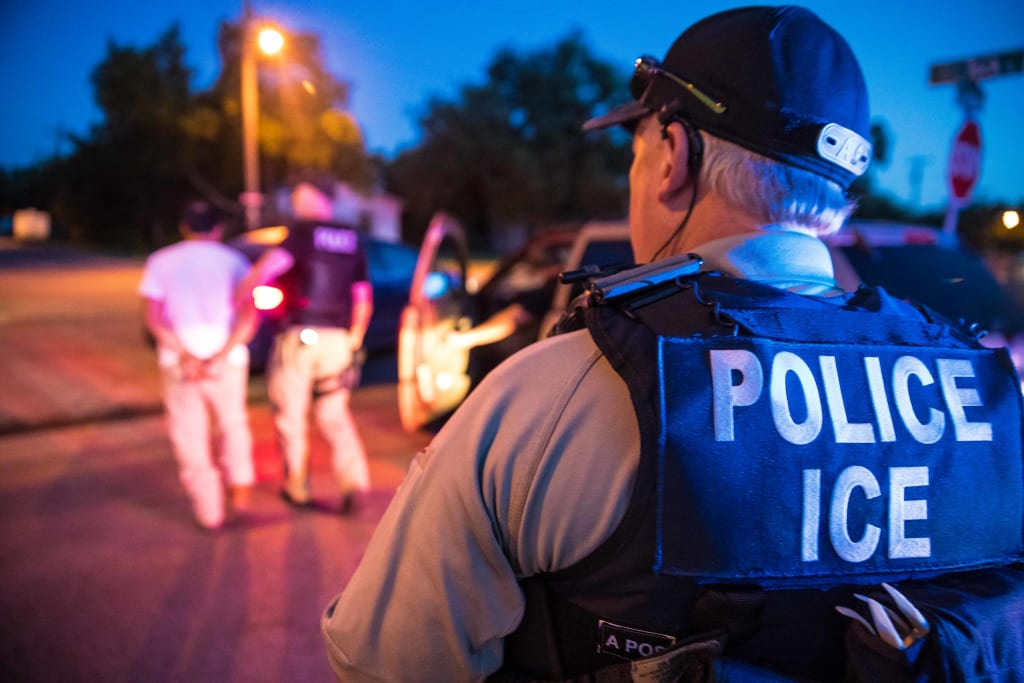
There is a kind of silence that is louder than any noise. It is the silence of a child waking in the night and realizing their parent is gone. It is the silence of a kitchen table with one chair suddenly empty. It is the silence of a home that still looks the same, but no longer feels the same. Across the United States, thousands of families live inside that silence. Not because of war. Not because of disaster. Not because of death. But because of policy.
Immigration and Customs Enforcement, known as ICE, was created with the stated purpose of enforcing immigration law and protecting national security. In theory, it exists to keep people safe. In practice, for many families, it has become the moment their lives split into a “before” and an “after.” Before: birthdays together, rides to school, dinner conversations, shared worries and shared hopes. After: phone calls from detention centers, lawyers’ numbers scribbled on napkins, children translating adult pain into questions they are too young to carry. “Where did my mom go?” “Why can’t my dad come home?” “Did I do something wrong?”
These are not political questions. They are human ones.
Supporters of harsh immigration enforcement often speak the language of order. They talk about rules, borders, legality, and security. Those words sound clean and logical. But the reality those words produce is not clean at all. It looks like a father pulled over for a broken taillight and never returning home. It looks like a mother detained at a routine check-in and disappearing from her children’s daily lives. It looks like a teenager becoming a caregiver overnight, a family losing its only income, its emotional anchor, and its sense of safety all at once.
This is not a rare mistake. It is not an unfortunate accident. It is a predictable outcome of a system that values enforcement numbers over human lives. When a policy repeatedly results in children crying themselves to sleep, communities living in fear, and families being torn apart, we have to ask what exactly is being protected. Is it safety, or is it the appearance of control?
We count deportations. We count arrests. We count “removals” and “enforcement actions.” We do not count the number of children who develop anxiety after a parent is taken. We do not count the number of kids who stop trusting police, teachers, and institutions because authority became associated with loss. We do not count the families who fall into poverty after losing their main provider, or the dreams that quietly dissolve. Trauma does not disappear when a person is deported. It stays behind, living in bedrooms, in report cards, in bedtime routines that no longer exist.
Psychologists tell us that childhood trauma reshapes the brain. It affects emotional regulation, learning, and long-term health. A child who experiences sudden separation does not simply “get over it.” That loss becomes part of who they are. So when we say enforcement, what we often mean is trauma delivered by uniform, and we ask children to carry it.
America likes to tell a story about itself. A story of Ellis Island, of hopeful arrivals and second chances, of people who came with nothing and built everything. It is a beautiful story. But it becomes hollow when we refuse to extend that humanity to the people living the story now. Most undocumented immigrants did not come to harm America. They came to survive. They came to escape violence, poverty, instability, or hopelessness. They came to work, to raise families, to give their children something better than what they themselves had.
Instead, many find themselves living in fear. Fear of driving. Fear of reporting crime. Fear of going to the doctor. Fear of answering the door. This is not what a healthy society looks like. A society that rules by fear is not secure; it is brittle.
The law is not sacred. It is not infallible. It is something humans create, and humans can create it better or worse. There was a time when the law said women could not vote. There was a time when the law protected slavery. There was a time when the law enforced segregation. The law has been wrong before. It is not radical to question whether it is wrong now.
What makes a policy moral is not how efficiently it operates, but how justly it treats people. A system that achieves “order” by producing widespread suffering is not a triumph of governance; it is a failure of compassion.
ICE agents themselves are often trapped inside this system. Many are not monsters. Many are parents. Many are simply doing a job inside a machine that leaves little room for discretion or mercy. This does not absolve the harm, but it reminds us that the problem is structural, not just individual. It is a machine that turns ordinary people into instruments of pain and then asks society to accept the results as normal.
But broken things should not be normalized.
Children should not grow up associating safety with fear. Parents should not have to choose between survival and legality. Communities should not be forced into the shadows to exist.
If America is truly strong, it does not need to tear families apart to prove it. If America is truly confident, it does not need to rule through terror to maintain order. Strength is not measured by how harshly a country can punish, but by how humanely it can govern.
We can choose differently. We can build an immigration system that prioritizes family unity, due process, and human dignity. We can invest in courts instead of cages, in pathways instead of walls, in solutions instead of suffering. We can acknowledge that migration is a human reality, not a crime wave. We can recognize that people are not problems to be solved, but lives to be respected.
The silence in these homes does not have to be permanent. It is created by policy, and it can be undone by policy. It requires courage, empathy, and imagination — the willingness to see immigrants not as statistics, but as neighbors; not as threats, but as families; not as outsiders, but as part of the story we are still writing.
History will ask us what we did when we knew. Whether we chose fear or compassion. Whether we chose control or connection. Whether we chose silence or voice.
May we be the generation that refused to accept broken families as collateral damage. May we be the ones who insisted that love matters more than paperwork, that children matter more than quotas, and that humanity matters more than borders.
Because in the end, a nation is not defined by the lines it draws on a map, but by the way it treats the people who live within them.
And we can be better than this.
About the Creator
Keep reading
More stories from writers in Families and other communities.
Wise~Guys
— Look Behind what's in Front of You ~ Make Good Choices — Hey, So how you Doin'..! Made~Men — Mobster Movies romanticise a distinctive, elegant appearance, impeccable attire style, along with the 'Families' expressive lingo. Making their 'Bones' gave them Panache — with vintage fedoras, tailored pin-striped suits, mirror-polished wing-tip shoes adorned with tassels; with their 'Gun Moll' gorgeous dates on their arms.
By Jay Kantor18 days ago in Families
Wild Card Weekend Recap: What Happens Now?
I think I figured out why I love Wild Card Weekend so much. It's because it's the first playoff anything of the calendar year. The NFL season starts in the fall, and once upon a time, the champion was crowned either on or slightly before New Year's. The evolution of the NFL schedule has resulted in the playoffs starting just into the New Year, and currently, the final week of the season falls on the first weekend of the New Year, with Wild Card Weekend coming a week after that. So yes, chronologically, the NFL's Wild Card Weekend serves as the first playoff anything of the calendar year.
By Clyde E. Dawkins6 days ago in Unbalanced




Comments
There are no comments for this story
Be the first to respond and start the conversation.