
“My Kid Is Crazy”:
Why Most Crises Begin at Home, Not in the Child


During my years as a mobile crisis therapist on the streets of Phoenix, I answered countless late-night calls that all started the same way. A parent would phone in—exhausted, exasperated—and say, “My kid is crazy.”
The child in question was usually between eleven and sixteen years old, sometimes younger. The assumption was always that the child was the problem: out of control, irrational, dangerous. But the first question we asked upon arrival often shifted the entire narrative.
“Is your child this way everywhere?”
“Do they erupt in church?”
“Does he cause chaos at the grocery store?”
“Does she lash out at grandma’s house?”
“Do they disrupt the classroom?”
“Or does it only happen at home?”
The answers were telling. More often than not, parents said, “No, just at home.”
Essentially, they admitted that the child held it together outside the home but unraveled inside it.
That distinction matters. A lot.
If a child can regulate in structured environments—classrooms, churches, extended family gatherings, public spaces—then this isn’t a global behavioral disorder. The parent just told on themselves. The “acting crazy” is situational—environmental.
In other words: most “kid problems” are “parenting issues”—whether the parent wants to believe it or not.
Environmental Truths and Forensic Mirrors
This isn’t a soft observation. It’s supported by decades of behavioral psychology and clinical research. Studies in child development consistently show that what’s framed as “defiance” or “craziness” is usually the child responding to inconsistent boundaries, poor modeling, or emotional chaos within the household.
Children are not passive recorders of behavior.
They are forensic mirrors—reflecting the systems around them. When those systems are inconsistent, dismissive, or permissive, the child adapts by amplifying the chaos.
Across the literature, the pattern is remarkably consistent:
The vast majority of presenting behavioral problems in youth—some estimates exceeding 90 percent—stem not from psychiatric illness but from environmental dysfunction.
Only a small fraction originate in true organic mental illness.
The Deflection Reflex
When parents label a child as “crazy,” they displace accountability. The label functions as both shield and sword:
- Shield: protecting the parent from confronting their own role.
- Sword: attacking the child’s credibility and self-concept.
A thirteen-year-old repeatedly called “crazy” will eventually believe it—even if their so-called symptoms vanish the moment they step into a classroom. That labeling can echo into adulthood, distorting self-esteem, relationships, and trust in authority.
From a forensic psychology perspective, this misattribution of blame has measurable consequences. Youth labeled as “problems” are more likely to be surveilled, disciplined, or criminalized. The pattern is predictable: frustrated parents call authorities, authorities respond with force, and the child learns that conflict resolution equals escalation. By the time these kids reach the justice system, their reputations precede them—while the household dynamics that bred the crisis remain untouched.
The Clinical Divider
Clinicians in the field are trained to separate psychiatric from environmental cases.
The diagnostic key is consistency:
- If disruptive behavior appears across all contexts, deeper psychiatric assessment is warranted.
- If it is context-dependent, the intervention must include the family system.
Otherwise, the child becomes the scapegoat for dysfunction they didn’t create. The ethical duty is truth-telling—even when truth indicts the adults.
The Ethical Bottom Line
It is far easier to pathologize a child than to confront painful realities about parenting, communication, or household modeling. But the forensic record is clear: environment shapes behavior. Blaming the child is not only inaccurate—it’s harmful.
So when a parent insists, “My kid is crazy,” the better question is:
“Where, and with whom?”
- If the answer points back to home, then the issue is not the child.
- It is the system—the environment—surrounding them.
Crises do not appear in a vacuum.
They are cultivated, often unintentionally, by the very environments meant to prevent them. Until that truth is faced, children will continue carrying the weight of dysfunction that rightfully belongs to the adults in the room.
Sources That Don’t Suck
Kazdin, A. E. (2005). Parent Management Training: Treatment for Oppositional, Aggressive, and Antisocial Behavior in Children and Adolescents. Oxford University Press.
Patterson, G. R., Reid, J. B., & Dishion, T. J. (1992). Antisocial Boys. Castalia Publishing.
American Academy of Child & Adolescent Psychiatry. (2013). Practice parameter for the assessment and treatment of children and adolescents with oppositional defiant disorder. Journal of the American Academy of Child & Adolescent Psychiatry, 52(9), 1028–1042.
Dodge, K. A., & Pettit, G. S. (2003). A biopsychosocial model of the development of chronic conduct problems in adolescence. Developmental Psychology, 39(2), 349–371.
About the Creator
Dr. Mozelle Martin
Behavioral analyst and investigative writer examining how people, institutions, and narratives behave under pressure—and what remains when systems fail.
Keep reading
More stories from Dr. Mozelle Martin and writers in Families and other communities.
How Much Does Memory Care Cost in the U.S.? Average Monthly Prices Explained
With the onset of memory loss in a loved one as a result of some conditions such as dementia or Alzheimer disease, families tend to start to seek specialized care services. The first question that one would want to have answered when undergoing this process is very basic, yet significant, and that is how much is the cost of memory care?
By Patrica Overton6 days ago in Families
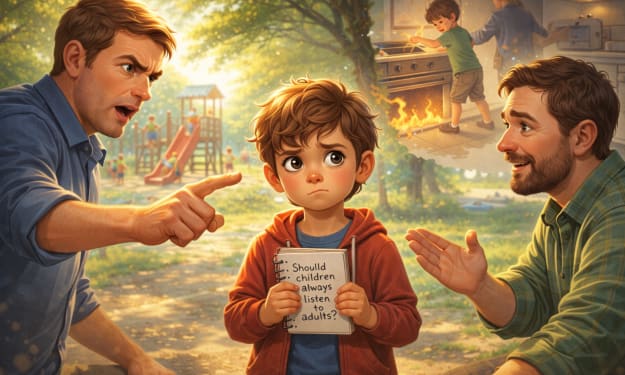
Should Children ALWAYS listen to Adults?
Many people believe children should always listen to adults because adults have more experience and knowledge about life. Adults have faced many situations and learned from their mistakes over time. Because of this, they often try to guide children and help them avoid problems. However, others argue that adults are not always right and that children should also learn to think for themselves. Children are individuals with their own thoughts and ideas, and sometimes they may see things differently from adults. This text will explore both sides of the argument to understand whether children should always listen to adults.
By *+*+*~Teja~*+*+*4 days ago in Families



Comments
There are no comments for this story
Be the first to respond and start the conversation.