
Growing Up with Colourism in Brown Households
How beauty standards built around fairness, smoothness, and silence leave lasting marks on brown girls.

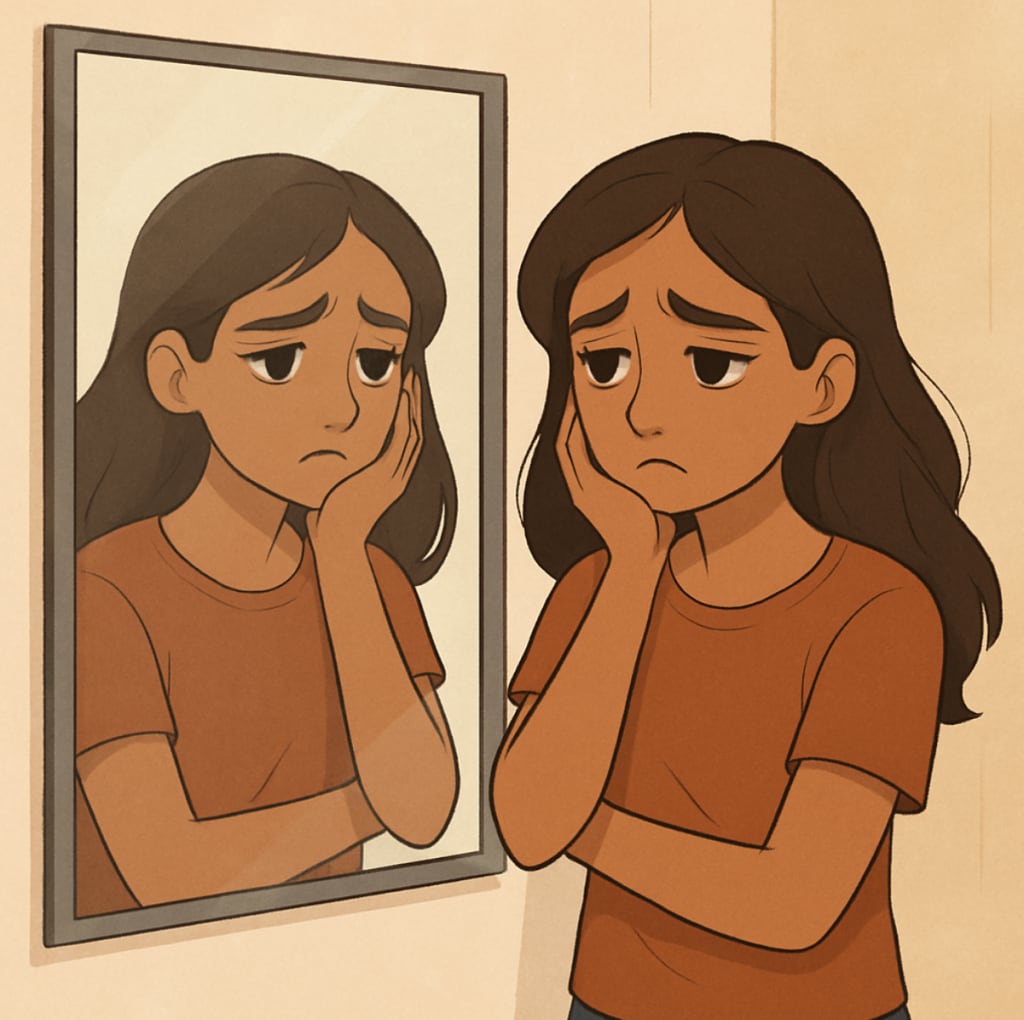
Growing up brown often means growing up in a house where the TV is always on, but the messages it sends are quietly shaping you. A skin-lightening commercial plays in the background. A distant relative compliments you with, “You’re looking fairer these days!” Your mom hands you a face pack, not because you asked for skincare, but because it has turmeric in it—"good for brightening."
You don’t question it. You just learn: lighter is better.
The Birth of a Beauty Myth
For many brown girls, the pressure to be beautiful starts before they even understand what beauty means. And for a long time, that definition was set by the screen. Every Bollywood heroine from the early 2000s seemed to look the same: light skin, narrow nose, straight hair, zero body hair. If you didn’t fit that mould, you were either the “best friend” or invisible. Add to that the endless stream of “Fair & Lovely” ads—where the girl gets a job, love, and validation only after becoming several shades lighter—and you’re basically growing up in a world that tells you: fair = success.
Even now, though the product is called “Glow & Lovely” to seem more inclusive, the message hasn’t really changed. It’s still about transformation. About becoming better by becoming lighter.
The Silent Checklist
In brown households, beauty becomes a checklist:
✦ Fair skin
✦ Thin body
✦ Long, straight hair
✦ No body hair
✦ Pointed nose
Fall short on any one of these? Cue the subtle comments, the unsolicited advice, and the quiet reminder that you’re almost pretty—if only.
Colourism doesn’t always look like someone calling you “dark” or “ugly.” It looks like the lighter cousin is getting more compliments. It looks like being told to “stay out of the sun” as if your natural skin tone is a flaw. It’s being handed lightning with the same casualness as a glass of water. It’s so deeply woven into our culture that it doesn’t always feel like hate. It feels like help.
That’s what makes it harder to push back.
Feeling Too Seen (and Still Not Seen)
As a brown girl living in China, I felt like I was being stared at all the time, not because I was doing anything, just because I looked different. Not white, not East Asian. Just… brown. And it made me shrink in ways I didn’t realise at the time. I didn’t want to take up space. I didn’t want to be looked at. And I didn’t want to be photographed.
I wasn’t lighter. I wasn’t dainty. I didn’t have a narrow nose or perfect hair. I was just me. And that never felt like enough.
Hair: The Unspoken Rule
And then comes body hair. If you’re a brown girl, it’s not just a beauty issue—it’s a battlefield. The moment you hit puberty, you’re expected to wax, thread, shave, and bleach every visible inch of your skin. I was 12 the first time someone pointed out the hair on my arms like it was a problem to be solved.
No one said boys should worry about this. Just us.
The worst part? If you dared to miss a spot or show up with stubble, the judgment was immediate. You weren’t “put together.” You weren’t “well-kept.” You were lazy, unfeminine.
The Invisible Weight
These things stick. You grow up questioning your reflection, second-guessing every photo, choosing outfits that hide rather than express. You hesitate before posting a selfie. You never quite believe the compliments.
You learn to filter yourself in real life long before you learn to use an Instagram filter.
And the worst part? You don’t even realise how much you’ve internalised until someone points it out—or until you see someone loving the very parts of themselves you were taught to hide.
But Things Are Shifting
We’re in a different time now. More brown girls are speaking up. We’re celebrating melanin, embracing our curls, calling out microaggressions, and letting our body hair live its best life.
We’re unlearning what our aunties and old-school ads taught us. The idea that beauty has to come in one shade, one texture, one body type—that script is finally being edited.
It’s not about rejecting tradition; it’s about rejecting the shame that was quietly handed down with it. You don’t have to shrink yourself to be accepted. You don’t have to fix what was never broken.
We're not chasing glow-ups. We're just finally seeing ourselves clearly—and liking what we see.
Because the truth is: you were always enough. It was the mirror that needed changing.
About the Creator
Tavleen Kaur
🧠 Psychology student decoding the human brain one blog at a time.
🎭 Into overthinking, under-sleeping, and asking “but why though?” way too often.
✨ Writing about healing, identity, and emotion
Keep reading
More stories from Tavleen Kaur and writers in Families and other communities.
Things I Wish I Could Say at the Dinner Table
Dinner tables in brown households are their own kind of theatre. Everyone has a role: the talkative uncle with endless stories, the aunt with unsolicited advice, the parent who slips in reminders about grades or weight, the sibling who tries to disappear into their phone. And then there’s me, the one quietly calculating which version of myself will cause the least chaos.
By Tavleen Kaur4 months ago in Families
Wise~Guys
— Look Behind what's in Front of You ~ Make Good Choices — Hey, So how you Doin'..! Made~Men — Mobster Movies romanticise a distinctive, elegant appearance, impeccable attire style, along with the 'Families' expressive lingo. Making their 'Bones' gave them Panache — with vintage fedoras, tailored pin-striped suits, mirror-polished wing-tip shoes adorned with tassels; with their 'Gun Moll' gorgeous dates on their arms.
By Jay Kantor18 days ago in Families



Comments
There are no comments for this story
Be the first to respond and start the conversation.