
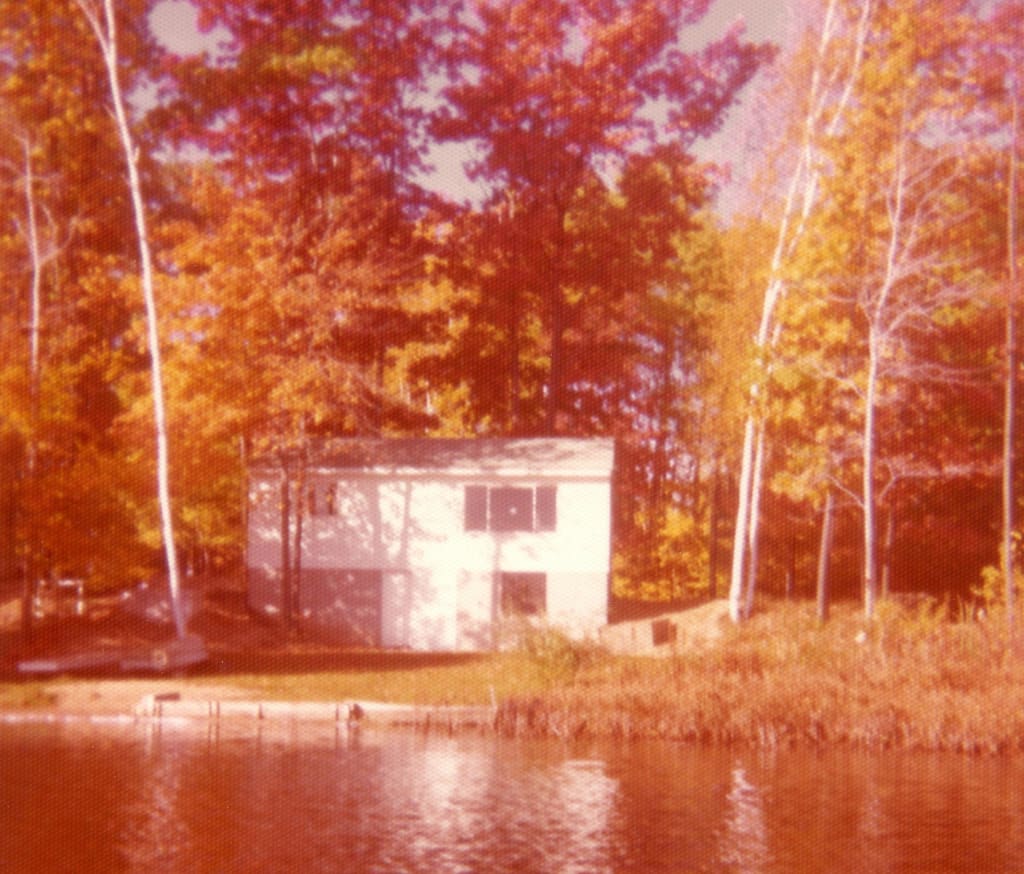
Fortress of Solitude
By Mark Staal
We stepped out into the darkness, immersed in the sounds of the marsh and the wood. The air was warm and pleasant, the stickiness of the day had lifted, and we noticed a chill coming off the water as we made our way down to the dock. Crickets, tree frogs, something in the bog – all cried out that we were there – a welcome or an alarm, I couldn’t tell you…maybe just an ongoing conversation we had interrupted. We spoke in hushed tones to not scare anything away that might be poised to strike. We hoped to find a bent pole, to hear a splash, or the kind of sound created by something thrashing in the deep water – anything to indicate we had a fish on the line.
Our nightly vigil most often ended in disappointment. A still bobber, a straight pole and slack line…it might mean nothing, the loss of our bait fish, a half-eaten tease from a snacking bull-head or worse yet, a tired fish that had failed to attract an apex predator. A quick inspection confirmed the worst.
After a de-weeding of the bait and a quick re-cast to ensure a better position near the mouth of the channel, we trudged up the steps to the deck and back inside the cottage, encouraging each other along the way about what might yet be out there. “Nothing!” …we announced quickly to telegraph our disappointment to the family. A negative report was so common that it surprised no one, not even the heralds themselves. None-the-less it had become a pro forma expectation and if nothing was heard after the fisherman’s pregnant pause, my parents would muster, “anything?” It felt like a bone to throw out – a casting of their own to say, we’re interested but not surprised.
My parent’s charity was appreciated and to be honest, by the end of a night marked by repeated bad news, I found myself apathetic and resigned to go to bed empty-handed. Despite this fact, my brother and I generally stayed engaged with our ritual and remained outwardly upbeat. I suspect my father shared our enthusiasm for the adventure, the unknown possibility – a vicarious experience that filled him with thoughts of his own youthful exploits. In contrast, my mother appreciated our excitement and certainly applauded our successes but was less viscerally invested in the outcome. She was a stalwart supporter of the family fishery in general, but less adapted or interested in the snake wrangling, the turtle hunts, or even the late-night whaling. None-the-less they both offered the consolation of a smile and the tease of the next line-check. “The night is young”, my father would say, “the big ones are just making their rounds”. Perhaps, I thought. My father’s credibility waned each time he offered up this hope, but we were suckers ourselves and took the bait.
Catching fish, spotting waterfowl, probing the undergrowth for snakes, plumbing the depths for snapping turtles, and chasing painted turtles from their sunning stations atop weeded mounds – that’s how we spent our daylight hours. There was always a hunt afoot, always a creature treasure to find, and the hope for an animal trophy to show our parents or to store away in our make-shift zoo. There was something about exercising our stewardship over this Eden …the temporary possession of a creature, no matter how small it might be – even a little toad would do – it tapped into a primitive satisfaction. There was excitement in the hunt, reward in the technique required for each capture, a sense of pride in the management of our treasures, and an inescapable pleasure in taming the wild.
What was it all about? Was it more than just two young boys having fun? I’ve always thought so. Could it be some weird working-through that harkened back to the Adam within…man’s first man exploring Eden, tending the garden, and naming the animals? Maybe that’s too archetypal or too deep. If not, then what? How about the hunter-gather we descended from? Something in the DNA that called to us and directed our efforts to find, control, and master. Who knows, but it was something for sure.
As kids, we didn’t control (or care) for much. Like most, we lived life largely in receive-mode, parents telling us when to get up, how to dress, what to eat, where to go, etc. In contrast, the cottage opened the possibility for a child’s manifest destiny…our first true taste of autonomy and God-given liberty. We only went when we were on vacation, so there were no alarm clocks directing our sleep, no bus to catch in the morning, no school or homework to occupy our days and no mandatory events to attend. In contrast to the modern era, no one had heard of an iPhone or social media. Sure, there were mealtimes, but even those were called audibly, day-by-day…an event that needed to be worked around the fishing and turtle hunting. We were largely on our own recognizance as they say…and that’s the way we liked it.
The living world at our fingertips wasn’t limited to the animal kingdom, on the contrary, with a wood filled with fallen trees, a field of tall grasses, and a marsh with spotty islands, there were plenty of additional diversions to capture our attention and secure our time. This ample landscape was infused with a healthy dose of BB guns, walkie-talkies, rope swings and fort structures. The question each day wasn’t the typical, “I’m bored…there’s nothing to do” but instead, “what should we do first?”, and “how long can we stay?”
This was the kind of place I spent the best parts of my childhood. It was a place that was largely stripped of the outside world. Yes, there was the nightly opportunity for “the late show with Johnny Carson” – one of three channels our black-and-white television received, but that was about it. It was “off the grid” and “unplugged” before such things were “things.” In retrospect, we were lucky to have it and although there was no way for my parents to foresee the full measure of value back in 1971, for me, the family cottage was my fortress of solitude.
About the Creator
Keep reading
More stories from Mark Staal and writers in Families and other communities.
The Oarsman
The Oarsman Time is both kind and cruel. It is the one thing that gives us perspective, if spent well it also grants us wisdom, and with both, mercy. But time can also be harsh in its treatment of our bodies and our minds. Time had been gracious to my father in many ways but it had also dealt a blow to his health. As his body slowly shut down, his mind and his imagination seemed to take over. It was almost like what happens to someone who loses a sense (sight or hearing) and the other senses take over and amplify their capabilities to lend a hand. This is what was happening to my dad. He was increasingly chair-ridden, if not bed-ridden. He was old, and he looked older to me during each visit. I never knew exactly what I would find when I came to see him, but during a recent visit, I found my dad as I had hoped to see him, in sound mind and good spirits. He wasn’t the father of my youth - I didn’t like to see him age. It seemed unnatural to me that a strong man would become a weak man, as a factor of time alone. I looked up to him growing up. He was large and strong and smelled like a man. Now, I looked down on him and he looked weak, and he smelled less like a man than I had remembered. “I had a wonderful dream last night”, he said. “You’d be interested in hearing it. You were in it. It all took place at the cottage”. He was right, I was interested. My father was a good story teller and his dreams were notorious nail-biters. In recent months he seemed to live as much through the fantasy world of his dreams as he did through the real world of his decline.
By Mark Staal4 years ago in Longevity
Wise~Guys
— Look Behind what's in Front of You ~ Make Good Choices — Hey, So how you Doin'..! Made~Men — Mobster Movies romanticise a distinctive, elegant appearance, impeccable attire style, along with the 'Families' expressive lingo. Making their 'Bones' gave them Panache — with vintage fedoras, tailored pin-striped suits, mirror-polished wing-tip shoes adorned with tassels; with their 'Gun Moll' gorgeous dates on their arms.
By Jay Kantor18 days ago in Families
Silver Screen Magic with Mae West
American actress and singer Mae West became a popular film actress during the Great Depression. She started entertaining in vaudeville, then performed on Broadway, and finally went to Hollywood. She signed up with Paramount Pictures and made her debut in the 1932 film “Night After Night.” She also starred in musicals, comedies, and crime dramas. The American Film Institute named her one of the best classic Hollywood actresses.
By Rasma Raisters6 days ago in Geeks




Comments
There are no comments for this story
Be the first to respond and start the conversation.