
The Oarsman
Time is both kind and cruel. It is the one thing that gives us perspective, if spent well it also grants us wisdom, and with both, mercy. But time can also be harsh in its treatment of our bodies and our minds. Time had been gracious to my father in many ways but it had also dealt a blow to his health. As his body slowly shut down, his mind and his imagination seemed to take over. It was almost like what happens to someone who loses a sense (sight or hearing) and the other senses take over and amplify their capabilities to lend a hand. This is what was happening to my dad. He was increasingly chair-ridden, if not bed-ridden. He was old, and he looked older to me during each visit. I never knew exactly what I would find when I came to see him, but during a recent visit, I found my dad as I had hoped to see him, in sound mind and good spirits. He wasn’t the father of my youth - I didn’t like to see him age. It seemed unnatural to me that a strong man would become a weak man, as a factor of time alone. I looked up to him growing up. He was large and strong and smelled like a man. Now, I looked down on him and he looked weak, and he smelled less like a man than I had remembered. “I had a wonderful dream last night”, he said. “You’d be interested in hearing it. You were in it. It all took place at the cottage”. He was right, I was interested. My father was a good story teller and his dreams were notorious nail-biters. In recent months he seemed to live as much through the fantasy world of his dreams as he did through the real world of his decline.
When I was young, I spent the better part of my summers at a family cottage on a lake, a cottage that my father had built with the help of his father and brothers. Of course, I was too young to remember this, but I’ve seen the pictures of a toddler playing in a sand basement before it was poured and hunting for toads among construction scaffolding. My memories of the cottage are diverse but most center on themes that include taming the swamp, conquering the woods, plumbing the depths of the deep, and capturing the creatures that live within. For me, the lake itself held the greatest treasures, turtles of various shapes and sizes, some painted and some spotted. My favorite, the Goliath of the deep muck, a throw-back to the days of the dinosaur with its bark-backed shell and its razor sharp beak – the great American snapping turtle. I spent many nights fearing and fantasizing over catching the largest one in the lake. “Nessy” is the name we gave it. Just like the great Scottish behemoth of legend, the “Nessy” of our Lake was as much shadow as substance and the mere mention of her name was sufficient to excite us as children.
I walked over to my father’s bedside and grabbed a seat. He started talking about fishing – what was the largest fish each of us had ever caught – not the proverbial fish story, but an honest assessment. He was amid a recollection when he stopped short and asked, “Did I tell you about my recent dream? It was about the cottage and the lake” he said. I smiled. I couldn’t help but wonder if it was dementia or just normal aging that kept his memory from being sure-footed. “No, you haven’t told me yet”, I said, and he eagerly continued.
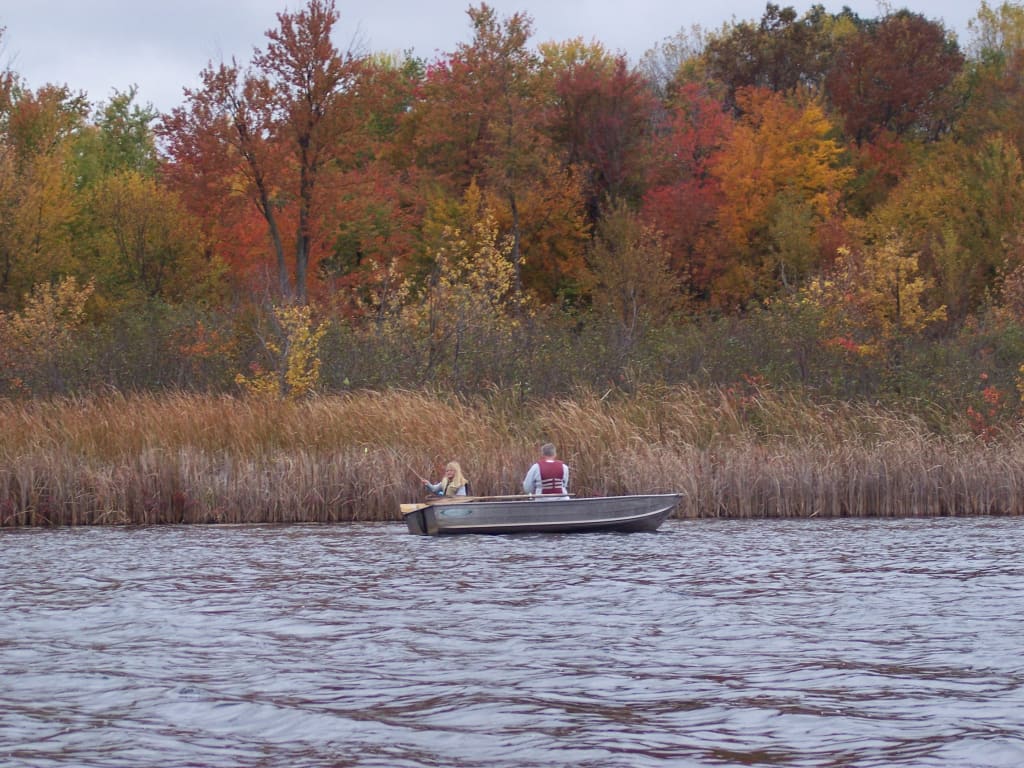
“It was a typical fall day…cool but not cold. The colors across the marsh were wonderful, full of reds and oranges, based in browns. There was a crispness in the air and it was late in the day. I knew it was pointless to keep casting, nothing was biting, and I felt time slipping away. As I prepared to call it a day, I walked down to the shoreline one last time, and there was our old rowboat with its roped anchor tossed in the sand. I don’t know what compelled me to get into the boat exactly, but I recall thinking it was something I needed to do”. My father’s eyes flashed, and a smile broke across his face. I could tell this was going to be a good story, and I settled into his chair. He looked pleased that he had caught my attention and he continued, “I looked across the lake and saw the opposing shoreline. I had stared at it for years but couldn’t recall the last time I had actually gone over to explore the other side. So, I got in the boat, drew up the anchor, settled into my seat and grabbed the oars. The first few strokes were awkward. I hadn’t rowed the boat this season and until my body adopted the required rhythm, I was beating against the water.” He began making rowing motions with his arms. If you’ve never rowed before there’s a sweet spot that makes each pull effective. Pulling too deep and the oars get caught in the weeds. Pull too shallow and you splash about and go now where. You have to find the sweet spot where your body pulls in a rhythm.
After gauging my reaction with a nod, he picked up his story again. “Time passed, and with each pull I found myself falling deeper and deeper into a Zen-like state. I know it sounds dumb, but I felt like something organic was happening between me, the boat and the water. I was hitting just the right rhythm in my strokes, not too deep, and not too shallow. The weather was perfect – just warm enough to be comfortable, but also cool enough to keep me from overheating while I rowed. Under the sun, rowing can feel like work but in the overcast of a cool fall day, it’s as easy as walking. I turned forward to catch a glimpse of my destination and could see that the opposite side of the lake was gradually coming into view. The outline of the advancing shore was just visible and the land beyond was getting larger with each stroke. At the same time, our cottage shoreline that I had known so well was fading into the distance. With each pull I was carrying myself across the waters to the other side.”
My father was becoming more and more animated in his telling of the tale and I was starting to wonder how much of the story was true, and how much was dreamt up in the moment of the re-telling, regardless, he continued. “Toward the middle of the lake the waves were the roughest and I found myself straining to keep an effective rhythm. To help, I closed my eyes, straightened my posture, and tightened my grip on each oar.” I watched as my father seemed to straighten up in his bed, assume his rowing posture, and prepare for a hard pull. “I was putting my back into it and focusing on the rhythm of each pull. You know that feeling when you can’t really tune into a task with your eyes open – too many distractions siphoning away resources and effort – closing my eyes seemed to do the trick. I didn’t need to see the oars or the boat or the water, I needed to feel them all. It wasn’t until I let go of the seeing, that my rhythm returned, and my stroke was again effectively moving the bow through the water and speeding me on to the other side.”
“I could feel like I was getting close. The shoreline was becoming more distinct and I could make out the details of other boats moored and anchored along the beach. Just as my body was leaning forward, anticipating a full-stroke, my left side oar got stuck, hung up on some Lilli-pads. I awkwardly fought my way out of their grasp, pulled some debris off the tip of the paddle, and reset my stroke. I had to crane my neck to make sure the bow was pointed dead-center at the beach before I started back at it again. Any hint of the sun had long disappeared at this point and dusk was setting in. I could feel the air getting colder and I knew it would soon be night. My strokes came quicker”. “Pilots call it “get-home-itis”, I interjected. “It’s that feeling toward the end of long journey when you just want to get there. In anticipation of being done, you tend to speed up and cut corners. It’s considered a time of great risk for the safety of a crew. To counteract this risk, pilots are taught to slow things down. Slow is smooth, smooth is fast. That’s the mantra used to bring back effective focus”.
My father appeared annoyed that I had interrupted the flow of his story. Ironically, I was pleased with myself. I felt I had shared an interesting fact and had demonstrated to him that I was keeping up with the story. After pausing to see if I would say more, he launched back into the dream. “Yes, right. I suppose that’s the same thing” he said. “Anyway, I was anticipating hitting the shoreline – the end of the race if you will – and so the rhythm of my pulls increased. I was anxious to get there, and the late hour of the day made me even more anxious. I took a few deep breaths and slowed my pace. I told myself to relax – that I would get there when I was supposed to get there. No need to rush. The shore was very near at this point and with a few hard strokes the bow of my boat crashed onto the beach. In the dream, I hopped out of the boat and pulled it up on the sand. The bank was gradual, and the sand was dry. The boat slid easily onto the shore and there was no need to toss the anchor. I had arrived on the other side of the lake and a sense of satisfaction and pride washed over me as I looked back across the expanse. I couldn’t make out our cottage or even be sure of the shoreline, but it didn’t matter. I was proud of myself for completing the journey and felt as though I had finished well.”
“I was tired, a little thirsty and ready to rest from my rowing. I turned to look closer at my landing and noticed a well-beaten path, just beyond the rise of the sandy beach. From there, I could make out the outline of a well-lit cottage, and I could hear what sounded like friendly voices inside. It was familiar, perhaps something I had seen in a previous dream. I couldn’t be sure, but I knew I would take a closer look. I started up the path and then for a moment I turned back to look at my boat.” My father looked at me directly. “I had the strangest feeling that I would never row back and the oddest sensation that it didn’t matter either way”. It was an odd thing to say and I could see the puzzlement on his own face give way to a smile. As he ended the tale’s retelling, we sat and stared at each other. He smiled at me, and said, “It was a nice dream.” I just nodded. I didn’t know what to say. It was a nice dream.
Time had been kind to my father in many ways and yet, I hated watching him get old. In the end, I was never sure what I would find during my visits. Some days he was a man full of wisdom who had been granted mercy. There would be more stories - based in reality and in fantasy. I came to appreciate both equally, celebrating more in his excitement and creativity and less in the facts. There were also cruel days, where the stories seemed to play themselves out in themes of sadness, loneliness, and much suffering. Eventually, I found him resting from his rowing.
As time has begun to give me perspective, I look for its wisdom, I pray for its mercy, and I imagine rowing the boat across the expanse of our lake that I might see him again, resting on the other shore.
About the Creator
Keep reading
More stories from Mark Staal and writers in Longevity and other communities.
Fortress of Solitude
Fortress of Solitude By Mark Staal We stepped out into the darkness, immersed in the sounds of the marsh and the wood. The air was warm and pleasant, the stickiness of the day had lifted, and we noticed a chill coming off the water as we made our way down to the dock. Crickets, tree frogs, something in the bog – all cried out that we were there – a welcome or an alarm, I couldn’t tell you…maybe just an ongoing conversation we had interrupted. We spoke in hushed tones to not scare anything away that might be poised to strike. We hoped to find a bent pole, to hear a splash, or the kind of sound created by something thrashing in the deep water – anything to indicate we had a fish on the line.
By Mark Staal4 years ago in Families
Day 4 of Quitting
If this is how sobriety feels, maybe it’s better to go through life a little buzzed… this, along with other hits like, I want to kill myself, I wish I was dead, and I’m going to throw myself off a bridge have been the only thoughts on rotation these past few days. I promise myself that if, in a month, I still feel like this (‘this’ meaning despondent, full of rage, and simultaneously numb) I can go back to smoking. Until mid-February though? Nicotine is off the table.
By sleepy drafts13 days ago in Longevity


Comments
There are no comments for this story
Be the first to respond and start the conversation.