
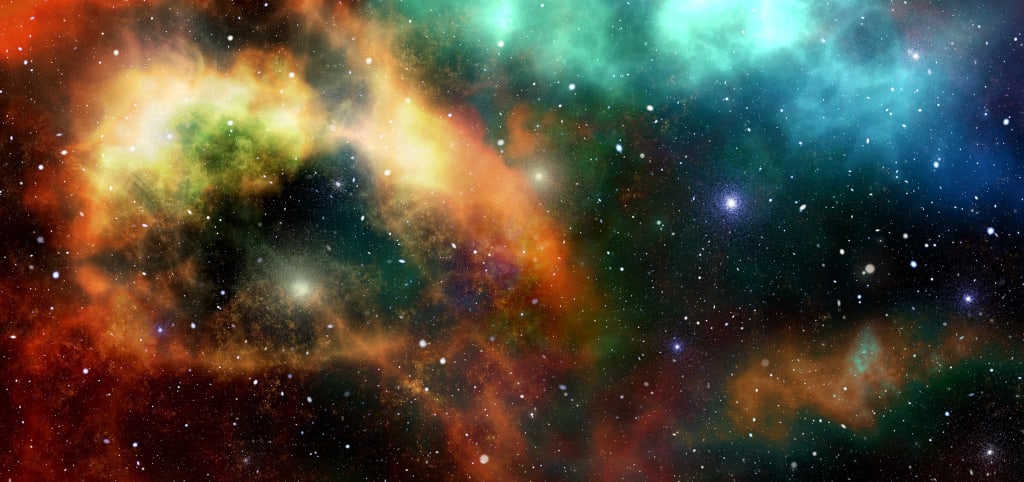
For centuries, people have been captivated by space, the vast and seemingly endless region that lies beyond Earth. Our desire to learn more about the universe has grown over time, from ancient astronomers studying the stars to contemporary space missions visiting far-off planets. Space is not merely empty; it is teeming with stars, galaxies, black holes, and innumerable unsolved mysteries.
Space: What Is It?
The area outside of Earth's atmosphere where there is no air to breathe or sunlight to scatter is referred to as space, or outer space. It contains very little matter because it is a near-perfect vacuum. It is not completely empty, though, as it contains electromagnetic radiation, cosmic rays, and small particles.
The Big Bang, a tremendous explosion that produced all matter and energy, is thought to have created the universe some 13.8 billion years ago. Since then, galaxies have been getting farther apart as space has expanded.
The Solar System: Our Neighbor in Space
The Milky Way galaxy is much larger than our solar system. The Sun, eight planets, dwarf planets, moons, asteroids, and comets make up this system.
Our solar system's central star, the Sun, is a huge source of light and heat.
Planets include the rocky planets Mercury, Venus, Earth, and Mars; gas giants Jupiter and Saturn; and ice giants Uranus and Neptune.
Dwarf Planets—Pluto, Ceres, and Eris are among the known dwarf planets.
Comets and asteroids are rocky, icy objects that orbit the Sun and occasionally make their way into Earth's atmosphere as meteors.
Beyond Galaxies
There are billions of galaxies in the universe, including the Milky Way. There are three types of galaxies: irregular, elliptical, and spiral, like our own. At roughly 2.5 million light-years, Andromeda is the nearest major galaxy to our own.
In addition to galaxies, the universe includes:
Black Holes: Areas where gravity is so intense that light cannot escape.
Nebulas are enormous gas and dust clouds that give birth to new stars.
About 95% of the universe is made up of mysterious forces called dark matter and dark energy, about which we know very little.
1. Human Space Exploration Reaching space has always been a dream of humankind. Important turning points include:
Sputnik, the first artificial satellite, was launched by the Soviet Union in 1957.
2. Yuri Gagarin was the first person in space in 1961.
3. 1969: During Apollo 11, Neil Armstrong and Buzz Aldrin took a lunar walk.
4. The launch of the Hubble Space Telescope in 1990 produced breathtaking pictures of deep space.
5. The International Space Station (ISS) developed into a center for scientific study in the 2000s.
6. 2020s: SpaceX and other private firms are developing missions to Mars and beyond.
Why Investigate Space?
7. Scientific Discovery: Space exploration aids in our understanding of the universe, physics, and the beginnings of life.
8. Technological Advancements: Space exploration is the origin of GPS, satellite communications, and medical technologies.
Survival of Humanity: Asteroids and climate change pose a threat to Earth, and future space colonization may be required.
Space missions inspire younger generations to pursue science, engineering, and exploration.
Space Exploration's Future
There are exciting prospects for the future:
Mars Colonization: In the upcoming decades, NASA and SpaceX hope to send people to Mars.
Missions such as the James Webb Space Telescope are looking for evidence of extraterrestrial life.
Interstellar Travel: In order to travel faster through space, scientists are researching ideas like wormholes and warp drives.
In conclusion
Space is a place of unending wonder and mysteries that test our comprehension of the cosmos. Humanity's exploration of space will continue as technology develops, revealing mysteries that may alter the course of history. Space exploration continues to be one of the greatest adventures of all time, whether the goal is to find extraterrestrial life, discover new worlds, or ensure human survival.
We have only just begun to explore the vastness of the cosmos. Who knows what amazing things could be discovered in the depths of space?
About the Creator
Earning Money Online Through Freelancing
Earning Money Online Through Freelancing In today’s digital world, earning money online has become easier than ever before. One of the most popular and trusted ways to make money online is through freelancing. Freelancing allows people to work independently, use their skills, and earn income without being tied to a traditional office job. With just a computer, an internet connection, and useful skills, anyone can start freelancing from anywhere in the world.
By Bilal Mohammadiabout 23 hours ago in Education
Adding Tech to Ed
Technology is reshaping education in ways that were unimaginable just a generation ago. While access to quality learning was once limited by geography, income, language, or physical ability, digital innovation is steadily removing many of those barriers. Today, technology is not simply enhancing classrooms—it is expanding who education is for, when it happens, and how it is experienced. By increasing flexibility, personalization, and inclusion, technology is making education more accessible to learners of all ages and backgrounds.
By Dennis Muizers Lovejoyabout 18 hours ago in Education




Comments (1)
♥