
VC Math Unlocked: The Secret Formula Investors Use to Value Startups (And How to Crack It
A Practical Toolkit for Startup Valuation Logic


From the outside, startup valuations often look like a high-stakes tug-of-war. But behind the scenes, venture capitalists rely on a specific mental model to determine whether the numbers add up.
In this article, we dissect the logic driving those decisions:
Post-Money Valuation Math: How ownership percentages shape deals.
Preferred Equity: Why liquidation preferences and terms matter more than headlines.
Hurdle Rates: The minimum returns VCs demand to justify risk.
The "VC Method": A step-by-step framework for pricing early-stage startups.
📎 Bonus Toolkit: I’ve created a free, editable Google Doc with formulas, dilution-adjusted return targets, and investor-grade heuristics—ready to copy, tweak, and apply.
This version tightens the structure, uses subheadings and bullet points for clarity, and emphasizes actionable takeaways. The emoji and bold text draw attention to the bonus resource, while keywords like "VC Method" and "startup valuations" align with SEO goals.
1. Post-Money vs. Pre-Money Valuation Basics
Start with the foundational math:
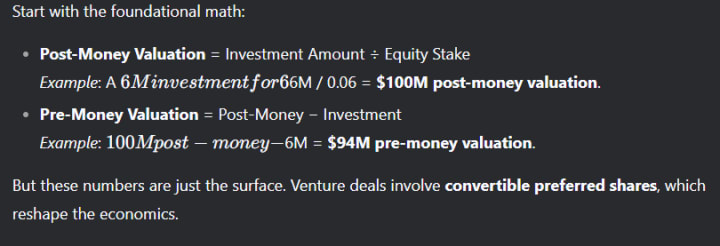
2. The Reality of Convertible Preferred Shares
VCs rarely buy common equity. Instead, they secure convertible preferred stock with protections like:
Liquidation preferences (e.g., 1x–2x payout priority),
Accrued dividends,
Anti-dilution clauses,
Conversion rights to common stock.
Example:
Total shares: 100 (80 common, 20 preferred with 1.5x conversion).
Upon conversion: 20 preferred shares × 1.5 = 30 common shares.
New ownership: 30 / 110 total shares = 27.3% (vs. the original 20%).
Key Takeaway:
Preferred shares act as a safety net (priority payout if the startup fails) and upside accelerator (conversion to common equity if it succeeds).
3. Hurdle Rates: Calculating Minimum Returns
VCs demand returns that justify risk. The hurdle rate factors:
Risk level of the startup,
Time to exit (typically 5–10 years),
Probability of success (often ≤20%).
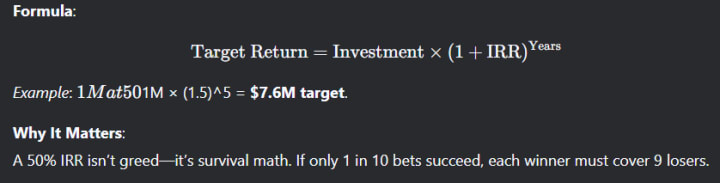
4. The VC Method: Backing into Valuation
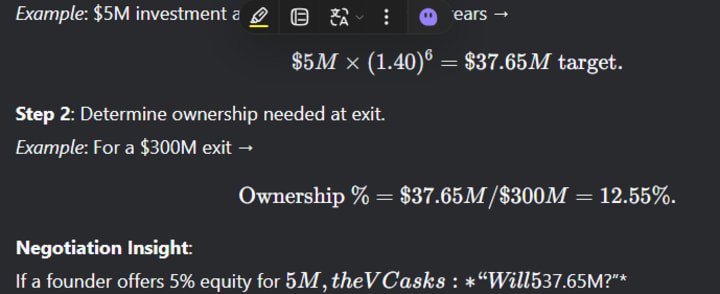
VCs reverse-engineer valuations based on future exit potential:
Step 1: Calculate the required return.
5. Cash-on-Cash Multiples & Expected Value
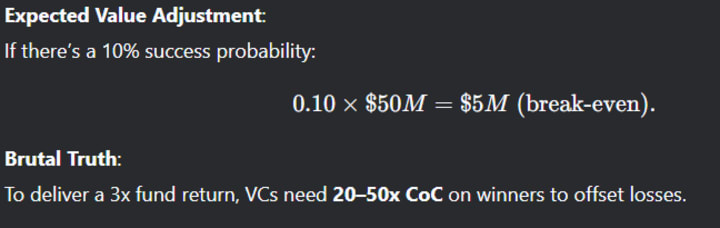
VCs weigh gross returns against failure rates:
Cash-on-Cash (CoC) = Total Return ÷ Investment
Example: A
5 M investment returning 50M → 10x CoC.
6. The Impact of Dilution on Returns
Future funding rounds dilute ownership. Investors model this upfront:
Example:
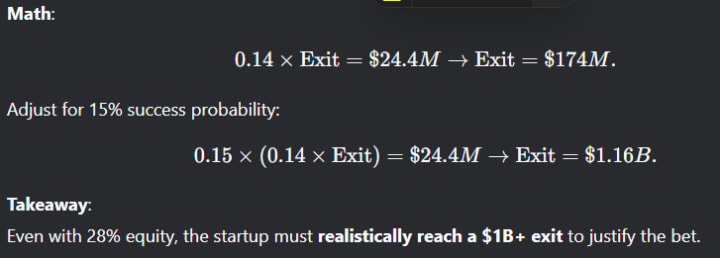
Invest $10M for 28% equity.
Expected dilution: 50% → final stake = 14%.
Target return (25% IRR over 6 years): $24.4M.
Why Founders Hear No
VCs aren’t judging your idea—they’re solving an equation. If the math doesn’t predict a 10–30x return after dilution and risk, the answer is “pass.”
TL;DR:
Valuations hinge on future exit scenarios, not current metrics.
Preferred shares and dilution massively impact real returns.
VCs need outsized outcomes to make their fund economics work.
🔁 The VC Method: Backing Into Valuation From the Future
The method flips traditional valuation on its head. Instead of asking, “What is this company worth today?”, it starts with:
“What could this company be worth at exit — and how much of it do I need to own to make my investment pay off?”
Let’s say you’re a VC evaluating a startup. Here’s what you’re working with:
You believe the company could exit for $300M in 6 years
You require a 40% annual return (your hurdle rate)
You’re considering investing $5M
The Setup
💰 Investment: $10M
📊 Initial equity offered: 28%
🧪 Expected dilution: 50% → your stake shrinks to 14% at exit
⏳ Holding period: 6 years
💸 Required return (IRR): 25%
🧮 Probability of success: 15%
Final Thought: Why This Math Matters
None of this is just arithmetic. Valuation, ownership, exit expectations — they’re all intertwined in a logic chain built around risk, time, and probability. Understanding that logic lets you:
Negotiate from first principles
Build fundraising narratives that make sense
And design your cap table to support future raises without regret.
For founders, knowing this math doesn’t mean you need to model every scenario. It means you can see the conversation through the eyes of your investor — and meet them where the numbers live.
Because venture capital isn’t just about money. It’s about conviction in the face of odds — and math that makes it possible.
Thanks for reading this article, check back other article too.
About the Creator
Jacky Kapadia
Driven by a passion for digital innovation, I am a social media influencer & digital marketer with a talent for simplifying the complexities of the digital world. Let’s connect & explore the future together—follow me on LinkedIn And Medium
Keep reading
More stories from Jacky Kapadia and writers in Education and other communities.
The Rise Of Decentralized Media: How Web3 Is Changing The Way We Consume Content
The internet has undergone several transformative phases—from the static Web1 to the interactive, social Web2. Now, we are entering the era of Web3, a decentralized internet powered by blockchain technology. One of the most significant shifts happening in this new phase is the rise of decentralized media, which is fundamentally changing how content is created, distributed, and consumed.
By Jacky Kapadia9 months ago in Education
Avoiding Common Counterfeit U.S. Coins: Expert Tips from Laura Bennett
Expert Guide to Spotting Fake U.S. Coins I’ve handled tens of thousands of coins in my career, and that moment of doubt—the gut feeling something isn’t right—is something every collector experiences. That feeling isn't a weakness; it's your best line of defense. This guide is your toolkit to turn that doubt into decisive action. I’ll share the same systematic approach I use to separate the real treasures from the clever fakes, so you can build your collection with confidence.
By Laura Bennett7 days ago in Education
The Devil's Cut
“Comrade, finally you’re awake.” The voice was smooth, sensual. A flickering incandescent bar was all that lit the white, sterile room. All Vladimir remembered was everything going black. He tried to move his arms and found them strapped to the gurney.
By Matthew J. Fromm5 days ago in Fiction


Comments
There are no comments for this story
Be the first to respond and start the conversation.