
Unveiling Jupiter
Exploring the Mysteries of the Giant Planet
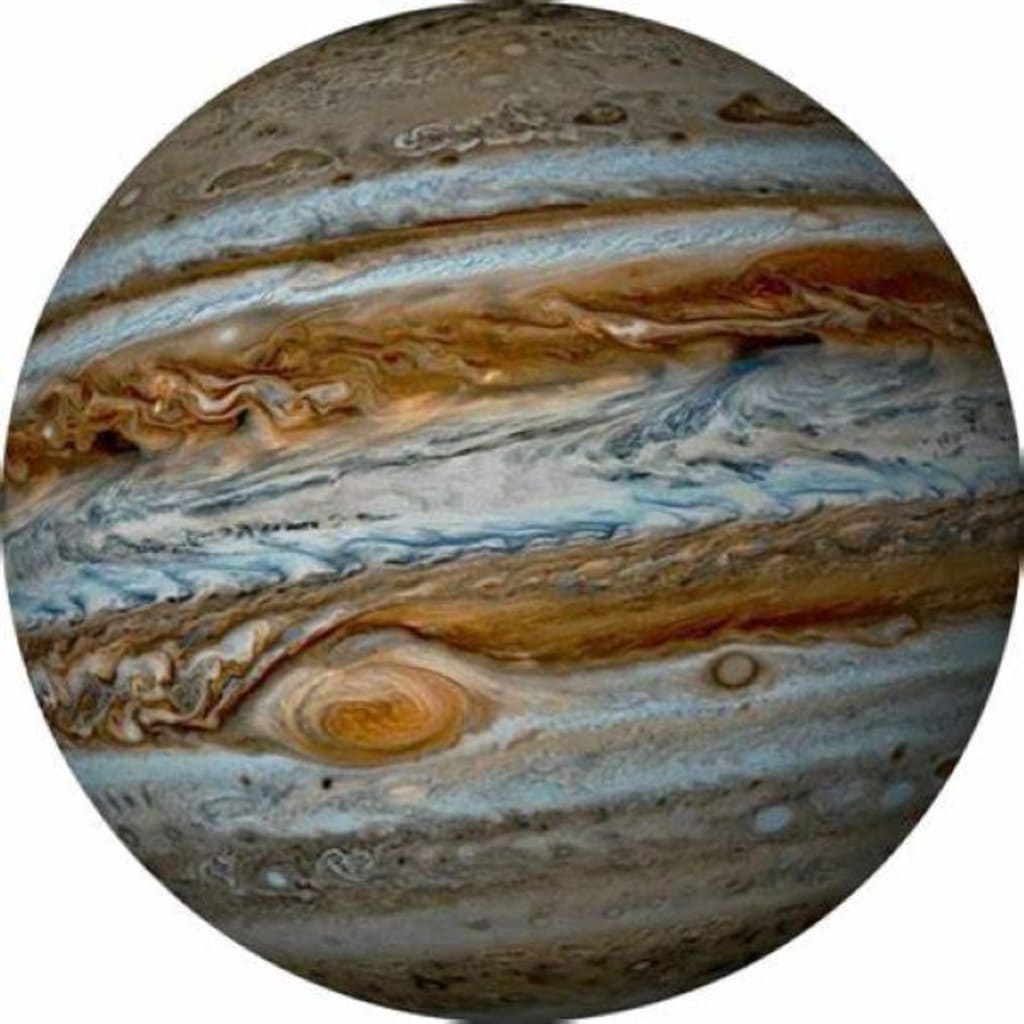
Venturing into the unknown has always been a driving force for humanity, leading us to send spacecraft to various celestial bodies within our solar system. From the Moon to Mars, we have expanded our knowledge and understanding of these worlds. However, one enigmatic realm continues to elude our grasp: Jupiter. Composed primarily of hydrogen and helium gas, Jupiter poses a unique challenge, making landing on its surface an impossible feat. With no solid crust to land on, Jupiter's atmosphere stretches endlessly, presenting a compelling question: Can one fall through Jupiter and emerge on the other side? As we embark on this speculative journey, we will unravel the captivating mysteries concealed within Jupiter's domain.
Journeying through Jupiter:
Preparing for such a perilous voyage necessitates careful consideration of the inhospitable conditions awaiting intrepid explorers. First and foremost, the absence of oxygen in Jupiter's atmosphere demands that ample supply be brought along. Furthermore, the scorching temperatures call for the inclusion of an air conditioning system to counter the extreme heat. Equipped with these provisions, we embark on an unprecedented expedition of epic proportions.
As we approach the upper layers of Jupiter's atmosphere, hurtling at a mind-boggling velocity of 110,000 miles per hour under the relentless pull of Jupiter's gravity, we brace ourselves for the imminent encounter with denser atmospheric layers. The impact is akin to colliding with an impenetrable wall, yet not forceful enough to halt our progress. After approximately three minutes of descent, we reach the cloud tops situated 155 miles below the initial entry point. Here, the full force of Jupiter's rotation is experienced, as it claims the distinction of being the fastest rotating planet in our solar system. A single day on Jupiter lasts a mere nine-and-a-half Earth hours, generating winds that can whip around the planet at speeds exceeding 300 miles per hour.
Descending further, approximately 75 miles beneath the clouds, we reach the limit of human exploration. The Galileo probe managed to descend this far into Jupiter's atmosphere in 1995, but its mission was short-lived. After only 58 minutes, contact was lost, and the probe succumbed to the crushing pressure. In this treacherous region, the pressure becomes nearly 100 times greater than that experienced on Earth's surface, rendering visibility nonexistent. Navigating these depths necessitates complete reliance on specialized instruments to survey the surroundings. At a depth of 430 miles, the pressure reaches a staggering 1,150 times the pressure on Earth's surface.
Theoretically, survival at this depth could be possible with a spacecraft engineered similarly to the Trieste submarine, the deepest-diving submarine on Earth. However, venturing deeper proves to be an insurmountable challenge. Beyond this point, the spacecraft would be unable to endure the increasingly extreme pressure and temperature conditions. Nonetheless, let us imagine a scenario where we could descend even further into the abyss, unearthing Jupiter's most profound enigmas. Regrettably, communication would be severed, as Jupiter's deep atmosphere absorbs radio waves, isolating us from the outside world.
At a depth of 2,500 miles, the temperature soars to a scorching 6,100 degrees Fahrenheit, surpassing the melting point of tungsten—the metal with the highest melting point in the universe. By this stage, more than 12 hours have elapsed since the commencement of our descent, and yet, we have not even reached the halfway point. Descending further, we arrive at 13,000 miles, encountering Jupiter's innermost layer. In this harrowing domain, the pressure reaches a staggering two million times that of Earth's surface, while the temperature exceeds even the scorching surface of the Sun. These extreme conditions transform the hydrogen surrounding us, resulting in a peculiar substance known as metallic hydrogen. Due to its high density and exceptional reflectivity, attempting to illuminate this region would prove futile.
As we continue our descent, the buoyancy force exerted by the metallic hydrogen counteracts the gravitational pull, creating a perpetual yo-yo-like motion. Eventually, gravity seizes control once again, propelling us back downward until the buoyancy force halts our descent. This equilibrium leaves us suspended in mid-Jupiter, incapable of ascending or descending, and utterly devoid of any means of escape. Clearly, attempting to land on Jupiter would be an ill-fated endeavor, consigning us to an eternal state of weightlessness within its tumultuous depths.
In conclusion, Jupiter remains a celestial enigma, enticing us with its majestic appearance while guarding its secrets beneath layers of impenetrable gas. Our current limitations preclude a comprehensive understanding of this mesmerizing giant, rendering landing on its surface an unattainable dream. However, from a safe distance, we can still marvel at Jupiter's awe-inspiring presence and continue studying this captivating planet. While the mysteries of Jupiter's innermost reaches may elude us, the pursuit of knowledge and the wonders of the cosmos shall forever ignite the spark of human curiosity.
About the Creator
Keep reading
More stories from BOADI SETH OMANE and writers in Education and other communities.
The Perils of Water
When we hear the word "poison," our minds often conjure up images of lethal substances like arsenic or cyanide. However, there is a lesser-known contender that may surprise you: water. Water is essential for life, but under specific circumstances, it can be as dangerous as any toxic compound.
By BOADI SETH OMANE3 years ago in Education
Rabbi Shlomo Slatkin, M.S., LCPC on Imago Dialogue, Repair, and Relationship Safety
Rabbi Shlomo Slatkin, M.S., LCPC, is founder and therapist at The Marriage Restoration Project in the Baltimore area. An ordained rabbi and Certified Imago Relationship Therapist and workshop presenter, he guides couples through intensives, retreats, and counseling aimed at restoring safety, communication, and connection after conflict or crisis. He holds a master’s in Counseling Psychology from Loyola University Maryland and trained with the Imago Relationship Institute. Slatkin earned a B.A. in Middle Eastern Studies, with undergraduate study at George Washington University and Oxford, and authored The Five Step Action Plan to a Happy & Healthy Marriage. He also co-edited curricula.
By Scott Douglas Jacobsen5 days ago in Education
Why Tailwheel Training Still Matters for Pilots in Today’s Aviation World
Tailwheel Training may sound old fashioned to some pilots, but it still plays an important role in modern aviation. Many training aircraft today use tricycle landing gear, which feels easier and more forgiving. This has led some pilots to believe that tailwheel skills are no longer needed. That idea is incorrect. Tailwheel Training teaches core flying skills that improve safety, control, and awareness in any aircraft.
By Duke Valentour2 days ago in Education
Affection and Healing for Yourself
During the night of the last quarter moon, I gathered my ritual supplies. I carefully handled the chunk of black tourmaline that would protect me from your overall negative and narcissistic energy. I carefully walked the house with my stick of selenite in hand, asking the universe to cleanse our working space.
By Alisha Wilkins ✒️🦋🖋️5 days ago in Fiction


Comments
There are no comments for this story
Be the first to respond and start the conversation.