
Understanding Black Holes: Definition, Formation, and Their Role in the Universe
Black holes are among the most mysterious and powerful objects in the universe. For decades, they have captured the curiosity of scientists and space enthusiasts alike. In this article, we’ll explore what black holes are, how they form, and why they are essential to our understanding of the cosmos.

What Is a Black Hole?
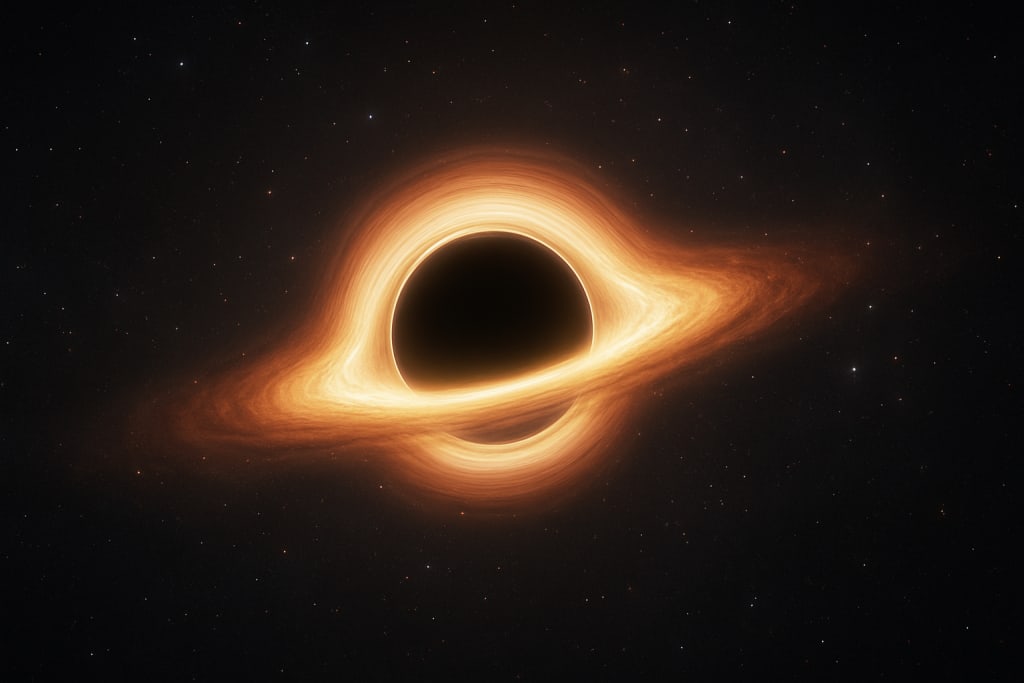
A black hole is a region of space with gravity so intense that nothing—not even light—can escape its pull. Because they emit no light, black holes are invisible. Astronomers detect them by observing the effects they have on nearby stars, gas, and light.
Black holes typically form from the remains of extremely massive stars. To understand their nature, it’s important to look at their primary characteristics.
Key Properties of Black Holes
1. Event Horizon
The event horizon is the boundary surrounding a black hole. Once an object crosses this point, it cannot escape. It is not a physical surface—it’s a theoretical boundary representing the “point of no return.”
2. Singularity
At the center lies the singularity, a point of infinite density where gravity becomes immeasurably strong. Here, the known laws of physics break down, making it one of the biggest puzzles in modern science.
3. Types of Black Holes
Black holes are classified according to their mass:
Stellar Black Holes
Formed from the collapse of massive stars; typically 3–100 times the mass of the Sun.
Supermassive Black Holes
Found at the centers of galaxies (including the Milky Way). They contain millions to billions of solar masses.
Intermediate Black Holes
A rare, less understood type that falls between stellar and supermassive categories.
4. Accretion Disk
When gas and dust spiral into a black hole, they form a rotating accretion disk. Friction heats this material to extreme temperatures, causing it to emit X-rays—one of the strongest indicators of a black hole’s presence.
How Do Black Holes Form?
Black holes form mainly through two processes: stellar collapse and black hole mergers.
1. Collapse of Massive Stars
Most black holes are formed from the death of massive stars. The life cycle includes:
A. Stellar Evolution
Main Sequence:
The star fuses hydrogen in its core, producing energy that prevents gravitational collapse.
Red Giant Phase:
When hydrogen is exhausted, the star expands and begins fusing heavier elements.
Supernova Explosion:
Once nuclear fuel runs out, gravity overwhelms the star, triggering a massive explosion that ejects its outer layers.
B. Birth of a Black Hole
If the remaining core is more than three times the mass of the Sun, gravity collapses it into a singularity, creating a stellar-mass black hole.
2. Black Hole Mergers
Black holes also form when two smaller black holes collide and merge.
A. Gravitational Waves
As they spiral inward, they release gravitational waves—ripples in space-time. These waves, first detected by LIGO, provide direct evidence of black hole mergers.
B. Growth into Supermassive Black Holes
Over billions of years, repeated galaxy mergers can cause central black holes to join and accumulate mass, eventually forming supermassive black holes.
Why Black Holes Matter
Black holes aren’t just cosmic anomalies—they are fundamental to understanding how the universe works.
1. Testing Gravity
Black holes push Einstein’s theory of General Relativity to its limits. Studying them helps scientists explore how gravity behaves under extreme conditions.
2. Shaping Galaxies
Supermassive black holes influence the formation and evolution of galaxies. Their immense gravity affects the motion of stars and controls the flow of gas.
3. Extreme Physics
Black holes allow scientists to study phenomena such as:
Time dilation
High-energy particle acceleration
Behavior of matter under intense gravity
4. Gravitational Wave Astronomy
Gravitational waves from black hole mergers have opened a new era of astrophysics, giving scientists fresh tools to study cosmic history.
How Do Scientists Detect Black Holes?
Even though black holes emit no light, astronomers can identify them through:
1. X-ray Emissions
Hot material in the accretion disk radiates X-rays, which can be detected by space observatories like Chandra.
2. Gravitational Influence
Stars orbiting an unseen massive object may indicate a black hole. This method was used to confirm the supermassive black hole at the center of the Milky Way.
3. Gravitational Waves
Merging black holes send out detectable gravitational waves, letting scientists directly observe their collisions.
Conclusion
Black holes are some of the most extraordinary objects in the universe. Formed from dying stars or through cosmic mergers, they reshape our understanding of gravity, galaxy evolution, and the nature of space and time itself.
As technology advances, astronomers continue to uncover new secrets about these cosmic giants. Studying black holes not only deepens our knowledge of the universe—it inspires us to explore the unknown and expand the boundaries of human discovery.
About the Creator
Keep reading
More stories from shahkar jalal and writers in Education and other communities.
Understanding Galaxy Clusters: The Cosmic Neighborhoods of the Universe
What Are Galaxy Clusters? A galaxy cluster is a gravitationally bound collection of galaxies. These clusters can contain anywhere from a handful of galaxies to thousands packed into the same region of space. Because the galaxies are located so close together, clusters act as cosmic communities where interactions and transformations occur.
By shahkar jalal2 months ago in Education
Designing a Meaningful Future: Strategic Planning for Mission-Focused Entrepreneurs
In today’s evolving business landscape, entrepreneurs are increasingly motivated by more than financial success. Many are building companies around a mission to create social, environmental, or community-driven impact. While passion and vision ignite these ventures, strategic planning transforms purpose into a lasting, scalable business. For mission-focused entrepreneurs, planning is not about restriction but about clarity, alignment, and sustainable growth.
By Mario Payne2 days ago in Education
Digital Signage Solutions Supporting Communication in Schools
I still remember the chaos of my first week as a communications coordinator at a mid-sized university. Between emergency alerts that never reached students, event posters peeling off bulletin boards, and faculty members who couldn't find the right room for meetings, I realized our campus communication system was stuck in the 1990s. That experience changed how I think about information flow in educational settings.
By Jerry Kane 5 days ago in Education



Comments
There are no comments for this story
Be the first to respond and start the conversation.