
Trump at West Point graduation lauds "Golden Age" as anti-DEI and pro-defense
In a bold return to campaign-style rhetoric, Donald Trump declares a “Golden Age” of American strength, slams diversity efforts, and outlines a militaristic future before a crowd of newly commissioned cadets.
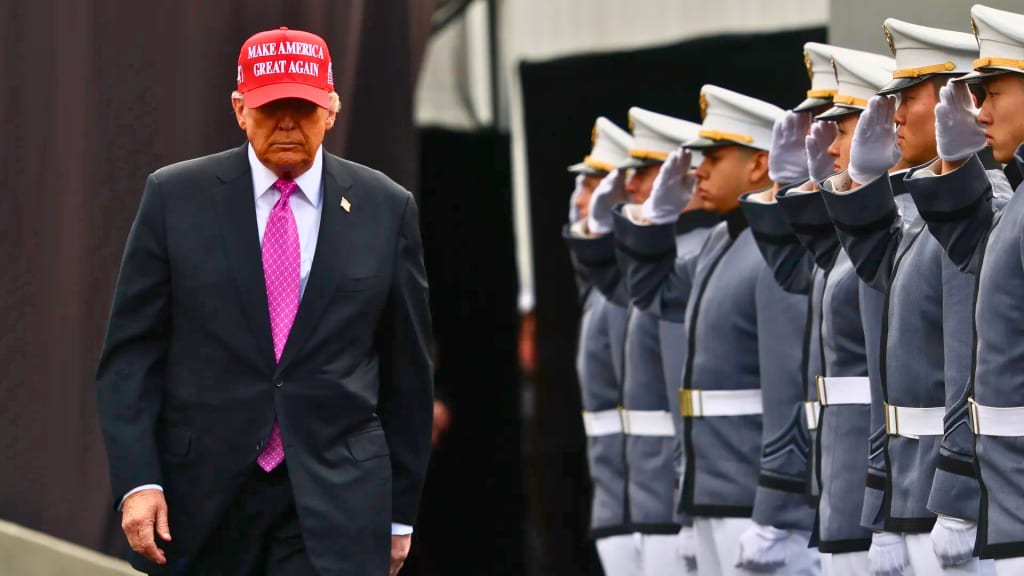
On a crisp spring morning at the United States Military Academy at West Point, former President Donald Trump delivered a charged commencement address that blended traditional patriotism with sharp political undertones. Speaking before more than 1,000 graduating cadets and thousands of families on May 24, 2025, Trump declared the beginning of what he called the “Golden Age of American Strength,” marked by military dominance, renewed nationalism, and the rejection of what he called “woke ideology.”
The event, steeped in historic tradition and pomp, took a distinctly political turn as Trump used the prestigious platform to critique current diversity, equity, and inclusion (DEI) initiatives in the military and reassert his vision for a defense-first America.
A Pledge for Strength: “The Golden Age Begins With You”
From the moment he stepped onto the podium, Trump adopted a tone equal parts inspirational and combative. He praised the West Point Class of 2025 as “warriors, not ideologues” and insisted that their generation would be the foundation of a new era — one where military might, discipline, and loyalty to the flag come first.
“You are the first graduating class of the Golden Age,” he said, looking over the cadets in full dress. “America will be respected again. Our enemies will fear us again. And our military will be focused only on one thing: winning wars.”
The phrase “Golden Age” echoed throughout his speech, which framed this moment in history as a turning point — a rejection of what Trump described as “weakness, cultural decay, and globalist distractions.”
Anti-DEI Rhetoric and Policy Promises
One of the most controversial portions of the speech was Trump’s full-throated condemnation of DEI policies in the U.S. military.
“There will be no more drag shows at military bases. No more critical race theory. No more gender experiments. The mission of our military is not to promote social experiments — it’s to kill enemies and protect America.”
The line drew a loud reaction from parts of the audience, while others watched with unease as the former president leaned into a political message that departed from the usual tone of apolitical military ceremonies.
Trump went further, tying these promises to his Executive Order 14151 — a real initiative under his prior administration that aimed to dismantle DEI programs across federal agencies, including the Department of Defense. He vowed to re-enact and expand the order if re-elected.
“Under my leadership, we will eliminate every DEI office, every activist training, and every political commissar embedded in our armed forces,” he said. “We don’t need indoctrination. We need preparation.”
Defense Spending, Geopolitical Strategy, and the “Golden Dome”
Moving to national security, Trump outlined a bold vision for U.S. defense in the coming years. He pledged over $1 trillion in new military investment, much of it aimed at modernizing U.S. missile defense, including what he dubbed the “Golden Dome” — a high-tech defense shield modeled on Israel’s Iron Dome but scaled for global threats.
“We will build the greatest missile defense system the world has ever seen. The Golden Dome will protect every American city from foreign attack,” he said, invoking threats from China, Russia, and Iran.
Critics immediately raised concerns about the feasibility and cost of such a program, but for supporters, it reinforced Trump’s tough-on-defense identity.
Calls for Patriotism, Unity — and Loyalty
Despite the speech’s political undertones, Trump ended on a unifying note, calling the graduates “the heart and soul of America” and encouraging them to embody the West Point motto: Duty, Honor, Country.
“You will lead this nation through storms and fire. But you will do it with your chin held high and your oath intact,” he said. “No matter what the media says, no matter what the woke bureaucrats say — you serve the Constitution and the people.”
He nodded to military heroes of the past, including General Douglas MacArthur and Dwight D. Eisenhower, drawing a line between those historic leaders and the future these cadets would shape.
Political Overtones at a Military Milestone
While commencement speeches at West Point traditionally steer clear of controversy, Trump’s address was unmistakably political — signaling not only his return to the national stage but also previewing the tone of his 2024 campaign platform: anti-DEI, pro-military, and unapologetically nationalist.
Critics, including retired military leaders, questioned the appropriateness of politicizing a graduation ceremony. However, supporters viewed it as a breath of fresh air — a clear, no-nonsense message at a time of global uncertainty.
Conclusion
Donald Trump’s West Point speech wasn’t just a commencement address — it was a manifesto. A declaration of war against DEI policies. A call for a rebirth of American dominance. And a promise to the newest officers in America’s Army that under his leadership, the mission would be clear, focused, and singular: win.
About the Creator
Most Sales Deals Fail Because Sellers Talk to the Wrong People
There is a quiet reason many sales conversations feel productive but go nowhere. Everyone leaves the call optimistic. Emails move back and forth. Documents get shared. Then momentum fades. Weeks pass. The deal stalls without a clear explanation.
By Armi Ponsica7 days ago in Education
The Energy Pivot The State of Russia’s Oil and Gas in 2026
For decades, this was the "world's gas station": Russia's pipeline network to Europe was the veins of the world economy. By 2026, that aura is dull and those veins are rerouted out of Europe. Since the collapse of the Soviet Union, the Russian oil and gas sector is facing the largest structural change.
By Neeraj kumar6 days ago in Education


Comments
There are no comments for this story
Be the first to respond and start the conversation.