
The Warrior Who Broke 9 Swords in One Day — And Changed the World"
"The undefeated general who obeyed orders like a foot soldier."

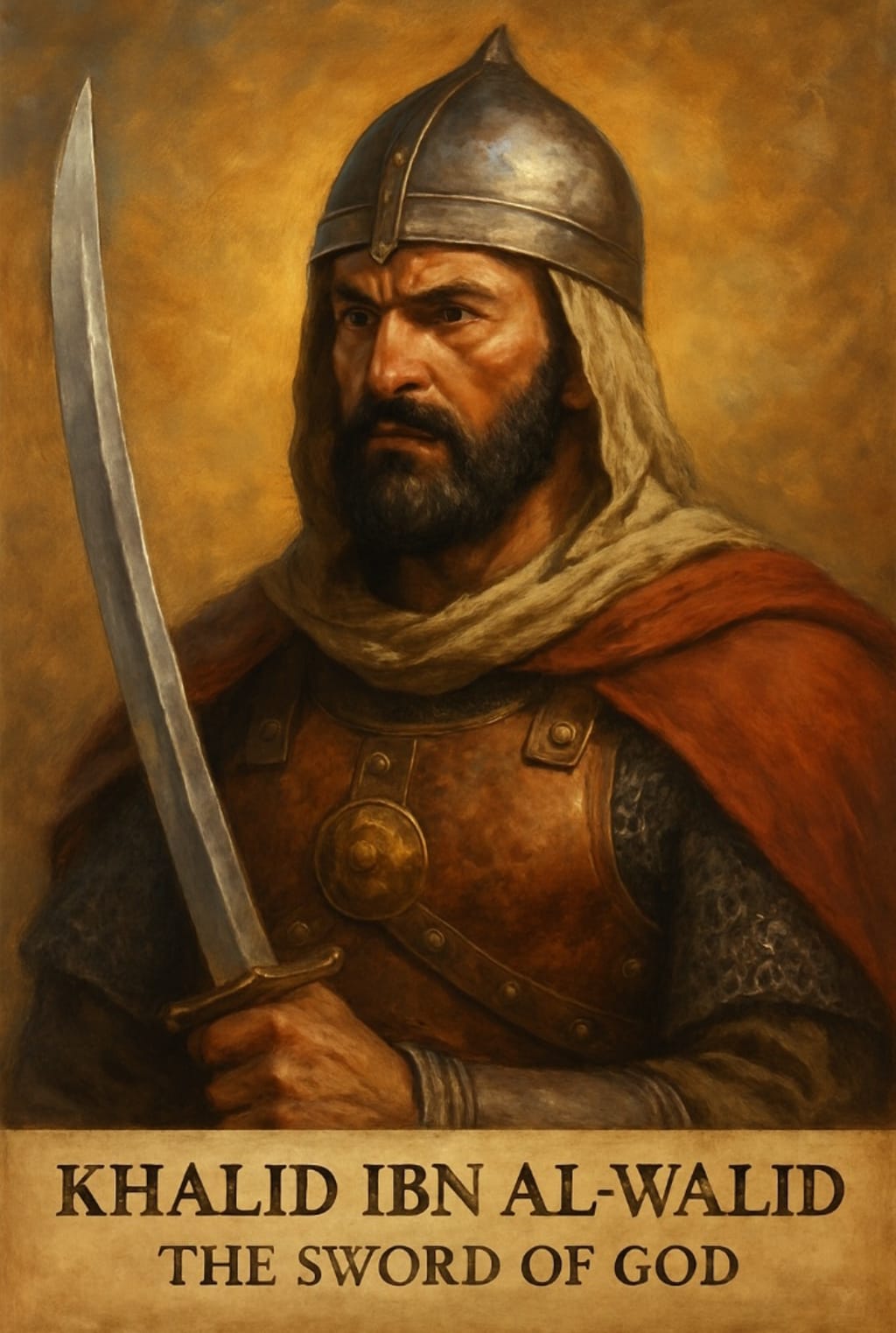
The Sword of God: The Astonishing Life of Khalid ibn al-Walid
Throughout human history, there have been figures so powerful, so legendary, that they transcend borders, religions, and ideologies. Their courage, intelligence, and leadership become universal lessons — and one such man was Khalid ibn al-Walid.
Known by the title “The Sword of God”, Khalid was a military genius who never lost a single battle in over 100 engagements. But his story is far more than just blood and glory — it's a tale of transformation, humility, and greatness that continues to inspire even today.
---
From Warrior of the Quraysh to Defender of Islam
Khalid was born into the noble Quraysh tribe in 6th-century Arabia — the same tribe as the Prophet Muhammad (peace be upon him). He was raised among warriors, trained in swordsmanship and tactics from a young age. When Islam first emerged in Mecca, Khalid stood among its fiercest opponents.
In fact, he played a decisive role in the Battle of Uhud, where the early Muslim army suffered heavy losses — many due to Khalid’s masterful cavalry maneuver.
But then, something changed.
Khalid watched the rise of Islam — not just as a religion, but as a force for justice, unity, and transformation. He saw men he once fought beside now living with purpose, discipline, and compassion. His heart began to shift.
One day, Khalid rode into Medina, entered the Prophet Muhammad’s mosque, and declared his faith in Islam.
The Prophet smiled and said:
> “Praise be to God who guided you, O Khalid. I always saw greatness in you.”
And from that day, Khalid’s sword no longer served tribal pride — it served a greater cause.
---
The Turning Point: The Battle of Mu’tah
Soon after his conversion, Khalid joined a Muslim army sent to confront the Roman Empire at Mu’tah (in present-day Jordan). The original commanders — Zayd ibn Harithah, Ja’far ibn Abi Talib, and Abdullah ibn Rawahah — were all killed in battle.
The Muslim army was vastly outnumbered — 3,000 against more than 100,000 Roman troops.
At this critical moment, Khalid took command. Using unmatched tactical brilliance, he reorganized the troops, executed feint retreats and flanking maneuvers, and managed to save the Muslim army from total annihilation.
He broke nine swords in that one battle.
When news reached the Prophet, he said:
> “Khalid is a sword among the swords of Allah, unleashed upon the enemies of truth.”
From that moment, he was known as “Sayf Allah” — The Sword of God.
---
The Battle of Yarmouk: When Legends Are Born
Khalid’s most legendary victory came in 636 AD at the Battle of Yarmouk, where a Muslim force of just 40,000 faced a Roman army of over 200,000.
Any military analyst would call that suicide — but not when Khalid ibn al-Walid was in charge.
He executed a masterclass in mobile warfare, leading cavalry charges, breaking Roman supply lines, and inspiring morale among the Muslims. He moved his troops with lightning speed, creating the illusion of greater numbers, and attacking the enemy from unexpected directions.
The Roman Empire suffered a catastrophic defeat. Their dream of reclaiming the Levant was shattered forever.
A Western historian once wrote:
> “Had Khalid served the Romans, Europe might have spoken Arabic today.”
---
A Leader Without Ego
One of the most remarkable moments in Khalid’s life came not on the battlefield, but in an unexpected order.
Caliph Umar ibn al-Khattab, fearing that people might start placing too much trust in Khalid rather than in divine help, removed him from command — in the middle of his victories.
And Khalid’s response?
No rebellion. No bitterness. He simply said:
> “I fight for God, not for a position.”
He continued to serve as a regular soldier under the new commander — the very essence of humility and discipline.
---
The Most Shocking Part: How He Died
Here’s the most surprising twist of all.
Khalid ibn al-Walid — a man who fought over 100 battles, who was wounded head to toe, whose sword shaped the fate of empires — did not die in battle.
He died in his bed.
In his final moments, he is said to have wept and said:
> “I’ve fought in so many battles, and there is no spot on my body without a scar from a sword or an arrow — yet here I die, like a camel in bed. May cowards never sleep in peace.”
For a man who lived and breathed valor, dying a natural death was almost a heartbreak.
---
Why Khalid ibn al-Walid’s Life Still Matters
You don’t need to be Muslim to admire Khalid ibn al-Walid.
He was a man who changed his beliefs when he saw the truth — something very few can do.
He fought not for personal glory, but for justice, purpose, and unity.
He respected discipline, leadership, and morality even when it meant sacrificing his ego.
He wasn’t just a warrior. He was a man of principles.
---
Final Thoughts: Lessons from the Sword of God
Redemption is real — Even the fiercest of opponents can become the noblest of allies.
Leadership is about service, not ego.
True greatness lies in character, not just conquest.
Khalid ibn al-Walid’s story isn’t just a chapter in Islamic history — it’s a timeless human tale of transformation, resilience, and glory.
Whether you're a student of history, a leader, a soldier, or just someone seeking inspiration — his life offers lessons you won’t find in textbooks.
About the Creator
MUSLIM Talk
Sharing inspiring and informative stories from @MUSLIM Talk— exploring the lives of great figures and lessons from the past.
Keep reading
More stories from MUSLIM Talk and writers in Education and other communities.
Earning Money Online Through Freelancing
Earning Money Online Through Freelancing In today’s digital world, earning money online has become easier than ever before. One of the most popular and trusted ways to make money online is through freelancing. Freelancing allows people to work independently, use their skills, and earn income without being tied to a traditional office job. With just a computer, an internet connection, and useful skills, anyone can start freelancing from anywhere in the world.
By Bilal Mohammadi2 days ago in Education
Adding Tech to Ed
Technology is reshaping education in ways that were unimaginable just a generation ago. While access to quality learning was once limited by geography, income, language, or physical ability, digital innovation is steadily removing many of those barriers. Today, technology is not simply enhancing classrooms—it is expanding who education is for, when it happens, and how it is experienced. By increasing flexibility, personalization, and inclusion, technology is making education more accessible to learners of all ages and backgrounds.
By Dennis Muizers Lovejoya day ago in Education


Comments
There are no comments for this story
Be the first to respond and start the conversation.