

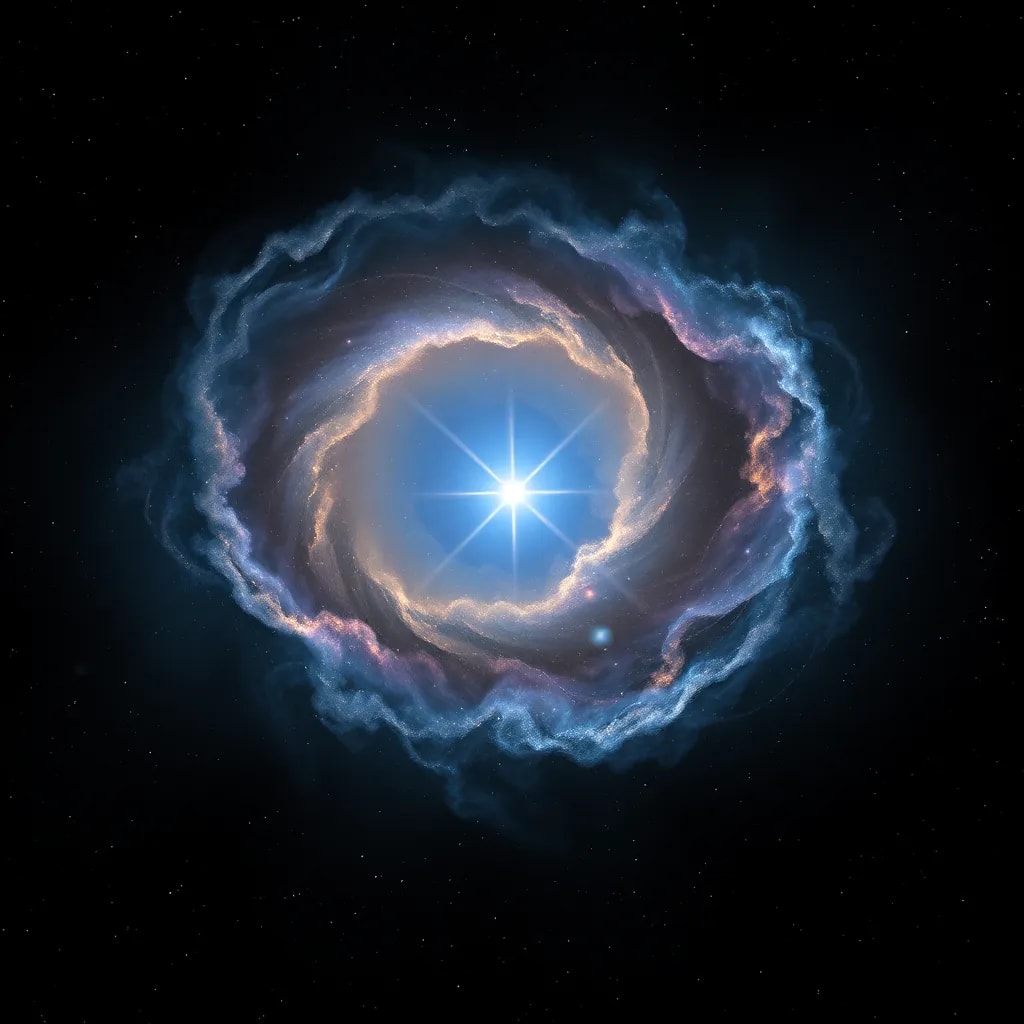
Among the countless wonders of the universe, few objects capture the imagination of astronomers quite like Wolf–Rayet stars. These rare and powerful giants live fast and die young, blazing across the cosmos with ferocity and beauty that defies comparison. They shed their mass at incredible rates, unleashing stellar winds that sweep through space with unimaginable force. Many scientists see them as the last, dramatic act before a star explodes as a supernova or even as the progenitors of the universe’s most violent outbursts: gamma-ray bursts. But what makes these stars so extraordinary, and why are they shrouded in mystery?
A Brief History of Discovery
The story of Wolf–Rayet stars begins in the 19th century. In 1867, French astronomers Charles Wolf and Georges Rayet were using a telescope in Paris to study stellar spectra when they noticed something peculiar. Instead of the usual absorption lines found in ordinary stars, these objects displayed bright emission lines signatures of hot gases being ejected into space. At first, no one understood what they were seeing. Only decades later did astronomers realize that these unusual stars were a distinct class: massive, unstable, and shedding their outer layers into the cosmos.
What Exactly Are Wolf–Rayet Stars?
Wolf–Rayet stars are the evolved descendants of massive stars, typically more than 20 times the mass of our Sun. Unlike ordinary stars, which hide their chemical secrets deep inside, Wolf–Rayet stars expose their inner layers. Their spectra reveal strong signatures of helium, nitrogen, carbon, and oxygen elements usually concealed beneath thick stellar envelopes.
But what truly sets them apart are their winds. These stars hurl material into space at speeds up to 3,000 kilometers per second. Imagine Earth’s entire atmosphere being blown away in just a few minutes—that’s the kind of raw power we’re talking about. Over the course of their short lifetimes, Wolf–Rayet stars lose more mass than the Sun will shed in 10 billion years.
The expelled gases form vast nebulae, glowing shells and spirals of material that can stretch across light-years. These “cosmic bubbles” often look like works of art, illuminated by the star’s fierce radiation.
Rare and Short-Lived Giants
One reason Wolf–Rayet stars remain mysterious is their rarity. Despite being some of the most luminous stars in existence shining hundreds of thousands of times brighter than the Sun there are only a few hundred known in our entire Milky Way galaxy. Their scarcity is linked to their incredibly brief lifespans. A typical Wolf–Rayet phase lasts just a few hundred thousand years, a cosmic blink of an eye compared to the billions of years enjoyed by ordinary stars.
Factories of Heavy Elements
While their lives are fleeting, their impact on the universe is immense. Wolf–Rayet stars are cosmic forges, manufacturing and distributing the heavy elements that make planets, atmospheres, and even life possible. The carbon in your body, the oxygen you breathe, and the calcium in your bones all trace their origins to ancient stellar explosions and Wolf–Rayet stars played a critical role in seeding galaxies with these building blocks.
Harbingers of Cosmic Catastrophes
What happens when such a massive, unstable star reaches the end of its life? For many Wolf–Rayet stars, the finale is a titanic supernova explosion. Some collapse into neutron stars, while others give birth to black holes. In especially extreme cases, they are thought to produce gamma-ray bursts the brightest and most energetic explosions known.
Gamma-ray bursts can release more energy in a few seconds than the Sun will emit in its entire lifetime. If one occurred too close to Earth, the radiation could damage our planet’s atmosphere. Thankfully, the nearest Wolf–Rayet stars capable of such events are located thousands of light-years away, far enough to pose no threat.
Enigmatic Nebulae and Hidden Clues
Surrounding many Wolf–Rayet stars are strange, intricate nebulae rings, shells, or even spiral patterns created by the interaction of stellar winds. In binary systems, where a Wolf–Rayet star orbits with a companion, these spirals can resemble cosmic whirlpools. Each formation holds clues to how these stars lose mass and evolve over time.
One of the most famous examples is the Crescent Nebula (NGC 6888), sculpted by the winds of a Wolf–Rayet star known as WR 136. Its delicate arcs and filaments are both hauntingly beautiful and scientifically invaluable, offering astronomers a glimpse into stellar processes that shape galaxies.
The Mysteries Ahead
Even today, much about Wolf–Rayet stars remains uncertain. Do all of them explode as supernovae, or do some collapse directly into black holes without a visible explosion? Why do some produce gamma-ray bursts while others do not? And how exactly do their ferocious winds interact with their surroundings?
With the help of next-generation telescopes like the James Webb Space Telescope, astronomers are beginning to peel back the layers of these mysteries. By observing Wolf–Rayet stars in infrared light, researchers can see through the dusty shells that surround them and study their turbulent lives in unprecedented detail.
Wolf–Rayet stars remind us that beauty in the universe is often fleeting. They burn brilliantly but briefly, shaping galaxies and enriching the cosmos before vanishing in spectacular finales. In many ways, they are the cosmic embodiment of the phrase: live fast, die young, leave behind a lasting legacy.
About the Creator
Keep reading
More stories from Holianyk Ihor and writers in Education and other communities.
How Star Clusters Are Born
When we look up at the night sky, the stars may appear scattered randomly across the cosmos. Yet, the truth is that most stars are not born in isolation. Instead, they emerge together in vast groups known as star clusters. These cosmic families can contain hundreds, thousands, or even millions of stars, bound by their shared origin. For astronomers, star clusters are not just beautiful sights they are natural laboratories that help us uncover the secrets of how stars form and how galaxies evolve.
By Holianyk Ihor5 months ago in Education
What to Eat (And Avoid) During Colon Cancer Treatment: A Nutritionist-Approved Guide
When undergoing colon cancer treatment, your diet is more important than ever. The right nutrition can support your immune system, reduce side effects, and even enhance the effectiveness of treatments like chemotherapy and radiation. But knowing what to eat and what to avoid can be overwhelming.
By Erika Phillips 5 days ago in Education
Surviving Cancer: Entering the Golden Alchemical Door to Teaching
It starts with love . . . Entering the Golden Door: Who Am I? Going through cancer treatments with chemo, a strange thing happened, for I started to forget things, even who I am because my wife ghosted me and my friends would have nothing to do with me. Without human contact, you forget what it means to be human. I am a professor at a university, but I forgot what I taught. . . .
By WILD WAYNE : The Dragon Kingabout 8 hours ago in Education




Comments
There are no comments for this story
Be the first to respond and start the conversation.