
The Hidden Heart of Galaxies: Supermassive Black Holes
Space

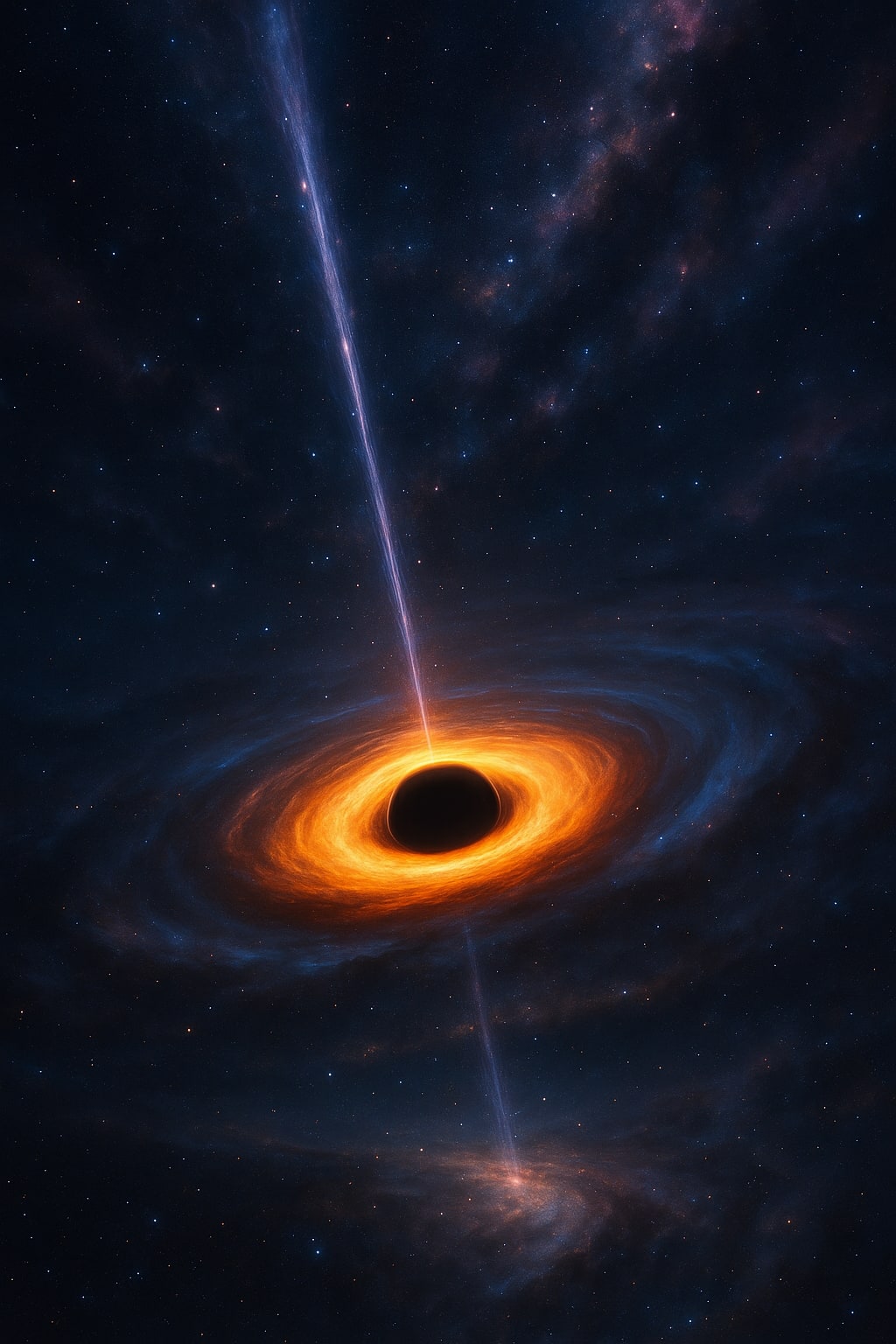
When you think of a black hole, you might imagine a cosmic monster — a dark, invisible force devouring everything that dares to cross its path. It sounds terrifying, almost like something out of science fiction. Yet, reality is even more astonishing. Astronomers have discovered that almost every galaxy in the universe, including our own Milky Way, has one of these cosmic beasts lurking at its center — a supermassive black hole millions or even billions of times heavier than the Sun.
A Mystery That Started With Movement
For decades, black holes were purely theoretical — fascinating ideas born from Einstein’s equations but lacking proof. That began to change in the latter half of the 20th century. Astronomers noticed something strange: stars near the centers of many galaxies were moving far too fast. The only explanation was that something incredibly massive but invisible was holding them in orbit.
In our own Milky Way, this hidden gravitational anchor is called Sagittarius A* (pronounced “Sagittarius A-star”). It lies about 26,000 light-years away and contains about four million times the mass of the Sun. For years, scientists could only infer its existence from the dizzying dance of nearby stars. Then, in 2022, humanity finally caught a glimpse of it. Using the Event Horizon Telescope (EHT) — a global network of radio telescopes acting as one giant lens — astronomers captured the first direct image of the Milky Way’s black hole. What they saw wasn’t the black hole itself, but its “shadow,” a dark circle surrounded by a glowing ring of superheated gas spiraling into oblivion.
It was one of the most remarkable scientific achievements of the century — a photograph of the unseeable.
Engines of Creation and Destruction
Black holes are often portrayed as cosmic vacuum cleaners that swallow everything. That’s true — but it’s only half the story. In reality, supermassive black holes are also engines of creation. Paradoxically, these destroyers can shape entire galaxies, even determining where and when new stars are born.
As matter falls toward a black hole, it doesn’t simply vanish. It forms a whirling accretion disk — a flattened ring of gas and dust that heats up to millions of degrees. This process releases enormous amounts of energy, often outshining the rest of the galaxy. From the poles of some of these disks, relativistic jets — streams of particles moving near the speed of light — blast into space, extending for thousands of light-years.
These jets and outflows can either stimulate star formation by compressing clouds of gas or suppress it by heating and dispersing that gas. In this way, the black hole acts like a galactic thermostat, regulating the growth and behavior of its host galaxy.
Think of it as the heart of a cosmic ecosystem — pumping energy, influencing its surroundings, and keeping the balance between chaos and creation.
A Cosmic Partnership
The relationship between a galaxy and its central black hole is one of the great unsolved puzzles of astrophysics. Observations show a strange correlation: the larger a galaxy’s central bulge, the heavier its black hole. This suggests that galaxies and their black holes evolve together, influencing each other over billions of years.
But which came first — the galaxy or the black hole?
Some scientists believe that black holes formed first, acting as gravitational seeds that attracted gas and stars, eventually growing into full-fledged galaxies. Others argue that galaxies formed first, and that black holes grew later as matter accumulated in their centers. The truth may be a combination of both — a cosmic feedback loop where growth on one side fuels growth on the other.
The Human Connection to Cosmic Darkness
Despite their fearsome reputation, black holes are among the most fascinating and important objects in the universe. Without them, galaxies might not exist in their current form. They help shape the architecture of the cosmos, influence how matter behaves on the largest scales, and push the boundaries of physics itself.
Studying black holes also pushes the boundaries of human curiosity. To peer into the heart of a galaxy millions of light-years away is to look both outward and inward — to confront the limits of what we can know. Every new discovery about these dark giants brings us closer to answering fundamental questions:
- How did the universe organize itself?
- What happens to matter — and information — beyond the event horizon?
- And could understanding black holes one day reveal a deeper link between gravity and quantum physics?
Darkness That Illuminates the Universe
Supermassive black holes remind us that the universe is full of contradictions. They destroy, yet they create. They are invisible, yet they define the visible structure of galaxies. They are the ultimate void — and yet, paradoxically, they give us light in the form of blazing quasars and luminous accretion disks.
Each image, each new simulation, each observation brings us a step closer to understanding these cosmic enigmas. In their darkness, we glimpse not an ending, but a beginning — the silent heartbeat of the universe itself.
About the Creator
Keep reading
More stories from Holianyk Ihor and writers in Education and other communities.
Desert Planets and Their Unique Climate Systems: Worlds of Dust, Heat, and Endless Wind
When we imagine distant planets beyond our Solar System, most of us picture Earth-like worlds—blue oceans, drifting clouds, and sprawling continents. But astronomers now believe that one of the most common types of terrestrial planet in the galaxy may look nothing like our home. Instead, many rocky exoplanets are likely desert planets: dry, dusty, and extreme. Their climates are harsh, their landscapes barren, yet they are scientifically fascinating—and, surprisingly, some might even be habitable.
By Holianyk Ihor3 months ago in Education
Half Dollars That Defied Time: Kennedy, Franklin & Walking Liberty
If you’ve found yourself holding an old half dollar, you’ve probably wondered: is this just pocket change, or could it be something more? I’ve had that same conversation with countless collectors in my eight years as a numismatist. The answer often hinges on three legendary names: Walking Liberty, Franklin, and Kennedy. More than just silver, these coins are tangible pieces of 20th-century America. This guide will help you understand their stories, values, and which one might be the perfect fit for your goals, whether you're building a collection or an investment.
By Laura Bennett4 days ago in Education
Rewiring Wellness: How Neuroscience Is Redefining the Mind-Body Connection in Therapy
In recent years, neuroscience has reshaped the understanding of how emotional and physical processes interact, offering therapists new insight into healing. The mind-body connection, once viewed as more philosophical than scientific, now has clear biological explanations. Studies show that thoughts, emotions, and physical sensations are deeply intertwined, influencing everything from stress responses to overall wellbeing. This knowledge is transforming modern therapeutic practices by providing clinicians with evidence-based tools that support integrated healing.
By Debra Bailey PHDabout 7 hours ago in Education
Rachel Reviews: The Spiral Archive by Pieter Hendrik
It's difficult for me to know where to start with a review of this book as it was, for me, an entirely unique experience and one that I'll probably never have again. I don't want that to be interpreted as unenjoyable but it has left me scratching my head a little and ruminating on its content, its themes and its characters.
By Rachel Deeminga day ago in BookClub




Comments
There are no comments for this story
Be the first to respond and start the conversation.