
Desert Planets and Their Unique Climate Systems: Worlds of Dust, Heat, and Endless Wind
Space

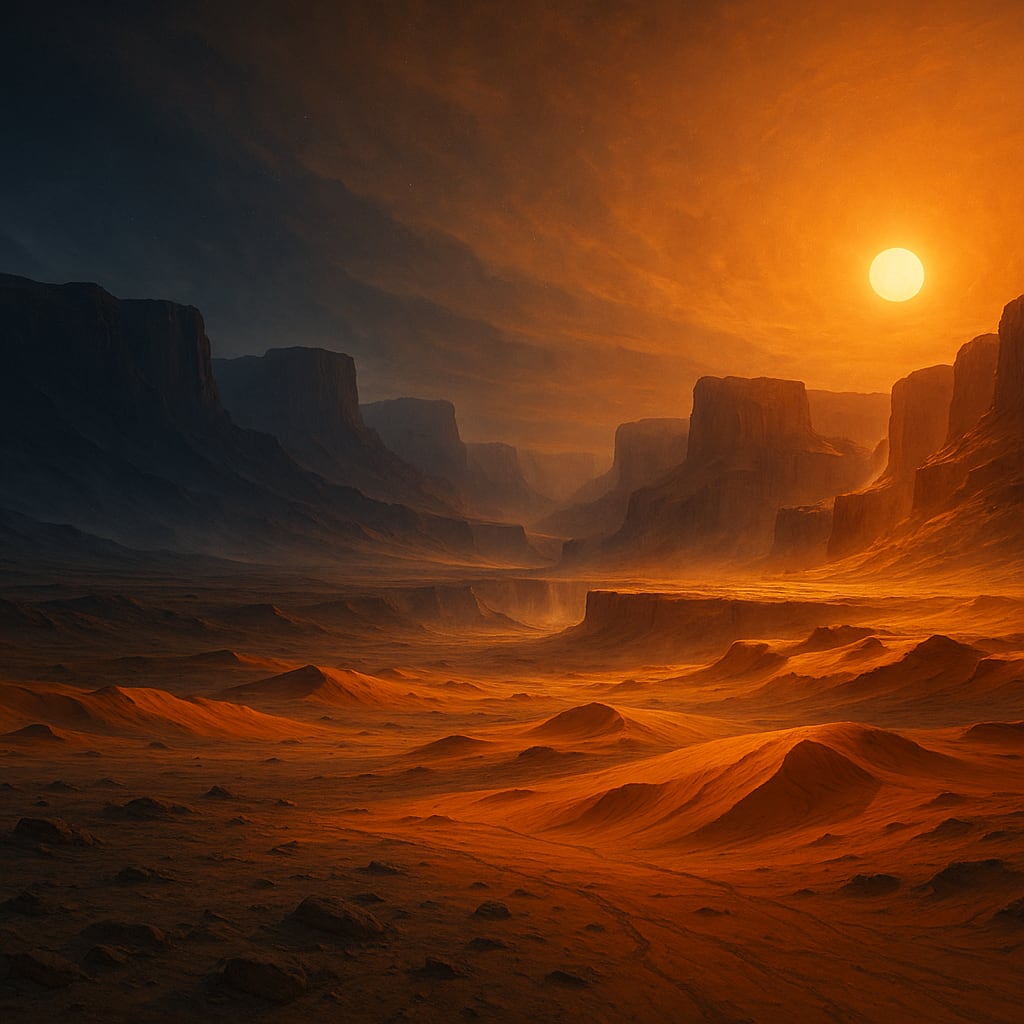
When we imagine distant planets beyond our Solar System, most of us picture Earth-like worlds—blue oceans, drifting clouds, and sprawling continents. But astronomers now believe that one of the most common types of terrestrial planet in the galaxy may look nothing like our home. Instead, many rocky exoplanets are likely desert planets: dry, dusty, and extreme. Their climates are harsh, their landscapes barren, yet they are scientifically fascinating—and, surprisingly, some might even be habitable.
What Exactly Is a Desert Planet?
A desert planet is a world with very little surface water. Instead of oceans, they are dominated by sand, rock, and dust. Scientists divide them into several broad categories:
- Hot Desert Planets – located close to their star, often hotter and drier than Venus, with cloudless skies and scorching winds.
- Cold Desert Planets – found far from their star, where water exists only as ice or frost, resembling a frozen Mars.
- Terminator Desert Planets – worlds that always show the same face to their star, creating a blazing day side, a frozen night side, and a thin ring of twilight where conditions might be mild.
Although desert planets sound inhospitable, their simplicity makes them intriguing. With fewer oceans and less water vapor, their climates are driven by raw physics: wind, sunlight, dust, and rock.
Extreme Winds and Global Dust Storms
On Earth, oceans act as giant thermostats. They store heat, move it around, and help stabilize weather. On a desert planet, that regulator is gone. As a result, temperatures can swing wildly between different regions, generating ferocious atmospheric circulation.
Computer models predict that on some desert planets, jet streams could reach thousands of kilometers per hour, creating continuous worldwide winds. Even a thin atmosphere can produce incredible storms.
We already have a local example: Mars. While not a “true” desert planet by exoplanet standards, it’s close. Mars experiences dust storms so large they can swallow the entire planet for months, turning its red surface into a hazy orange blur. Now imagine a larger planet with a thicker atmosphere—its storms could be far more violent, sculpting dunes the size of mountain ranges and redistributing dust on a planetary scale.
The “Infrared Greenhouse” Effect
Many desert worlds may have a climate driven by a unique version of the greenhouse effect. With few clouds and little water vapor, sunlight can easily reach the surface and heat it. At night, however, the remaining atmosphere traps infrared radiation, creating an “infrared greenhouse” that keeps temperatures high. The result can be a planet that is blisteringly hot, yet surprisingly stable.
On some hot desert planets, this stability might make them more comfortable for life than a humid, ocean world—at least in narrow regions.
The Wild Climate of Tidally Locked Desert Worlds
One of the most intriguing desert planet scenarios involves tidally locked planets orbiting red dwarf stars. These worlds always face their star with the same side—just like the Moon always shows the same face to Earth. This creates:
- a permanent day side, hot enough to melt rock;
- a permanent night side, cold enough to freeze nearly every gas;
- a twilight “terminator zone”, where a thin, habitable climate might exist.
Scientists increasingly suspect these twilight belts could harbor stable temperatures and even liquid water—just not in oceans. Instead, water might collect in lakes, oases, or underground aquifers. In other words, life—if it exists—would live in perpetual sunset.
Fragile Atmospheres and the Battle Against Evaporation
Desert planets face a major challenge: atmospheric escape. Without large bodies of water, a sudden temperature shift can cause rapid evaporation. Around active stars, especially red dwarfs known for violent flares, stellar winds may strip away the upper atmosphere over time. Many desert planets likely have thin, restless atmospheres constantly reshaped by space weather.
And yet, some survive for billions of years—long enough for biology to potentially take root.
Could Desert Planets Support Life?
It sounds unlikely, but many researchers argue yes. In several ways, desert planets may even be better candidates than ocean worlds:
- Less water means fewer runaway greenhouse catastrophes.
- Stable regions (like twilight zones) could maintain mild temperatures.
- Underground ice and aquifers might provide long-term water sources.
Mars shows that deserts can preserve biosignatures for millions of years. Earth adds another hint: our oldest microfossils formed in shallow, dry environments—not oceans.
So, our first discovered extraterrestrial life might come from a desert, not a sea.
Why These Worlds Matter
Desert planets act as natural laboratories. By studying them, we learn:
- how atmospheres evolve,
- how extreme climates stabilize,
- and where the boundaries of habitability truly lie.
They also broaden our imagination. Not every living world will look like Earth. Some may be worlds of storms, dust, and endless wind—harsh, yes, but undeniably alive.
About the Creator
Keep reading
More stories from Holianyk Ihor and writers in Education and other communities.
Hunting for Alien Life: The Search for Atmospheric Biosignatures on Distant Worlds
Just a few decades ago, the idea of planets orbiting other stars lived mostly in science fiction. Today, astronomers have confirmed more than five thousand exoplanets—burning-hot gas giants, frozen mini-Neptunes, super-Earths cloaked in clouds, and even rocky worlds that remind us of home. Yet the true holy grail remains undiscovered: evidence of life beyond Earth.
By Holianyk Ihor3 months ago in Education
Creating a Calm and Confident Path Toward Retirement
Retirement planning often feels intimidating, especially when people imagine complex calculations and uncertain outcomes. However, when you approach the process with clarity and patience, it becomes far more manageable. Instead of focusing on stress, thoughtful planning helps you feel confident about the future you are building.
By Michael Petruska4 days ago in Education
The Night of Mi‘rāj: A Journey Beyond Time, Space, and Human Imagination
Mi‘rāj — A Night That Reshaped Human Understanding Among all the extraordinary events recorded in Islamic tradition, Mi‘rāj stands as one of the most profound. It is not merely a journey; it is a moment when the boundaries of time, space, and perception were transcended by the Prophet Muhammad ﷺ through the will of God.
By Muhammad Islam khan swati4 days ago in Education
Miss Persephone's Manual to a Seemingly Ordinary Life
Miss Persephone was found at the dining table, her blue eyes swollen, her tears arriving and retreating like the tides of the ocean. Earlier that day, her family had visited her in the retirement home where she had lived for eight years. It was her eightieth birthday.
By Imola Tóth3 days ago in Fiction


Comments
There are no comments for this story
Be the first to respond and start the conversation.