degree
Degrees defined: PhD, Master, Bachelor, Associate–all about that expensive piece of paper called your degree.
Empowering Minds: The Transformative Power of Education
Empowering Minds: The Transformative Power of Education How Learning Shapes Brighter Futures and Builds Stronger Communities In a small village nestled between rolling hills and golden fields, lived a curious 10-year-old girl named Amina. Her eyes sparkled with questions about the world — why the stars twinkled, how birds knew where to fly, and what lay beyond the horizon. But for a long time, her questions had no place to land. Her family, like many others in the village, struggled to make ends meet, and school was a distant dream. That changed when a local non-profit partnered with government educators to open a school in the village. It wasn’t grand — just a few classrooms, wooden benches, and a chalkboard — but for Amina and dozens of other children, it was a gateway to a new world. From the moment she stepped into the classroom, Amina’s life began to change. She learned to read, write, and count. She discovered the stories of faraway lands, the mysteries of science, and the beauty of her own culture’s history. Most importantly, she discovered her own voice. Education gave Amina something she had never felt before: hope. It gave her the confidence to dream beyond her circumstances and the tools to one day make those dreams real. --- Amina’s story is just one of millions around the globe — a testament to the power of education. Beyond just reading and writing, education builds critical thinking, empathy, confidence, and a sense of belonging. It’s one of the most powerful tools we have to fight poverty, inequality, and injustice. Why is education so important? Education doesn’t only shape individuals — it strengthens families and transforms communities. When children go to school, they grow up to make better choices, access better job opportunities, and contribute positively to society. Educated individuals are more likely to support democratic values, care for their environment, and raise healthier children. According to UNESCO, each additional year of schooling can increase a person’s income by up to 10%. Girls who complete secondary education are far less likely to marry early and more likely to become leaders and entrepreneurs. In fact, when you educate a girl, you educate an entire generation. In communities where education is prioritized, there are lower crime rates, better health outcomes, and stronger economies. Simply put, education plants the seeds for long-term, sustainable growth. --- But despite the proven benefits, millions of children worldwide still lack access to quality education due to poverty, conflict, discrimination, or lack of resources. For many, the nearest school is hours away, the teachers are undertrained, or families can't afford the supplies. That’s why organizations, governments, and individuals around the world are working together to break these barriers — by building schools in rural areas, training passionate educators, providing scholarships, and advocating for policies that protect every child’s right to learn. In one rural region of South America, for example, a mobile classroom project brings education to children who live in remote mountain communities. Teachers travel by donkey or boat, carrying books and supplies to ensure no child is left behind. In cities, mentorship programs help young students from low-income families stay in school and believe in their potential. These are more than just feel-good stories — they are real-life examples of how education changes lives. --- Back in Amina’s village, years have passed. She is now a confident teenager, teaching her younger siblings how to read and write under the same tree where she once asked about the stars. Her school helped her gain a scholarship to attend secondary school in the nearby town. She dreams of becoming a doctor, not just to treat people but to teach others how to care for their health. Her journey is a reminder that the gift of education is never just for one person — it spreads. When we educate one child, we invest in a ripple effect of growth, change, and possibility. --- Conclusion: Education is more than just learning facts — it's about unlocking potential. It gives people the tools to build a better life, to understand the world, and to shape the future. Amina’s story, like many others, shows us that when we invest in education, we are building a brighter, more just world for all. It reminds us that no matter where a child is born — whether in a big city or a quiet village — every mind deserves the chance to shine. Because when we empower minds, we empower humanity.
By Muhammad Saad 6 months ago in Education
Empowering Minds, Changing the World
In the quiet hills of northern Kenya, the sun was just beginning to rise over the village of Laretu. A soft, golden light filtered through the acacia trees, warming the red earth and stirring life into a place that, for generations, had been forgotten by progress. But something was changing. Twelve-year-old Amina sat under a tree, her well-worn notebook balanced on her knees. Her eyes scanned the pages with a mixture of determination and wonder. Only a few years earlier, books were foreign objects in her home—luxuries reserved for cities and for boys. But now, every morning before tending to her family’s goats, Amina read. And every night before sleep, she dreamed—not of marriage or chores, but of chemistry labs, stethoscopes, and faraway universities. What had happened in Laretu was not magic. It was education. A small, solar-powered school had been built just three years ago, through a collaboration between a global nonprofit and local leaders. At first, only a few families were willing to send their children—especially girls. But over time, change began to ripple. Amina's older brother, once resistant to her learning, watched her explain the water cycle better than any adult in the village. Her father, who had never learned to read himself, began to ask her to read letters for him. The village began to see knowledge not as a threat to tradition, but as a bridge to a better life. Across the globe, similar ripples were forming. In a refugee camp in Jordan, Syrian children who had lost their homes and families were rebuilding their identities through classrooms filled with stories, science, and hope. In the favelas of Brazil, coding programs were turning at-risk youth into software developers, some of whom would go on to launch startups tackling real-world problems in healthcare and finance. In rural Bangladesh, mobile classrooms on boats were reaching flood-prone communities, ensuring that even climate change could not interrupt a child’s right to learn. Education was proving to be the great equalizer—not instantly, and not perfectly—but undeniably. What made education so powerful was not just the transfer of knowledge, but the transformation of the self. When people learned, they began to question. They asked why things were the way they were, and whether they had to remain that way. Amina began to ask why her village lacked clean water, and what she could do to fix it. Others asked why women weren’t allowed to own land, or why corruption was accepted as normal. Education planted the seeds of critical thinking, and critical thinking sparked action. By the time Amina was sixteen, she had started a girls’ science club. By nineteen, she had received a scholarship to study environmental engineering abroad. And by twenty-five, she returned—not to escape her past, but to rebuild it. With help from university contacts and local government grants, Amina led a project to design and install a low-cost water purification system in Laretu, using solar distillation methods adapted from her studies. Illnesses dropped, children missed fewer school days, and mothers had more time for community enterprises. But perhaps the most transformative part was what she inspired. Younger girls began to follow in her footsteps. Boys, too, started to see education not as a threat to their identity, but as an expansion of it. The idea that power came through violence or wealth began to shift—now, the most respected people in the village were teachers, scientists, and community organizers. On a global scale, stories like Amina’s were multiplying. Educated populations were driving democratic reforms, innovating climate solutions, and demanding accountability from their leaders. Education wasn’t merely preparing people for jobs—it was preparing them to reshape the world. The United Nations’ reports confirmed what many already believed: no other single factor had as wide-reaching an impact on global well-being as education. It reduced poverty, improved health outcomes, promoted gender equality, and strengthened economies. In every corner of the world, empowered minds were rewriting futures. Standing on a small hill overlooking her village, Amina once said to a group of visiting students, “We used to think change had to come from outside—from governments, from donors, from heroes. But real change starts when one person learns something new, and decides not to keep it to themselves.” In a world facing crises of inequality, climate, and conflict, it was not weapons, wealth, or even technology that promised the greatest hope. It was education—humble, patient, and persistent—that lit the way forward. Empowering minds, changing the world. The transformation had already begun.
By Muhammad Saad 6 months ago in Education
Todd Eller: Why Someone Decides to Go into Medicine
Whether you are a physician, a nurse, a medical tech or someone else who works in a medical office or hospital, this is a very good question to ask yourself: why did you decide to go into medical field? The UCLA Career Center is the largest career center in the world. This question was asked of many individuals who were going into family practice, surgery, nursing and other medical careers. Many different people go into medicine for many different reasons. The respondents gave several different answers including:
By Benjamin Todd Eller6 months ago in Education
Artificial Intelligence: Origins, Benefits, Challenges, and the Future
1. Introduction Artificial Intelligence (AI) is no longer just a concept from science fiction or academic speculation. It is woven deeply into the technological and social fabric of the 21st century. Whether assisting doctors, optimizing logistics, parsing language, or generating art—AI permeates every domain of contemporary life. Its rise both excites and unsettles, promising accelerated innovation while raising profound ethical, legal, and social questions.
By Stefano D'angello6 months ago in Education
How to Choose the Best 24/7 Assignment Helper for Academic Success
In today’s fast-paced academic environment, students are expected to juggle lectures, assignments, part-time jobs, and sometimes even family responsibilities. When deadlines are tight and topics are overwhelming, seeking support from a reliable assignment helper becomes a smart strategy. But with so many services claiming to be the best, how do you really choose the one that will deliver top-quality work, 24/7 assistance, and ensure academic success?
By Shani Pandey6 months ago in Education
How Verbatim Transcription Enhances Qualitative Data Analysis
In the world of qualitative research, interviews serve as one of the most powerful tools for gathering in-depth insights. Whether you're studying human behavior, social dynamics, or personal experiences, interviews allow participants to share their perspectives in their own words. But the real challenge lies in how this rich, complex data is analyzed, and it all begins with transcription. Among the different types of transcription, verbatim transcription is often considered the gold standard for qualitative research. Unlike clean or summarized versions, verbatim transcription captures every spoken word and sound, including filler words like "uh," "um," pauses, stutters, repetitions, false starts, and even nonverbal cues like sighs or laughter. This may sound excessive at first, but in qualitative analysis, every detail counts. Here's how verbatim transcription plays a pivotal role in helping researchers make sense of interview data in a more authentic, nuanced, and rigorous way. Preserving Authenticity and Context At the core of qualitative research is the desire to understand people and their experiences authentically. Verbatim transcription helps preserve that authenticity by recording not only what participants say, but also how they say it. For instance, a pause before answering a sensitive question or a repeated phrase might hint at hesitation, uncertainty, or emphasis. These non-verbal elements can convey emotional undertones that are crucial to interpretation. Omitting such cues risks stripping the narrative of its emotional depth and context, which, in turn, weakens the analysis. Authenticity in data is not just about truthfulness; it's about preserving context, cultural, emotional, and psychological, which can be vital in fields like psychology, education, anthropology, or social work. Minimizing Researcher Bias One of the biggest challenges in qualitative research is the subjectivity of interpretation. Human memory is fallible, and researchers, often unconsciously, may interpret or remember responses in a way that fits their assumptions or expectations. Verbatim transcription acts as a corrective lens by providing a complete, objective record of the interview. Rather than relying on handwritten notes or partial recollections, researchers can refer to the transcript to ensure their interpretations are grounded in actual data. This reduces the risk of selectively quoting or paraphrasing based on personal bias, helping maintain the integrity and neutrality of the analysis. It also allows for participant validation or member checking, where participants can review the transcript for accuracy and clarify their intended meanings. Enabling Richer and Deeper Analysis In qualitative analysis, it's not just what participants say, it's how they say it. Verbatim transcription provides the level of detail needed to engage in deeper analytical techniques, such as: Discourse analysis (studying language patterns, power dynamics, and identity construction) Narrative analysis (focusing on the structure, tone, and flow of personal stories) Thematic analysis (identifying patterns and recurring themes across interviews) Grounded theory (generating theory from line-by-line data coding) These methods demand a text that reflects the organic, unfiltered nature of speech. Clean or edited transcripts often strip out the subtle linguistic elements that reveal contradictions, emotional states, or social cues, all of which are critical in qualitative work. Supporting Transparency and Rigor in Research Transparency is a key pillar of credible research. Verbatim transcripts provide a clear trail from raw data to interpretation, which enhances the auditability of a study. Reviewers, peers, or collaborators can trace how conclusions were drawn, how themes emerged, and how quotes were selected. This traceability is especially valuable when publishing qualitative studies in academic journals, where reviewers may request to see the original data or coding structure. Being able to demonstrate a precise, consistent method of analysis backed by verbatim data improves the trustworthiness of the findings. Moreover, quotes from participants, often used in the findings section, carry more weight when they are transcribed verbatim. It shows that the researcher hasn't paraphrased or sanitized the data, but rather respected the voice and perspective of the participant. Enabling Consistent Collaboration and Inter-Rater Reliability In studies involving more than one researcher, consistency in data analysis is vital. Verbatim transcription ensures that all team members work from the same dataset, reducing misunderstandings or discrepancies in interpretation. This uniformity supports inter-rater reliability, the degree to which different analysts or coders agree on the themes, codes, or interpretations. Without a detailed transcript, coders may rely on inconsistent memories or impressions, which can weaken the credibility of the analysis. By grounding the team in the same raw material, verbatim transcription supports both collaborative efficiency and methodological rigor. Improving Accessibility and Inclusivity Verbatim transcription also supports inclusive research practices. In diverse studies, participants may speak in dialects, accents, or culturally specific expressions. A skilled transcriptionist, especially a human one, ensures that all voices are accurately captured and understood, without standardizing or erasing linguistic uniqueness. This is especially important in cross-cultural or multilingual studies, where nuance in language can carry significant meaning. By maintaining the participant's original voice, researchers uphold cultural sensitivity and inclusivity in their work. Allowing for Re-analysis and Long-Term Use Finally, verbatim transcripts are valuable not just for current projects, but for future analysis. Researchers may return to transcripts for secondary analysis, comparative studies, or follow-up research years later. Having the full record ensures that nothing is lost, even if the original audio is no longer available. Moreover, if new questions or coding frameworks arise, a verbatim transcript provides the flexibility to explore fresh insights without needing to re-interview participants. Conclusion Verbatim transcription may require more time and effort than cleaner alternatives, but in qualitative research, it's a worthy investment. It safeguards the authenticity, richness, and depth of the data while supporting a more objective, transparent, and rigorous analysis process. From reducing bias to enhancing thematic exploration and improving collaboration, verbatim transcription services form the foundation of practical qualitative interview analysis. For researchers committed to uncovering real human insights, it's not just a helpful tool; it's an essential one. Partnering with a reliable, human-powered transcription service like GMR Transcription ensures that every voice is captured with the accuracy and nuance your analysis deserves.
By Beth Worthy6 months ago in Education
Unlocking Potential: The Power of Education
Education is more than just books and classrooms. It’s the bridge between dreams and reality, the spark that ignites curiosity, and the tool that empowers individuals to shape their future. Around the world, access to quality education has proven to be one of the most powerful forces for positive change—not only for individuals but for entire communities. Take the story of Amina, a young girl from a small rural village. For years, education in her community was seen as a luxury, especially for girls. Most families prioritized early marriage and household responsibilities over schooling. But Amina had a different vision for her life. She dreamed of becoming a doctor to help the sick in her village who often lacked access to healthcare. Thanks to a community education initiative, Amina was given the opportunity to attend school. The road wasn’t easy—she walked several kilometers each day and often studied by candlelight—but her determination never faded. Years later, Amina graduated from medical school and returned to her village, where she opened a small clinic. Today, she not only provides healthcare but also mentors young girls, encouraging them to pursue their own dreams through education. Amina’s story is just one example of how education changes lives. Education Opens Doors Across the globe, research consistently shows that higher levels of education are linked with better job opportunities, higher incomes, and improved health. But the benefits go far beyond personal gain. When people are educated, they are more likely to engage in their communities, vote, start businesses, and help others rise with them. Education fosters critical thinking, empathy, and innovation—qualities that every thriving society needs. For children, the early years of education build the foundation for lifelong learning. As they progress through school, they gain not just knowledge but also confidence and communication skills. For adults, continuing education opens doors to new careers, better financial security, and personal growth. The Ripple Effect Education doesn’t just affect the learner—it creates a ripple effect. Studies show that when women are educated, their children are more likely to survive infancy, attend school themselves, and grow up healthier. Educated parents are better equipped to support their children's learning, manage their family’s health, and contribute to their local economies. In communities where education levels rise, poverty often decreases. Local businesses grow, crime rates fall, and innovation flourishes. Education is like planting a seed—it takes time to grow, but when nurtured, it transforms entire landscapes. Barriers Still Remain Despite the progress made globally, millions of people still lack access to quality education due to poverty, conflict, gender inequality, and lack of resources. For many, even basic education remains out of reach. In some parts of the world, children walk miles to reach the nearest school. In others, they face overcrowded classrooms, untrained teachers, or outdated materials. Girls, in particular, face additional challenges such as early marriage, cultural bias, or safety concerns that prevent them from completing their studies. However, positive change is possible—and happening every day. Governments, non-profits, and community leaders are working together to break down barriers, build schools, train teachers, and provide scholarships to those who need them most. Technology as a Gateway In recent years, technology has become a powerful tool in expanding access to education. Online classes, mobile learning apps, and virtual classrooms have brought learning to remote villages, refugee camps, and busy city neighborhoods. Even during times of crisis—like the COVID-19 pandemic—technology enabled millions to continue learning from home. With the right investment and planning, digital education can bridge the gap for students who would otherwise be left behind. Investing in the Future Education is not just an expense—it’s an investment. For every dollar spent on education, societies see multiple dollars returned in the form of economic growth, public health, and civic engagement. By ensuring that every child, teen, and adult has the opportunity to learn, we build stronger economies and more peaceful societies. We unlock the potential of inventors, teachers, artists, entrepreneurs, and leaders who will shape the future. A Call to Action As Amina’s story shows, the impact of education goes far beyond the classroom. It’s about empowerment, opportunity, and transformation. It’s about planting seeds today that will bloom into a better tomorrow. Whether you’re a student, parent, teacher, or policymaker, there’s a role to play in supporting education. Advocate for equal access, donate to educational programs, mentor a young learner, or simply encourage those around you to keep learning. In a world facing so many challenges, education is one of our most hopeful solutions. It equips us to solve problems, understand each other better, and dream bigger. Let’s invest in learning. Let’s unlock potential. Let’s build a brighter future—one educated mind at a time.
By Muhammad Saad 6 months ago in Education
Unlocking Potential: The Power of Education
At 42 years old, Carmen Alvarez never imagined she'd find herself back in a classroom. A single mother of two and a night-shift janitor at a local hospital, her days were already full—of responsibility, fatigue, and routine. But something had shifted inside her the day her son Mateo asked, “Mom, did you go to college?” She had smiled and answered honestly. “No, mijo. I had to start working when I was your age.” Mateo had simply nodded, but his question lingered. Not as judgment, but as possibility. The next week, Carmen enrolled in a GED prep course at the community center. Her hands trembled when she signed the registration form. It had been over two decades since she’d last held a pencil for anything other than jotting down grocery lists. But that night, as she sat at the kitchen table with a used algebra textbook and a lukewarm cup of coffee, something stirred inside her: hope. Carmen’s story is not unique. Across cities and small towns, in libraries, online classrooms, and late-night study groups, adults are rediscovering the transformative power of education. Not just as a stepping stone to a better job, but as a key to unlocking self-worth, community change, and lifelong growth. Learning Beyond Limits When Carmen passed her GED exam nine months later, she cried in the testing center bathroom. It wasn’t just a piece of paper. It was a symbol of everything she had overcome—poverty, doubt, time. Her confidence grew. She enrolled in a community college part-time, studying health sciences with the hope of becoming a certified nursing assistant. Her classmates came from all walks of life: a retired mechanic learning computer programming, a young mother studying early childhood education, an immigrant working toward his business degree. They were bound by a shared belief—that it was never too late to learn. One of her professors, Dr. Lillian Reeves, often said, “Education isn’t just about degrees—it’s about dignity. It’s about giving people the tools to contribute meaningfully to their world.” That philosophy rang true in the community. The Ripple Effect As Carmen progressed in her studies, she noticed a shift at home. Mateo and his younger sister began doing homework more diligently. “If Mom can do it, I can too,” Mateo said one evening, grinning across the table. Carmen wasn’t just learning for herself—she was modeling resilience for her children. At the hospital where she still cleaned during the night shift, her coworkers started asking her about school. A few of them, inspired by her courage, signed up for adult education courses. The break room began buzzing with talk of class schedules and future plans. A community that learns together, grows together. Building a Brighter Future Education, especially lifelong learning, has a multiplier effect. It doesn’t stop with individual achievement—it builds stronger families, healthier communities, and more adaptable economies. Carmen’s journey eventually led her to a full-time position as a CNA. The financial stability allowed her to move her family into a safer neighborhood and reduce her hours at the hospital. But she didn’t stop there. With encouragement from her instructors, she began mentoring new students, helping others overcome the fear she once knew so well. At a local education summit two years after earning her GED, Carmen stood on stage and shared her story. “I used to think education was something I missed out on,” she said to the audience. “Now I realize it’s something I’m always a part of—as a student, a mother, a mentor. Learning never ends.” Education as Empowerment In today’s fast-changing world, where technology reshapes industries and global challenges demand adaptable minds, lifelong learning is more important than ever. It equips people not just to survive, but to thrive—to pivot careers, engage in civic life, and build a future rooted in equity and innovation. But access remains a challenge. Carmen was fortunate to live in a district with funded adult programs. For millions, barriers like cost, transportation, and childcare remain daunting. That’s why communities, governments, and organizations must invest in making education accessible at every age. Conclusion Carmen’s story is a testament to the power of education—not just formal schooling, but the broader, ongoing journey of learning that fuels personal transformation and community uplift. It’s a reminder that the classroom can be anywhere: a kitchen table, a public library, a late-night break room. What matters is the spark inside—the belief that learning can unlock a better version of ourselves. Education isn’t a finish line; it’s a lifelong passport to possibility. And when one person learns, we all grow.
By Muhammad Saad 6 months ago in Education
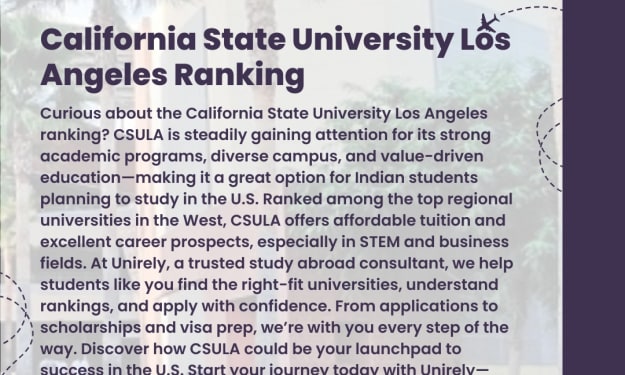
California State University Los Angeles Ranking
Why California State University, Los Angeles Might Be the Right Fit for You Choosing a university abroad is more than just checking rankings or comparing tuition fees—it's about finding a place that feels right. For many Indian students, California State University, Los Angeles (Cal State LA) is one of those places that quietly balances affordability, location, and opportunity without the overwhelming pressure of chasing top-brand names.
By Unirely Study Abroad6 months ago in Education
The Best Education for Children
Story: The Best Education for Children “What’s the best education for children?” It’s a question that parents across cultures, countries, and generations have asked—whispered in playgrounds, typed into search engines late at night, or worried silently while watching their child struggle with homework.
By waseem khan6 months ago in Education