
Procurement structure and operating model
Supply Chain Procurement

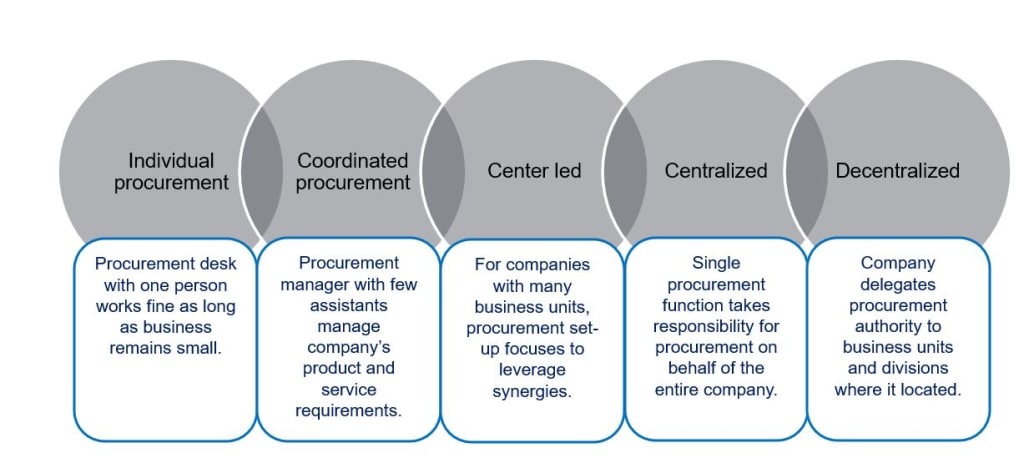
When it comes to defining the most efficient and effective operating model for procurement functions, there are hardly any easy answers to be found for that. Procurement operating model needs to be consistent with a company’s overall business strategy and global organization footprint and aligned with its supplier market.
Procurement function is important to manage internal and external business pressure well. Indeed, procurement functions must be adopted by the organizations, perhaps more frequently, as they are impacted by changes such as new corporate strategy, evolving manufacturing footprint, disruptive supplier innovations, changing supplier data base and higher savings objectives, all of which require increased flexibility.
Over the past decades, procurement operating models have gradually shifted from decentralized structure to more centralized one in order to capture the procurement savings from consolidating organizational spending.
In the following part, we will see all different procurement structures based on the different size of companies.
According to a recent study, 40% of procurement departments are centralized across divisions and business units, 20% decentralized and rest 40% center led approach, meaning that while procurement strategy is determined centrally, business units or locations handle the actual procurement.
Individual procurement
Unlike large corporations, small businesses tend to have procurement desks with one or two individuals running the show. Those who encourage and maintain personal relationships with the suppliers and can quickly act whenever issues arise. This set-up works effectively as long the business stays small.
As businesses grow, single procurement professionals can easily become overwhelmed with the responsibilities of maintaining relationships and tracking products and service deliveries. Therefore, small businesses must restructure their procurement desks matching with their overall business growth.
In a startup or small business, one person in general as finance head takes the responsibility of their product and service procurement. Alternatively, individual members of the management team such as the production manager or marketing manager, also procure products or services to meet their own functions and requirements.
In this scenario, the company would not have a consistent procurement procedure and would lack any procurement power to negotiate better deals from their group of suppliers.
Coordinated procurement
As the small business grows, the company might appoint a procurement manager with professional qualifications to set up formal procurement organizational structure.
The company may also recruit one or more procurement assistants if the scale of procurement grows. The manager or team owns the responsibility for the procurement of product and service requests for all cross-functions, discussing their requirements, identifying suppliers and processing purchase orders.
By coordinating procurement, the company can place larger orders with a few of their preferred suppliers who have long-term relationship with the organizations. It may be possible to negotiate better price conditions and impose consistent quality standards on their suppliers, but it won’t be efficient.
Centre Led
If the company has many business units, this structure helps it to leverage synergies. It intends to develop centralized procurement expertise and appoint experts. In most of the cases, it focused to control and manage with the suppliers who contribute to 80% of spending.
This structure tends to be regional and operates in regional markets or markets that are set up for specific regions. Hybrid organizations combine both functional and divisional structures to be best suited for this kind of procurement set-up and avoid the tendency of disconnected, remote, and heavy given business control. Hybrid approach being adopted in corporate sectors, based on the different business unit’s needs, there must be some degree of freedom that has to be provided to the purchasing function.
This may be due to the location of that business unit or the kind of product being manufactured over there or some other constraint pushing corporate to hold some level of localized decision making with respect to Purchasing of few things up to certain amount being allowed without bringing it to the notice / approval of headquarters or Centralized purchase head.
For example, expenses up to 1000$ is allowed per month to that business unit to spend on such purchases with the approval that BU head. Some of such things being done either cash pay or Petty Cash voucher.
Centralized procurement
Companies with several locations, operating divisions, large manufacturing footprints and business units have an option of operating centralized or decentralized procurement organization models.
In the centralized model, a single procurement function takes the responsibility for procurement on behalf of the company. The function, which may consist of a procurement director, managers, and assistants, imposes defined standard policies and procedures across the organization with the aim of reducing costs, increasing procurement efficiency and achieving consistent quality and efficient performance of suppliers.
Matured large-scale companies start exploring the possibilities of breaking out of the upper limits of centralization as an example of outsourcing category management by the third-party providers. This enables them to enjoy the benefits of economic scale and market intelligence more than managing their own team.
With all these systems in place, companies spending comes under control largely, maverick spending also gets reduced, strong supply base is created, comprehensive spend analysis comes at handy and supplier management is also improved. In order to improve the service level to their different locations, specialists are appointed who are responsible for procurement-specific categories at regional and global levels.
However, a centralized procurement structure will only be effective if it has the necessary resources to analyze spend data, manage supplier contracts, focus on compliance tracking, check performance measurement, and execute continuous improvements, category management and all necessary tools.
Centralized procurement functions minimize duplications, increase overall efficiency, reduce cost, and maintain better stakeholder’s alignment, process standardization and tax efficiencies.
Decentralized procurement
Decentralized structures place procurement power directly into the hands of those business units and operating divisions in need, by passing corporate procurement processes, which makes speed order processing with less validation, but not adhering to corporate process brings trouble during the execution of those purchase orders.
By this model, stakeholder’s satisfaction level and operational efficiency increase much higher than centralized set-up. These effective stakeholder relationships enable a new level of savings.
In the decentralized model, the company delegates procurement authority to business units and divisions where it is located. Procurement managers and assistants manage their local products and service needs. They may also receive support from their central procurement team.
While a decentralized structure enables autonomy, speeds up the order process and reduces bottlenecks, it may also lead to procurement inefficiency, inconsistent standards and increased overall procurement costs at the end.
Accordingly, the most effective procurement structure tends to be a better coordinated one that is neither center led, centralized nor decentralized.
By leveraging the best of centralized and decentralized procurement structures, overall efficiency of the organizations, service to internal customers and value addition to business are managed well by balancing local requirements and aggressively adhering to corporate expectations.
About the Creator
Sendil Arasu Vijaya Kumar
I attained bachelor degree in mechanical engineering and master degree in marketing management, having 21 Years of professional work experience. International exposure in Supply Chain Procurement domain. Author of "The Procurement Acumen"
Keep reading
More stories from Sendil Arasu Vijaya Kumar and writers in Education and other communities.
Topmost deliverables of Procurement function
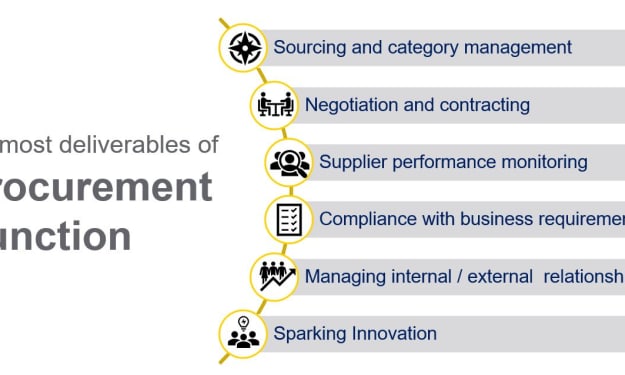
The roles and responsibilities of the entire procurement function in a business can be grouped into these topmost deliverables, starting with category management, which involves developing clear supplier strategies and organizing suppliers based on their classifications. Another important deliverable is managing innovation within the ecosystem. In addition, it is essential to uphold ethical standards and maintain compliance with the company's principles, which are considered to be core values.
By Sendil Arasu Vijaya Kumar3 years ago in Education
My New Book is Finally Here
My poetry collection Beautiful and Brutal Things is done. It's actually done and finally published over 270 pages. Over a year of my life went into this book. More than a year, really. Long days at my computer, sometimes seven days a week because I couldn't stop even when I probably should have. Then two months of editing that felt harder than the writing itself. But it's finished, and I'm still standing, and the book is real.
By Tim Carmichael3 days ago in BookClub



Comments
There are no comments for this story
Be the first to respond and start the conversation.