
Smart Storage & Grading for U.S. Coin Collections: a Checklist
Protect your collection's value. Our step-by-step checklist by expert Laura Bennett covers safe storage materials, avoiding PVC damage, and deciding when professional grading is worth it.

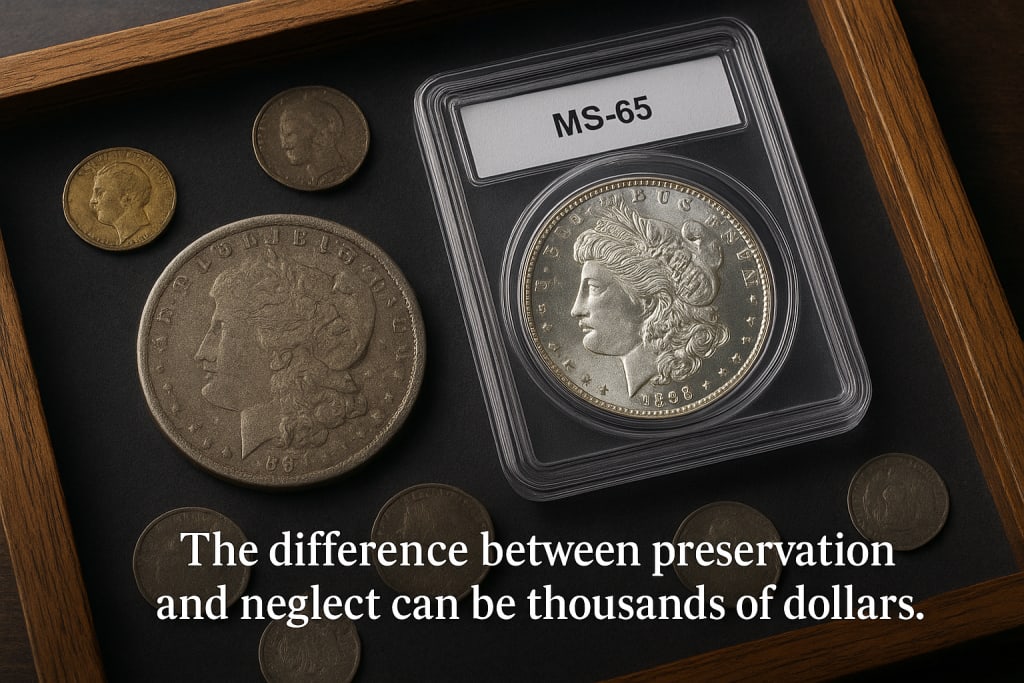
Phase 1: First Aid for Your Collection (The 24-Hour Triage)
Before buying any special supplies, you need to perform some emergency triage. Think of this as stopping the bleeding. The goal here is to prevent any active damage right now.
Step 1: Hands Off the Face!
This is rule number one. Always hold a coin by its edges. Your skin produces oils that are mildly acidic. When you touch the surface (the "fields" and "devices"), those oils transfer and can eventually etch permanent fingerprints into the metal. For your best pieces, use soft cotton gloves and always work over a clean microfiber pad.
Step 2: The PVC Patrol
Go through your collection and look for flimsy, flexible plastic flips. If they bend easily and feel a little greasy, they likely contain PVC (polyvinyl chloride). These are poison for coins. They release gases that cause a corrosive green "haze" that actively eats into the surface.
What to do: Immediately move any coins in these holders. Don't try to clean them—just get them out. A simple, temporary solution is an acid-free paper envelope.
Step 3: Snap a "Before" Picture
Use your phone to take clear, well-lit photos of the front and back of each coin. Do this on a plain, neutral background. This creates a dated baseline for your records. It’s crucial for insurance, tracking condition changes, and just knowing what you have.
Expert Tip: I keep a "quarantine box"—a simple container with acid-free envelopes. Any new coin from an unknown source goes here first. It’s a simple habit that prevents one bad apple from spoiling the barrel.
Phase 2: Choosing Your Coin's Armor
Now that you've stopped any immediate threats, it's time for long-term housing. Not all storage is equal. The right choice depends on the coin's value and your goals. The golden rule is archival quality—materials that won't chemically react with your coins over decades.
Here’s a quick guide to your options:
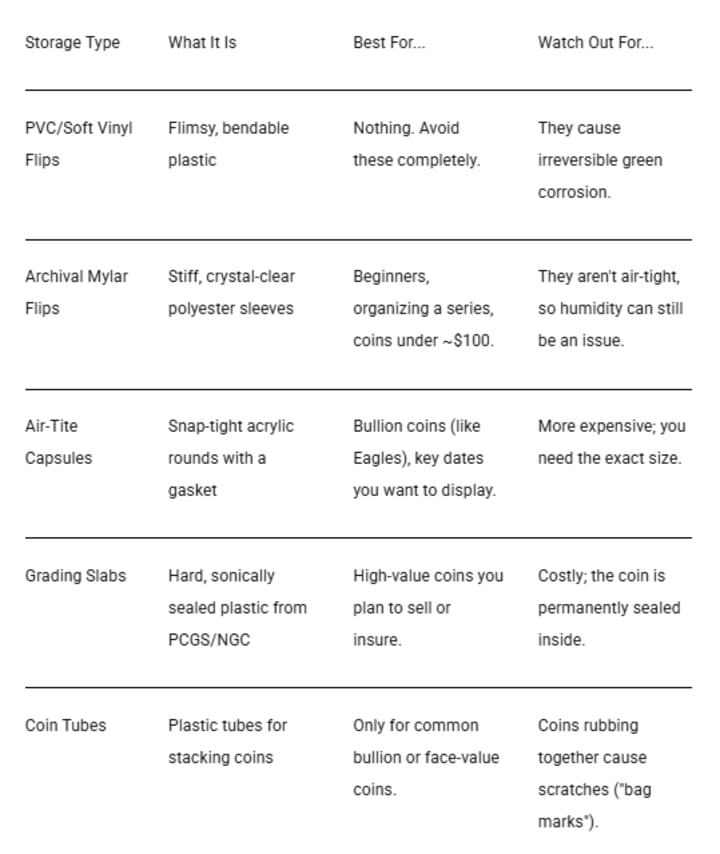
Most collectors use a mix. Start with archival flips for sorting and learning. Move your prize pieces into Air-Tites for display. Remember, the right holder isn't just a box—it's a long-term investment in your coin's condition.
Phase 3: The Grading Gamble: To Slab or Not to Slab?
Professional grading isn't for every coin. It's a financial decision. Slabbing authenticates and grades your coin, but it costs money and time. Use this simple filter to decide.
Apply the "20x Rule."
Ask yourself: Will slabbing this coin increase its value by at least 20 times the cost of grading? If grading costs $50, the slabbed coin should be worth at least $1,000 to make it worthwhile. This means you need a solid idea of your coin's potential value first. Guessing isn't good enough.
Evaluate "Eye Appeal."
Graders look at technical wear, but the market loves beauty. A coin with fantastic luster, attractive natural toning, and no distracting marks will command a premium—even over another coin with the same technical grade.
Know the Players.
For U.S. coins, PCGS and NGC are the gold standards. PCGS often has a slight edge in resale value for classic U.S. coins, while NGC is fantastic for world coins. ANACS can be a more affordable option for problem coins or getting a second opinion.
What NOT to Grade:
Cleaned or polished coins.
Coins with environmental damage (corrosion, pitting).
Very common coins in low grades.
Expert Tip: Think of grading as "monetizing condition." Start by grading just one or two of your best coins. It establishes a benchmark for your collection and teaches you how the process works.
Phase 4: Mastering the Long-Game Environment
A coin in a perfect capsule can still be ruined by a bad environment. Your final task is to control the space around your collection.
The Twin Enemies: Humidity & Heat.
Consistently high humidity (above 60%) invites spotting and corrosion. Wild temperature swings cause condensation. Your goal is a stable, cool, and dry place.
The Simple Solution: The Sealed Container.
You don't need a vault. Place your holders (in their boxes, if you have them) inside a sealable plastic storage container. Drop in a couple of silica gel desiccant packets to control moisture. This creates a stable "micro-climate." Recharge or replace the gel packets every 6-12 months.
Location, Location, Location.
Avoid attics (extreme heat), basements (dampness), and areas near vents or windows. A closet on an interior wall in an air-conditioned home is often perfect. For valuable collections, a bolted-down home safe adds security and further stabilizes the environment.
This final phase is your foundation. It’s what makes all the careful handling and proper storage worth it in the long run. A little vigilance today ensures your collection retains its history—and its full market value—for years to come.
Conclusion: Preservation is an Investment
Smart collecting isn't just about what you buy; it's about how you keep. This four-step checklist—Triage, Armor, Evaluate, and Control—turns overwhelming worry into a simple routine.
You’re not just putting coins in boxes. You’re actively protecting their story and their worth. Every fingerprint you avoid, every PVC flip you replace, and every strategic grading submission adds up to a more valuable and resilient portfolio.
FAQ: Your Burning Coin Care Questions, Answered
Can I clean my old, dirty coins?
Please, don't. Any cleaning, no matter how gentle, will likely leave micro-scratches or remove the original surface. Grading services can always detect it, and they'll label the coin "Cleaned," which can slash its value by 50% or more. A dirty original is almost always worth more.
What's the real-world difference between an MS-65 and an MS-70 grade?
It's the difference between "amazing" and "perfect." An MS-65 is a superb coin with maybe one or two tiny contact marks under magnification. An MS-70 is flawless—no marks, scratches, or imperfections visible at 5x power. For modern coins, this difference can be huge. For circulated classic coins, the scale focuses more on wear than absolute perfection.
Are cardboard 2x2 holders okay?
Only if they're archival. Regular cardboard is acidic and harmful. Look for holders explicitly labeled "acid-free" and "lignin-free." Even then, it's best to put the coin in an archival Mylar flip first, then staple that into the 2x2 cardboard.
How do I safely mail a coin for grading?
Use the "coin sandwich." Secure the coin in a rigid plastic flip. Tape that flip (using painter's tape) firmly to the center of a piece of sturdy cardboard. Put the cardboard in a bubble mailer. Never let a coin rattle loose in a box. Always use tracked and insured shipping.
Is toning good or bad?
It depends. Natural, attractive rainbow toning on silver can add a significant collector premium. Harsh, black, or corrosive toning from chemicals or PVC hurts value. If the toning is colorful and stable, it's usually a plus. If it's ugly or actively changing, it's a problem.
I found a strange coin. What's my first move?
Take good, clear photos. Use online resources or a trusted guide to identify coins accurately. Knowing what you have tells you everything about how to care for it and what it might be worth.
My Morgan dollars are in a leather album. Is that bad?
A: Unfortunately, yes. Traditional leather off-gasses sulfur, which causes unattractive, dark toning on silver. If you love the album look, seek out modern versions specifically made for coins with chemically inert pages.
About the Creator
Laura Bennett
Numismatist and data science expert passionate about uncovering the stories behind historical coins through analytics. Bachelor’s degree in Archaeology and a Master’s in Data Science from Harvard University. https://coin-identifier.com/
Keep reading
More stories from Laura Bennett and writers in Education and other communities.
Half Dollars That Defied Time: Kennedy, Franklin & Walking Liberty
If you’ve found yourself holding an old half dollar, you’ve probably wondered: is this just pocket change, or could it be something more? I’ve had that same conversation with countless collectors in my eight years as a numismatist. The answer often hinges on three legendary names: Walking Liberty, Franklin, and Kennedy. More than just silver, these coins are tangible pieces of 20th-century America. This guide will help you understand their stories, values, and which one might be the perfect fit for your goals, whether you're building a collection or an investment.
By Laura Bennett4 days ago in Education



Comments
There are no comments for this story
Be the first to respond and start the conversation.