
Semaphore in Operating System
Understanding Semaphore in Operating Systems: A Key to Effective Process Synchronization

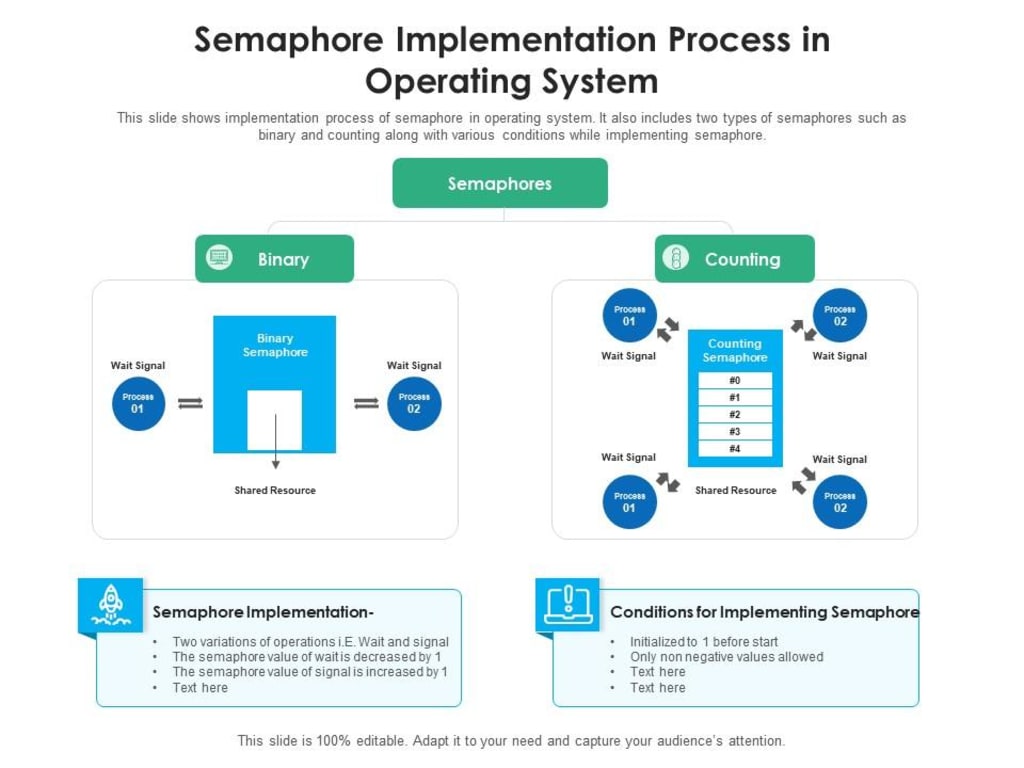
Semaphores are a fundamental synchronization primitive in operating systems. They are used to control access to shared resources and manage concurrent processes, ensuring that multiple processes do not enter critical sections of code simultaneously, which could lead to race conditions or data corruption. This article explores the concept of semaphores, their types, and their application in operating systems.
What is a Semaphore?
A semaphore is an abstract data type or variable used to control access to a common resource by multiple processes in a concurrent system such as an operating system. It is a signaling mechanism, and a semaphore variable is typically an integer that can be modified only by two atomic operations: wait() (often called P or down) and signal() (often called V or up).
Key Concepts:
- Atomic Operations: Operations that are completed in a single step without the possibility of interruption.
- Critical Section: A section of code that accesses shared resources and must not be concurrently executed by more than one thread.
Types of Semaphores
There are two main types of semaphores:
- Binary Semaphore (Mutex):
Can have only two values: 0 and 1.
Used for simple locking mechanisms where a resource can be either available (1) or locked (0).
Ensures mutual exclusion.
- Counting Semaphore:
Can have a range of values.
Used to control access to a resource that has a limited number of instances (e.g., a limited number of identical resources).
Allows up to a certain number of processes to access the resource simultaneously.
Semaphore Operations
- Wait Operation (P or down)
The wait() operation decrements the Semaphore Value. If the value becomes negative, the process executing the wait() is blocked until the semaphore value is greater than or equal to zero.
wait(Semaphore S) {
while (S <= 0);
S--;
}
- Signal Operation (V or up)
The signal() operation increments the semaphore value. If there are any processes waiting for the semaphore, one of them is unblocked.
signal(Semaphore S) {
S++;
}
- Implementing Semaphores
Modern operating systems implement semaphores through a range of low-level mechanisms provided by the hardware and kernel. Below is a simplified example demonstrating the use of semaphores in programming:
#include <stdio.h>
#include <pthread.h>
#include <semaphore.h>
#include <unistd.h>
sem_t semaphore;
void* process(void* arg) {
// Wait (P) operation
sem_wait(&semaphore);
printf("Entered..\n");
// Critical section
sleep(4);
// Signal (V) operation
printf("Exiting..\n");
sem_post(&semaphore);
}
int main() {
pthread_t t1, t2;
sem_init(&semaphore, 0, 1);
pthread_create(&t1, NULL, process, NULL);
sleep(2);
pthread_create(&t2, NULL, process, NULL);
pthread_join(t1, NULL);
pthread_join(t2, NULL);
sem_destroy(&semaphore);
return 0;
}
Explanation:
Initialization: The semaphore is initialized with a value of 1.
Wait Operation: sem_wait() is called, which decrements the semaphore value. If the value is 0, the calling thread is blocked until the value becomes positive.
Signal Operation: sem_post() is called, which increments the semaphore value and potentially unblocks a waiting thread.
Critical Section: The code between sem_wait() and sem_post() represents the critical section.
Advantages of Semaphores
- Simplifies Process Synchronization: Semaphores provide an easy-to-use mechanism to handle synchronization between multiple processes.
- Efficient Resource Management: They help in managing resources efficiently by allowing multiple processes to access a limited number of resources.
- Avoidance of Busy Waiting: Semaphores are utilized to prevent busy waiting, a scenario in which a process repeatedly checks to see if a condition has been fulfilled, thereby consuming unnecessary CPU cycles.
Disadvantages of Semaphores
- Complexity: Improper handling of semaphores may result in problems like deadlock, where multiple processes are indefinitely stalled, each waiting for the other to relinquish resources.
- Priority Inversion: Higher-priority processes may have to wait for lower-priority processes to release a semaphore, leading to suboptimal performance.
- Hard to Debug: Synchronization issues such as race conditions and deadlocks can be difficult to debug and resolve.
Conclusion
Semaphores play a vital role in operating systems by offering mechanisms for process synchronization and the management of resources. Grasping the concept of semaphores and their proper application is key to creating effective and dependable systems that operate concurrently. Through the careful use of semaphores, developers can guarantee optimal resource utilization and seamless process execution without mutual interference.
About the Creator
Pushpendra Sharma
I am currently working as Digital Marketing Executive in Tutorials and Examples.
Keep reading
More stories from Pushpendra Sharma and writers in Education and other communities.
Difference between Software Engineering and System Engineering
Introduction In the rapidly evolving world of technology, two pivotal fields stand out: Software Engineering and System Engineering. Both are essential to the creation and maintenance of technological solutions, but they differ significantly in scope, focus, and methodologies. Understanding these differences is crucial for professionals and organizations aiming to maximize efficiency and effectiveness in their tech projects.
By Pushpendra Sharma2 years ago in Education
A brief history of alcohol
This chimpanzee stumbles across a windfall of overripe plums. Many of them have split open, drawing him to their intoxicating fruity odor. He gorges himself and begins to experience some… strange effects. This unwitting ape has stumbled on a process that humans will eventually harness to create beer, wine, and other alcoholic drinks. The sugars in overripe fruit attract microscopic organisms known as yeasts. As the yeasts feed on the fruit sugars they produce a compound called ethanol— the type of alcohol in alcoholic beverages.
By Munesh Yadav3 days ago in Education




Comments
There are no comments for this story
Be the first to respond and start the conversation.