
How Online Practice Exams Help in Exam Success
Exam Success Tips

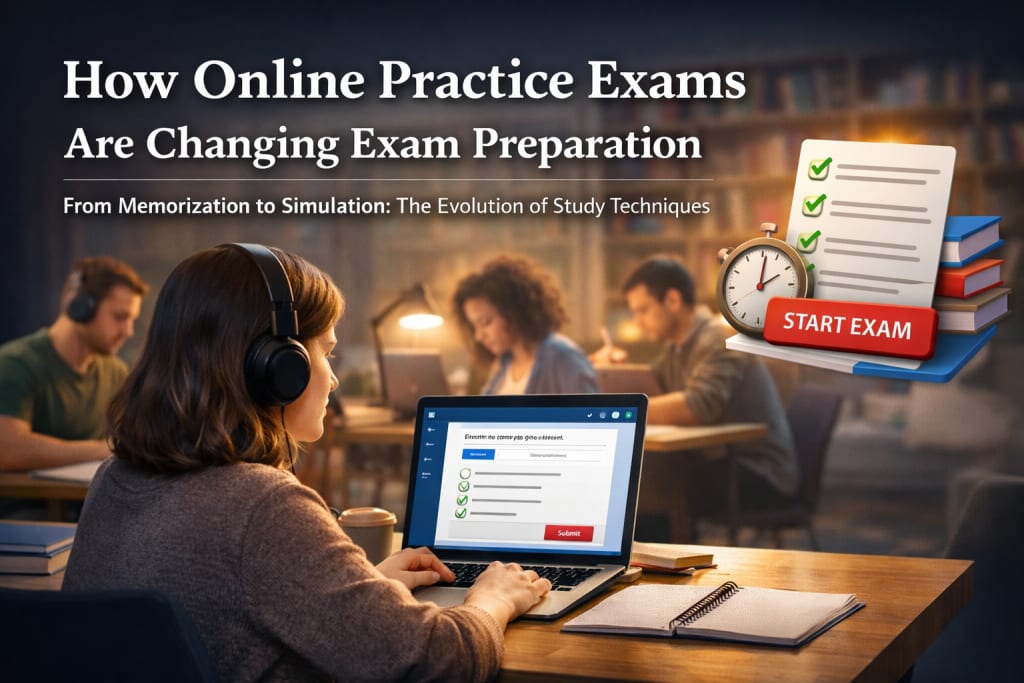
For most of modern educational history, preparing for an exam meant one thing: studying content. Learners read textbooks, reviewed notes, highlighted passages, memorized definitions, and repeated information until it felt familiar. The assumption was simple—if you consume enough material, success will follow.
Yet familiarity has never guaranteed performance.
Across classrooms, certification programs, and professional training environments, a different approach is quietly reshaping how people prepare for tests. Instead of focusing primarily on content consumption, learners are turning toward practice-based preparation—a model centered on testing, recall, feedback, and simulation.
At the center of this shift are online practice exams, which are changing not only how people study, but how learning itself is understood.
The Limits of Traditional Studying
Conventional study methods are largely passive. Reading, watching lectures, and reviewing notes create a sense of understanding, but often fail to build reliable recall. Recognition feels like knowledge, even when retrieval is weak.
This creates a common pattern:
Information feels familiar
Confidence rises during study
Performance drops during testing
The gap between perceived understanding and actual recall is one of the most common causes of exam failure. Students often know the material—but cannot access it efficiently under pressure.
Practice-based preparation addresses this disconnect by shifting learning from recognition to retrieval.
Learning Through Retrieval, Not Recognition
Modern learning science emphasizes a simple principle: memory strengthens when the brain is required to retrieve information, not merely recognize it.
When learners answer questions:
Neural pathways are reinforced
Recall speed improves
Memory durability increases
Understanding becomes more structured
Knowledge becomes usable
Practice exams force retrieval. They require learners to reconstruct knowledge from memory instead of recognizing it on a page. This process builds functional understanding, not surface familiarity.
Over time, this changes how information is stored and accessed.
The Role of Feedback in Learning
Practice exams also introduce something traditional studying often lacks: immediate feedback.
Feedback allows learners to:
Identify misconceptions
Correct errors early
Adjust mental models
Strengthen weak areas
Prevent repeated mistakes
Instead of reinforcing incorrect assumptions, feedback creates learning loops. Mistakes become data rather than discouragement.
This transforms preparation into a refinement process, not a repetition cycle.
Exam Simulation as Cognitive Training
Exams are not only tests of knowledge—they are tests of performance.
They involve:
Time pressure
Mental fatigue
Focus management
Decision-making speed
Stress regulation
Cognitive endurance
Traditional studying prepares learners for information. Practice exams prepare learners for conditions.
Simulated testing environments expose learners to the mental demands of real exams, training the brain to function under pressure. This builds familiarity with:
Question structure
Time pacing
Stress response
Cognitive load
Focus sustainability
Performance becomes trained, not improvised.
Confidence as a Cognitive Outcome
Confidence is often misunderstood as personality-based. In reality, confidence is largely experience-based.
Repeated exposure to testing conditions creates:
Predictability
Familiarity
Reduced fear response
Mental stability
Psychological resilience
Online practice exams allow learners to encounter difficulty in controlled environments. Over time, uncertainty becomes familiarity, and anxiety becomes manageability.
Confidence emerges from repetition, not reassurance.
Flexibility and Access
Digital practice platforms remove many structural barriers to preparation:
No physical materials
No fixed schedules
No geographic limits
No classroom dependency
No rigid timelines
This allows learners to integrate preparation into daily life rather than reorganize life around preparation. Learning becomes adaptable instead of disruptive.
For working professionals, remote learners, and adult students, this accessibility is not convenience—it is necessity.
Data as a Learning Tool
Modern practice platforms generate performance data that traditional studying cannot.
Learners gain insight into:
Accuracy patterns
Topic weaknesses
Time management issues
Retention gaps
Learning trends
Progress stability
This transforms preparation from general effort into targeted development. Instead of studying everything, learners focus on what matters most.
Learning becomes strategic rather than exhaustive.
A Structural Shift in Education
Education is moving away from content-first models toward performance-first learning.
Old model:
Learn → Study → Memorize → Test
Emerging model:
Test → Identify gaps → Learn → Practice → Refine
Practice becomes the starting point, not the endpoint.
This changes the role of testing—from assessment to instruction.
Practice-Based Platforms in Modern Learning
Some digital learning platforms now center their entire structure around practice-based learning, emphasizing structured testing, feedback cycles, and performance development rather than passive content delivery.
Platforms such as PrepPool reflect this broader shift by focusing on exam-style practice environments, performance tracking, and repeated testing as the foundation of preparation rather than content consumption. This approach mirrors how learning science increasingly defines effective preparation—not by volume of study, but by quality of practice.
This reflects a larger movement in digital education: learning designed around outcomes, not exposure.
Why This Transformation Is Accelerating
Several forces are driving the adoption of practice-based preparation:
Digital education normalization
Online learning is now a standard part of education systems worldwide.
Certification expansion
More careers require exams, credentials, and licensing.
Time constraints
Learners seek efficient, focused preparation methods.
Learning science awareness
Students are increasingly informed about effective learning strategies.
Technology access
Devices and platforms make digital learning universal.
Together, these factors make practice-based preparation not a trend, but a structural evolution.
Redefining “Studying”
Studying is no longer defined by time spent with books.
It is increasingly defined by:
Recall ability
Performance consistency
Error correction
Mental endurance
Focus training
Confidence development
Learning becomes something that is trained, not just consumed.
The Future of Exam Preparation
As education continues to evolve, exam preparation will increasingly emphasize:
Adaptive testing systems
Personalized practice pathways
Cognitive training models
Performance analytics
Skill-based assessment
Behavioral learning science
Practice exams will not replace learning—they will shape it.
Conclusion
Online practice exams are changing exam preparation because they align with how learning actually works.
They shift preparation from:
Passive reading → active recall
Memorization → performance
Exposure → experience
Anxiety → familiarity
Volume → precision
This transformation is not driven by technology alone—it is driven by understanding the human brain.
As education modernizes, one principle is becoming increasingly clear:
Preparation is no longer about how much you study.
It is about how effectively you practice.
And in that shift, online practice exams are not just tools—they are reshaping the foundation of learning itself.
About the Creator
PrepPool
PrepPool helps students prepare smarter for exams through realistic practice questions, exam-aligned study resources, and practical strategies for AP, nursing, healthcare, and professional certification exams.
Rewiring Wellness: How Neuroscience Is Redefining the Mind-Body Connection in Therapy
In recent years, neuroscience has reshaped the understanding of how emotional and physical processes interact, offering therapists new insight into healing. The mind-body connection, once viewed as more philosophical than scientific, now has clear biological explanations. Studies show that thoughts, emotions, and physical sensations are deeply intertwined, influencing everything from stress responses to overall wellbeing. This knowledge is transforming modern therapeutic practices by providing clinicians with evidence-based tools that support integrated healing.
By Debra Bailey PHD3 days ago in Education
The CEO of Everything
They say "jack of all trades, master of none," but they forgot to mention the part where the jack of all trades is also the camera woman, the makeup artist, and the person currently yelling at a tangled Wii microphone cable in a her own bathroom while recording herself singing and trying to make it look realistic and professional. (As professional as you can make it with nothing but a cell phone camera and a mic that doesn't work)
By Sara Wilson5 days ago in Humans




Comments
There are no comments for this story
Be the first to respond and start the conversation.