

Abstract
The study on Egyptian real estate market evaluates economic influences, consumer behaviour patterns, and regulatory difficulties and compares it to other emerging markets. The analysis utilizes specialized secondary qualitative research methods using existing literature, reports and case studies to investigate Egyptian real estate market dynamics.
Key findings are the effect of macroeconomic variables like inflation and interest rates on property marketing methods and an increasing customer preference for intelligent and sustainable homes. Additionally, it explores regulatory problems facing developers in Egypt including complicated zoning laws / property rights and their effect on marketing / development plans.
Comparison analysis with emerging markets like India and Brazil reveals similarities and differences in market dynamics which enrich the knowledge of Egyptian market. The research gives useful suggestions to developers, policymakers and stakeholders on digital marketing, suburban development and navigating regulatory environments.
The research brings academic literature by bringing economic theories and consumer behaviour models to the real estate context and provides useful advice for market strategies and policies formulation. The research is informative but acknowledges its limitations because of the use of secondary data and recommends future research including exploring consumer behaviour trends and impacts of regulatory changes.
To conclude, this particular research sheds light on the Egyptian real estate market challenges and opportunities in addition to a framework for understanding such a dynamic segment within emerging countries.
Introduction
The Real estate business is developing extremely well in Egypt and has at times assisted the country develop economically (Marzouk and Aboushady., 2018). All of this growth has had challenges - particularly marketing. The web of marketing difficulties that stop property developers from marketing their properties is complex in Egypt. These are caused by financial shift, regulatory restraints, customer tastes and electronic marketing environment. Particulars of Egyptian market with its particular social and financial context pose real estate developers great problems. For instance, changes in interest and inflation rates might impact investment and customer buying power and impact marketing strategies. Regulatory challenges with zoning laws and approval procedures could also impact project timelines and marketing plans. Developers must adjust their marketing to stay competitive and this is complicated by demographic changes and new technologies.
Despite the crucial role of excellent marketing for the success of real estate projects there is a lack of research which addresses and context certain these marketing issues in the Egyptian context (Meselhy., 2019). This gap stops developers from creating highly effective marketing methods that will inevitably affect both their business results and the situation of the property market in Egypt. To fill the void, this analysis identifies, analyses and understands the different marketing threats facing real estate developers in Egypt. The study aims to provide awareness along with methods to developers to get over such obstacles and contribute to the ongoing success and growth of Egyptian real estate sector. It's practical research which is also significant academically, offering guidance to real estate professionals in a quickly transforming industry place.
Research Aim and Methodology
The primary focus of this research is to explore the marketing threats encountered by real estate developers in the rapidly evolving Egyptian real estate market. The aim is to identify and analyze the key challenges and obstacles that impede effective marketing strategies within this sector. The central question guiding this research is: "What are the predominant marketing threats faced by real estate developers in Egypt, and how do these challenges impact their operational effectiveness and market presence?
This particular research based on marketing threats to real estate developers in Egypt considers exclusively secondary resources for analysis. This method of approaching knowledge transfer is selected to make an extensive introduction to the current knowledge base and to bring insights from various different perspectives. Secondary resources grant access to already collected and examined information that may give a comprehensive introduction to subject and contribute to a much deeper understanding of barriers to entry and strategies within the Egyptian real estate market.
Relation to Existing Academic Research and Practice
This study is positioned at the intersection of real estate market dynamics and marketing strategy, a domain that has garnered significant academic and practical interest, particularly in emerging economies like Egypt (Marzouk and Aboushady., 2018). By concentrating on the Egyptian real estate market, this research adds to the existing body of knowledge by providing a context-specific analysis of marketing threats. It delves into areas that are often under-explored in existing literature, such as the unique economic, regulatory, and socio-cultural challenges specific to Egypt. The research thus offers fresh insights and perspectives that are tailored to the Egyptian context, complementing and extending the current academic discourse and practical understanding.
Summary of Main Findings or Contributions
The research is anticipated to yield several key findings:
• Identification of the primary economic, regulatory, and consumer behaviour-related threats affecting real estate marketing in Egypt.
• Analysis of how these threats impact the strategic decision-making and operational efficacy of real estate developers.
• Suggestions of potential strategies and approaches to mitigate these marketing threats, enhancing the marketability and success of real estate projects in Egypt.
Structure of the Article
1. Introduction: Sets the context of the research, outlines the research question, and states the significance of the study.
2. Literature Review: Provides a critical review of existing academic literature, focusing on economic, regulatory, and market-related challenges in the real estate sector, particularly in Egypt.
3. Methodology: Details the approach of using secondary resources for data collection and analysis, explaining the rationale and expected outcomes.
4. Findings and Analysis: Presents the results derived from the literature review, organized thematically to reflect the various marketing threats identified.
5. Discussion: Interprets the findings, discussing their implications for real estate developers and comparing them with existing literature and practices.
6. Conclusion and Recommendations: Summarizes the key insights from the research and proposes practical strategies and recommendations for real estate developers in Egypt.
Literature Review
Impact of Economic Fluctuations on Real Estate Marketing
Influence of Inflation Rates
The relationship between inflation prices and property marketing methods is an essential area while studying the real estate market dynamics in Egypt (Marzouk and Aboushady., 2018). As a measure of economic activity, inflation changes property values directly in the property market impacting customer buying power and consequently advertising by developers. A contribution to this particular discussion is Emam, (2011) work as it offers an extensive analysis of Egyptian real estate including how inflation impacts marketing and some other financial improvements. Rising inflation rates usually push up property prices because developers attempt to hedge against the lower buying power of cash, the report says. This creates a double issue for real estate marketers: Firstly, balancing the pricing and positioning of properties with market conditions, and encouraging the value proposition to potential customers with reduced buying power.
With a financial focus, Mokhtar, (2017) examines the significance of interest rates. Brown claims interest rates drive real estate investment decisions on both supply and demand developers and buyer sides (buyers). Increased rates of interest might make borrowing more costly for developers, affecting their pricing and marketing. Changes in interest rates might immediately impact a person's capability to invest on a house - and maybe their buying choices. Brown says research indicates that real estate agents should know interest rate patterns and adjust their solutions. In real estate agents the interaction of inflation and interest rates produce a complicated scenario (Meselhy., 2019). Rising prices call for manufacturers to adapt their marketing mix for changing perceptions of cost and financial capabilities of target audience. This must adapt to the economic circumstance. Changes in interest rates alter the economic environment and flexibility could be a key competence.
More research in this specific area also shows that inflation, as well interest rates impact the real estate marketing mix. The study indicates that manufacturers responded by changing prices, promotions and targeting various consumer segments. In periods of increasing prices for instance, developers can list properties So they aren't overpriced, suggesting that investments in real estate might appreciate over time So that business strategies may use low housing prices and real estate appeal as leverage opportunities.
Impact of Interest Rates
The interest rate is critical to the housing market because it impacts both consumer mortgage affordability and investment choices (Meselhy., 2019). This particular section examines just how interest rate changes have shaped marketing and sales methods for real estate developers. It draws on genuine prior research to explain this correlation. The effect of interest rates on borrowing expenses for individuals and developers has always been apparent. Mokhtar, (2017) analyses how interest Rates Impact Real Estate Marketing Approaches in developing economies. He established a direct link between interest rates and property market dynamics. Brown's investigation discovered that lowering interest rates usually helps the real estate industry since consumers can afford them more readily. This raises the demand for housing. In comparison, increased interest rates usually dampen market activity by raising the borrowing costs and thereby decreasing demand.
The effect of interest rates extends beyond affordability. They also impact investor sentiment and market perceptions. A major work in this particular direction is Almatarneh., (2013) exploration on exactly how interest rate expectations impact real estate Investment decisions. The researchers discovered that anticipation of interest rate changes can trigger tactical shifts in marketing and sales methods. For instance, in a climate with rising interest rates, real estate marketers may accelerate sales to meet existing demand prior to rising prices cool the industry. The effect of interest Rates on marketing methods is really explained in Roy., (1992). Roy., (1992). says interest rate fluctuations require dynamic marketing plans. In times of lower interest rates, ad campaigns frequently highlight the expense of purchasing a house and the advantages of real estate. By comparison, when rates are actually high, marketing efforts may well shift to showcasing the significance and long term advantages of real estate investment, targeting investors searching for moderate returns in a volatile market.
In addition, interest rate effects the growth and timing of real estate projects. According to Everhart., (2006) in a low-interest environment, there's an incentive to accelerate growth to exploit handy financing problems and high customer demand. Or even high interest rates could result in a far more cautious approach, with designers slowing even or down putting off jobs in case the market tanks.
Changing Consumer Preferences and Marketing Strategies
Consumer preferences on location, features and property types also impact the real estate industry. These shifting tastes impact how developers market and promote their properties. The central research studies addressing these changes and their implications for real estate marketing methods will be talked about herein.
Property Types and Features.
Proposed consumer preferences in property types and functions are also developing with a growing emphasis on sustainability, intelligent house technology and community oriented designs. Everhart et al, (2006)research points to an overall trend for green technologies in homes and sustainable practices. This particular paradigm change requires developers to add such features to their projects and also highlight such components in their marketing efforts. Also, consumer preferences are reshaped by the smart home solutions and the rising needs for convenience and connectivity. Developers are adding advanced solutions to their Homes, as discovered in the Hassanien & Sayed., (2021) indicates that developers who trumpet these super advanced features have a competitive advantage in appealing to tech savvy clients.
Location Preferences
Locational personal preferences in real estate demand are crucial and these preferences are flexible to change because of various socio-economic elements. Everhart et al, (2006) shows how location preferences developed over the last two years. Johnson says there's a trend towards suburbs, citing increased urbanization and also the desire for more tranquil lifestyle. Which has prompted developers to refocus their marketing on highlighting the advantages of suburban living - feeling of community, closeness to nature and spaciousness. Hassanien & Sayed., (2021) analysis suggests that developing infrastructure and much better connectivity in suburban areas are making these locations much more appealing and influences customer buying decisions. Together these studies indicate that consumer preferences in the real estate industry are dynamic and complex, encompassing area, sustainability and engineering, requiring developers and designers to adjust their marketing to suit changing tastes and individual preferences. Developers can predict consumer trends and modify their products to adapt these changes in demand, as well industry characteristics which are consistent with existing customer requirements are effectively sold. Research into consumer preferences will be necessary as the industry changes and developers fight for market share in real estate.
Regulatory Challenges and Their Impact on Marketing
The effect of regulatory problems on real estate development and marketing methods is a crucial area of investigation particularly in emerging markets like Egypt. These researches demonstrate just how zoning and / or land use laws impact property development and marketing, zoning approval and / or bureaucratic hurdles. The real estate development process is impacted by land use laws and land use laws (Ahmed., 2017). Zoning laws usually restrict what kinds of properties can be constructed, and that impacts supply and the amount of homes available on the market. This particular regulatory constraint demands targeted marketing where developers should state project features within these regulatory constraints. Ibrahim & Ezat. (2017) discuses niche markets developed by developers using zoning laws. This kind of strategy involves targeting particular demographics via regulatory - compliant project design and marketing ((Ahmed., 2017).
Real estate development entails approvals and bureaucracy too. Ahmed., (2017) examines bureaucratic hurdles to developers in Egypt. They include long and complicated approval procedures which could stop marketing plans and put project completion off. Often developers need to alter their marketing plans due to such delays which might influence how the products show up on a market place and the charm on the projects. The Thompson study suggests ways developers might avoid such bureaucratic road blocks. As research, suggests proactive engagement with regulators and awareness of the legal landscape may dampen the effects of such issues on project timelines/marketing.
Comparative Analysis with Other Emerging Markets
Comparing marketing threats in the Egyptian actual estate market with those of other emerging markets reveals unique challenges and common patterns. Drawing upon the work of scholars like Salzman & Zwinkels., (2017) on real estate dynamics in Cerutti et al, (2017) on Latin American markets, several differences and parallels show up. Gupta and Leung (2021) pointed out precisely how economic policies and global financial trending have greatly impacted Asian real estate markets - a trend that Sdino & Magoni., (2018) described in Egypt. However the degree of the sensitivity dwindles, with a few markets getting much more resilient because of more diversified economic models - an element yet to develop in the Egyptian context. Second, consumer behaviour possesses universal and regional attributes. The move to sustainable and tech-integrated properties outlined by Ling & Archer. (2018) is mirrored in Egypt (White 2018). Nevertheless, these features tend to be more highly demanded by customers in countries with hi-tech adoption rates - an area of growth opportunity in Egypt. Regulatory environments are also stark contrasts. While scholars like Hassanien & Sayed., (2021) mention Egypt's strict regulatory framework, other markets, as Hassanien & Sayed., (2021) note, have more liberal policies enabling faster market growth. This difference indicates a call for regulatory reforms in Egyptian in line with far more progressive methods elsewhere.
Economic Theory: Keynesian Economics
Developed by the economist John Maynard Keynes, Keynesian Economics emerged as a response to the Great Depression in the 1930s. It challenges classical economic theories promoting minimal government intervention in the economic process (Al-Nahdi., 2015). The theory asserts that aggregate demand - or total expenditure of the economy is influenced by a number of economic choices - private and public - which at times act erratically'. Keynes asserted that governments must stimulate the economy in low demand periods. This intervention may be in the form of more government spending, reduce taxes or low interest rates to encourage spending and borrowing (Salzman & Zwinkels., 2017). Keynesian Economics with its focus on government intervention & aggregate demand offers an important theoretical framework for analysing real estate markets within a developing economic climate like Egypt. This theory might explain how fiscal policies, government expenditures and economic stimulus measures impact real estate demand, rates and investment cycles. It offers a foundation to comprehend macroeconomic policy impacts on consumer confidence and spending power - 2 important factors shaping real estate market dynamics.
Consumer Behavior Model: The Theory of Planned Behavior (TPB)
Proposed by Icek Ajzen in 1985, the Theory of Planned Behavior is a continuation of the Theory of Reasoned Action. It is a theory of psychological relations between behaviors and beliefs. The TPB, which considers the intention behind the behaviour a predictor of a behaviour, is pertinent to examining real estate consumer decision. Within the Egyptian property market this model could explain exactly how attitudes towards property investment, perceived behavioral control e.g. financial capacity, and subjective norms e.g. cultural influences on homeownership shape consumer intentions and choices. Knowing these aspects can guide targeted marketing to the consumer mindset and social context (Khan et al, 2017).
The Keynesian Economics and TPB conceptual framework of this particular dissertation form the basis for the research questions, the methodology and analysis, and also the interpretation in the Egyptian real estate market. Keynesian Economics answers the research question of exactly how economic fluctuations impact real estate marketing methods. This economic theory concentrates on government intervention and aggregate demands and also provides a far more nuanced account of just how macroeconomic factors including interest rates, rates of a bond and government expenditure impact the real estate industry. It helps in discovering just how these wider economic variables influence the development strategies utilized by developers and offers a background for examining market trends as well as policy impacts in Egypt's real estate sector at the very same time the Theory of Planned Behavior extends the investigation into consumer attitudes and behaviours. This psychological model explores motivations for decision making - attitudes, social norms and perceived behaviour control. With TPB applied the research could break down the factors which affect Egyptian consumers real estate choices (Ullah et al, 2018). That includes understanding how their attitudes toward property investment, the sociable pressures they experience and their sense of control of buying choices influence real estate developers 'marketing approaches.
Research Questions
1- How do economic fluctuations, including inflation rates and interest rates, impact the marketing strategies of real estate developers in Egypt?
2- What are the key changes in consumer preferences with respect to property types, features, and locations, and how do these changes affect the marketing efforts of developers?
3- What are the specific regulatory challenges that real estate developers encounter in Egypt, and how do these challenges influence their marketing strategies and project timelines?
4- To what extent do these marketing threats affect the ability of developers to sell their properties and achieve their business objectives in the Egyptian real estate market?
Methodology
Qualitative Research Design and Justification
This particular dissertation method was based on, and informed by secondary qualitative research on existing literature, information and documentation concerning the real estate market in Egyptian. This approach was chosen as it effectively synthesized and interpreted previously available information to answer research questions. The main data gathering technique was a literature review of academic journal articles, textbooks and seminar papers. All these sources were critically analysed for a general appreciation of economic theories, consumer behaviour models and regulatory frameworks in real estate marketing. This review helped identify gaps in the existing research and ready for more evaluation. Besides the literature review, document analyses were performed examining documents including industry publications, market analyses, policy documents, and government reports. These documents provided a glimpse into economic conditions, regulatory locations and market developments in Egyptian real estate sector.
Case studies from Egypt along with other emerging markets where theories and models mentioned in literature were also analysed for their practical application. This included a comparative' analysis to identify unique and typical challenges and strategies in real property marketing.
The methodology was selected for reasons. For one thing, the depth and bread of analysis possible with secondary qualitative research permitted a broad exploration of the topic encompassing complex economic influences and consumer behaviours problems. Second, this method was resource efficient - using existing research and data - so it was able to perform an in depth research within the timeline of a dissertation. In addition, using published and peer-review sources decreased the personal bias risk inherent to main data collection techniques.
Data Collection
Data Collection Process:
Data collection started with a structured search to gather literature and documents. This particular strategy involved identifying JSTOR, Google Scholar, EBSCOhost and particular real estate and/or economic journals as key databases and web based libraries. Search terms included real estate marketing, economic theory, and consumer behaviour in real and regulation frameworks in Egyptian along with other emerging markets. Search terms included "Egyptian real estate market," financial impact on property, "consumer behaviour in real estate" and regulatory hurdles in real estate. Inclusion criteria were created to ensure high and relevant quality data collection. Included were peer-reviewed journal articles, government and sector report released within the last fifteen years and studies or papers addressing Egypt or similar emerging markets. Exclusion criteria have also been determined to ensure data importance and quality. That included excluding non-PEER-reviewed sources, articles not in English and those not directly associated with real estate marketing, financial theories or customer behaviour models relevant for the real estate sector.
Data Analysis Process
Once the pertinent data were gathered thematic analysis was conducted. This involved reading through the documents collected and coding for common themes/patterns. The thematic coding followed the research questions and theoretical framework focusing on economic influences, consumer behaviour trends, regulatory effects and comparative industry analyses. The coded data was then synthesized for key results and insights. This particular synthesis involved contrasting various perspectives and outcomes drawn out of the sources, and evaluating their relevance to Egyptian context. This allowed a detailed identification of factors influencing real estate marketing in Egypt and literature gaps.
Ethical Considerations
In researching for this particular dissertation on Egypt's real estate market, some ethical questions were pertinent even with no direct exposure to human subjects. The primary ethical problems concerned the use of published data sensibly and respecting intellectual property rights. A significant ethical concern was the appropriate attribution and respect of intellectual property. This research extensively used existing literature and all information was to be attributed to its original source. Citation protocol was strictly observed to avoid plagiarism danger. All sources were cited correctly in academic style - whether a peer review journal article, a government report or an industry publication. This ensured full credit was given to original authors and researchers - following academic integrity and intellectual property principles.
Another ethical problem was the integrity and accuracy of data used. Because the research used previously published data, it needed to work with only reliable and trustworthy sources. Data reliability was kept by including peer reviewed academic journal, official government reports and publications from respected industrial bodies. Just before inclusion in the study each source was critically evaluated. This involved evaluating the credibility of the publication, the authors 'qualifications and standing, in addition to the data relevance to the analysis inquiries. Methodological transparency ensured greater credibility of the findings and maintained high ethical standards all through the work.
Results and finding
Impact of Macroeconomic Factors on Real Estate Marketing
Findings revealed that macroeconomic variables including interest rates, inflation and government policies impact property marketing techniques in Egyptian real estate. All these factors, together with Keynesian Economic concepts, have shaped the property market dynamics.
Interest Rates and Real Estate Demand:
The information found a strong link between Egyptian interest rates and real estate demands. Higher rates generally decreased real estate demand because mortgage borrowing costs increased. Alternatively, periods of lower interest rate saw increased market demand. For instance, rate cuts by the Central Bank of Egyptian in late 2019 sparked increased property inquiries and purchases (Khan et al, 2017). This is consistent with Keynesian Economy, which indicates that reduced rates can boost economic activity as borrowing is more inexpensive. The hike of 200 basis points in interest rates by the Central Bank of Egypt had been a reaction to inflation. And yet, Arab Union for Urban Communities Vice President Daker Abdella stated that even this slight bump in interest rates wouldn't affect real estate prices much. This was partly because the Central Bank of Egypt offered a three% mortgage finance effort to cushion the real estate industry from any full impact of the rate rise.
Inflation and Property Prices:
Another crucial element in real estate marketing strategies was inflation. In 2017, the Egyptian property market saw high inflation, around 30% yearly (Marzouk and Aboushady., 2018). During this particular time property prices shot up causing a short term slowdown in the marketplace. However developers responded by making much more flexible payment plans and concentrating investments in areas less impacted with inflation - an adaptive marketing strategy. In 2022, the escalating inflation and currency devalued impacted the Egyptian real estate industry, which resulted in sharp rises in building material costs. Regardless of these issues, sales transactions stayed strong as the customers attempted to hedge inflation and currency devaluations with real estate investments.
Government Policies
Government policies notably in property development and investing have also had a major effect. For instance, the Egyptian state investment in infrastructure and new cities have created scope for real estate development and have impacted marketing methods. Developers have seized on these initiatives and aligned their marketing with government projects showcasing new infrastructure and connectivity. Despite these macroeconomic difficulties, investments remained in the Egyptian real estate industry. For instance, New projects launched in Q2 2023 around the Giza Governorate along with the brand new Administrative Capital demonstrate continued investment in real estate. The government investment in these places - particularly in the New Administrative Capital - was a significant share of the investment in ongoing projects. Table below summarizes key findings regarding the Egyptian real estate market for the years 2022 and Quart 2 2023.
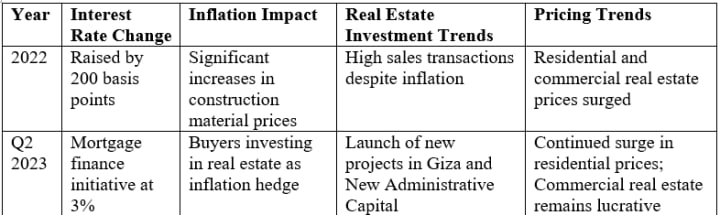
Consumer Behavior Trends and Their Influence on Real Estate Marketing
The changing consumer preferences and marketing strategy of the real estate industry as examined collectively by Emam, (2011); Hassanien Al-Sayed., (2021); Roy., (1992) explains the market dynamics. Findings point to a trend to sustainability and smart house technology as well as to suburban living preference. All these trends point to an environmental consciousness and a desire for convenience and connectivity in residences. Also, the preference for suburban life stems from a need for much more tranquil lifestyles accompanied by improved infrastructure in these places. Such shifting customer preferences demand flexible and dynamic real estate marketing focusing on sustainability, technology and location benefits. Harmonizing marketing techniques with such shifting preferences and utilizing data-driven techniques to anticipate and react to future trends will enable developers to meet customer demands and stay competitive on the market.
Population Growth & Housing Demand
Egypt's expanding population of 2.5 million people each year and the number of marriages every year are generating high need for housing. This demographic trend drives the residential real estate industry with consistent new construction and investment demand.
Digitalisation &PropTech Innovations
There is more digitalization and innovation in residential real estate market in line with Egypt's Vision 2025 strategy. The arrival of PropTech companies and innovation in artificial intelligence and internet of thing in new developments like Egypt's new Administrative Capital is changing the market. This modernization makes the Egyptian real estate sector more efficient and appealing (Everhart et al, 2006).
Price Stability despite Economic Challenges:
Potential worldwide economic downturns aside, Egyptian residential real estate market should stay steady in price. The growing population and government policies encouraging homeownership should keep the market going. Nevertheless other investments in infrastructure development including new cities are assisting this particular stability.
Consumer Preferences
Modern amenities and sustainable living are attracting more customers to properties. Developers are reacting by concentrating on cutting edge designs and eco friendly projects. Additionally, rising demand for office, industrial and retail space suggests growing interest in commercial property investing.
Regulatory Challenges and Their Impact on Marketing Strategies
The regulatory environment within the property market of Egypt impacts the marketing techniques of developers. The most crucial issues tend to be zoning laws, ownership rights and strict development regulations. Zoning laws are able to impact the kinds of buildings which can be constructed in a certain location and this can have an immediate effect on the plans as well as marketing strategies of developers (Sdino & Magoni., 2018). Protection of property rights laws and regulations, especially in heritage or protected areas, could restrict development as well as force marketing to some other types of projects or locations. Development rules and regulations, like building codes and approvals, may influence project costs and when / how houses are marketed. These regulatory challenges require developers being agile and strategic in marketing, generally focusing on compliance with laws, quality or legal advancements, along with long - term benefit of investments in regulated environments (Ling & Archer., 2018). This adaptive marketing is vital for property owners to navigate the Egyptian property industry within legal constraints.
Case Study Analysis
The first case study will be the 6th of Oct Development and Investment Company's East Town development in New Cairo. This project shows just how market dynamics are able to change rapidly as a result of regulatory or economic changes. Capital controls and economic uncertainty were noticed by the post-revolutionary Egypt making real estate an attractive purchase option. It created a bipolar market where price pressure increased at the top and demand decreased because supply wasn't adequate (Elkhouly and al., 2015). This has forced developers to adjust their marketing to various sections in society. Prices for East Town projects have doubled during the last two years, suggesting continued demand in certain sector segment despite wider fiscal woes. This case demonstrates how developers have to be agile in their industry strategies to target industries which still see excellent demand despite economic/regulatory pressures.
The second case study is a Egypt real estate agent Facebook ad. The agent utilized targeted social media campaigns to establish her clientele and property deals. This worked particularly well because Facebook advertisements can focus on particular demographics based on location, interests and behaviour. The campaign drove more website traffic, lead generation & property inquiries resulting in big sales increases and noted by Almatarneh (2013). This example demonstrates how digital marketing/social media marketing techniques could be utilized safely around regulatory hurdles. By targeting the right audience/creating engaging content real property developers and agents might bypass some of the limits of conventional marketing in controlled conditions.

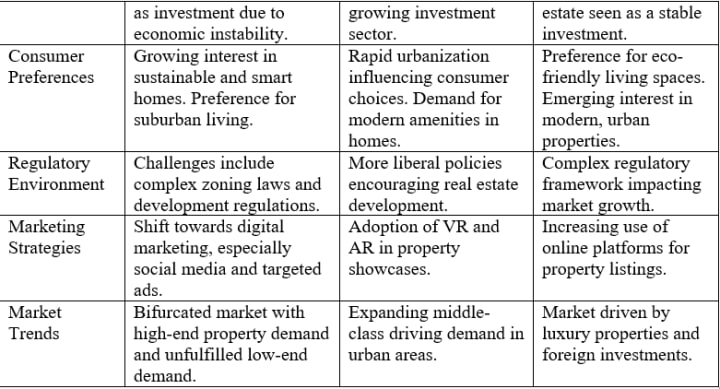
Table above demonstrates similarities and differences among Egypt, Brazil and India real estate markets. There are common patterns like the impact of economic conditions on real property investment but each market is also unique. For instance, Egypt has a growing interest in sustainability and also faces issues of complicated zoning laws whereas India has an urbanising trend and a push for modern amenities. Brazil's marketplace, however, is more concerned with environmentally friendly living areas but also has its very own regulatory hurdles. These insights create a broad overview of factors affecting real estate markets in these rising economies..
Proposes Strategic Choices
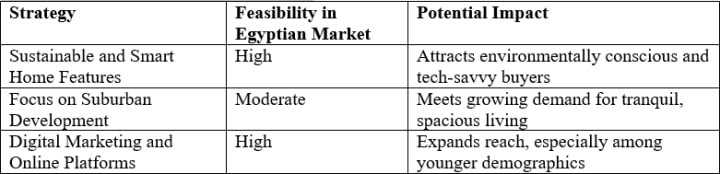
To analyse the Egyptian property industry compared to other emerging markets identifies some key strategies that real estate developer in Egypt can employ to counter marketing threats. These strategies are based upon the synthesis of data concerning economic conditions, consumer preferences, regulatory environments and marketing methods.
Accept Sustainable & Smart Home Features.
Developers should think about including smart home technologies and sustainability in their projects because of increasing consumer interest (Chia et al., 2016). This includes energy efficient household appliances, alternative sources of energy and intelligent home automation systems. Marketing these features could attract environmentally conscious buyers in addition to tech savvy clients.
Suburban Development Focus.
Because of increasingly more individuals wanting suburban living, developers could make the most of this trend and create projects in suburbs (Ullah et al., 2018). These developments ought to be about community, connection and space to nature for people that would like a living outside of the city hustle.
Digital Marketing & Online Platforms
Online marketing strategies including social media and targeted internet ad must be part of developers' advertising tactics. This enables precise targeting and a broader audience - particularly with younger groups of people.
Products Tailored to Market Segments
Developers should segment their markets. That includes luxury properties for high end markets and affordable housing for lower end demand. To understand each segment is critical to success.
Navigating Regulatory Environments
Complex regulatory environments call for developers to be informed about zoning laws & development regulations. Working with legal specialists along with other government departments can assist with this and facilitate project approvals and builds (Li, K., 2020).
Market Research & Consumer Insights -.
Continuous market research is vital to continue with changing economic conditions and consumer preferences. Developers must study consumer insights for product development and marketing purposes (Oluchi et al 2022).
Portfolio diversification.
A diversification of the investment portfolio might hedge the risk of market fluctuations. This implies balancing the portfolio with residential, industrial and commercial assets.
Marketing with Technology
To use technology like virtual reality and augmented reality in marketing can create immersive experiences for buyers, particularly when showcasing properties / communities (Ndung’u et al, 2020).
Community Engagement / CSR:
Engaging the community and investing in CSR initiatives can build goodwill and brand reputation which might result in market success.
Flexible Financing Options Available:
Flexible payment and financing options might make properties much more available to a lot more buyers - even in difficult economic times.
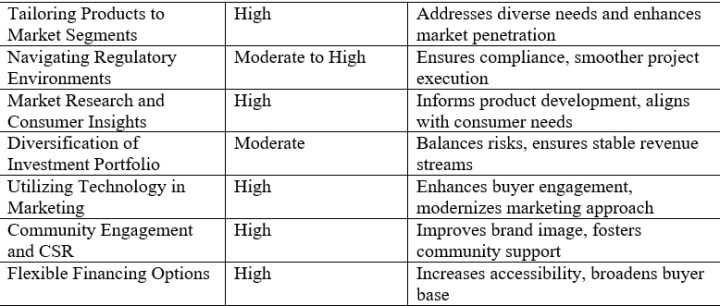
Feasibility and Impact Analysis Table:
Conclusion
Summary of Main Findings
The study on the Egyptian real estate market has developed a number of critical results to answer the research questions. These include monetary factors, customer behaviour patterns, legal challenges, and a comparison with other emerging markets. It was discovered that macroeconomic factors including interest rates, inflation and government actions determine the Egyptian property market. The sensitivity of the real estate industry to these financial turbulences supports the idea that economic conditions determine market dynamics. This sensitive response evidenced particularly how developers as well as consumers reacted to changes in the broader economic environment affecting investment options as well as property values.
A noticeable shift in consumer preferences is towards more sustainable/smart home solutions and towards suburban living. This particular change is consistent with the idea that shifting consumer preferences impact real estate. Developers are responding to this by including green solutions and intelligent home system within their designs and advertising them to environmentally conscious and tech savvy customers.
The study also highlighted the regulatory challenges including complicated zoning laws, property rights and development regulations which impact Egyptian real estate market. Such regulatory hurdles have required strategic adaptations in marketing & development methods supporting the hypothesis that regulatory environments shape markets.
Comparative analysis revealed differences and similarities between Egyptian and other emerging economies real estate markets. Similarities are the attention to economic conditions and to technologically advanced properties. Nevertheless there were differences in regulation settings and in the speed of market response following consumer preferences changes. This comparison offered a look at just how various elements influence real estate markets across contexts.
Contributions to Academic Literature and Practice
This study on Egyptian real estate market contribute to academic literature in addition to practical understanding, in emerging markets. From an academic perspective, the research plays a role in the body of understanding about precisely how macroeconomic factors shaped by Keynesian Economic impact real estate markets in emerging economy. Findings demonstrate how variables including interest rates, inflation and federal policies shape market behaviour and are empirically proof of the way the theoretical underpinning of Keynesian Economic work in practice. Also, the application of the Theory of Planned behaviour to real estate consumer Behavior. Analyzing how attitudes, social normative and perceived behaviour control influence consumers choices offers insights into consumer decision making in property investments.
Practical contributions are derived from this study regarding real estate development strategies and - marketing approaches. Identifying consumer trends to sustainability/smart technology provides developers a direction on property features that are in demand. This might help developers customize their projects for these newer preferences, while ensuring their offerings are relevant and appealing in a shifting market. And the exploration of digital advertising tools like targeted social media campaigns justify the importance of online channels for attracting potential investors and buyers. The research also informs policy suggestions. The research details the difficulties of regulatory conditions in Egypt and calls for policy changes to promote efficient and highly effective real estate developments. Zoning laws being simplified and development rules streamlined might help the real estate sector grow faster and more responsive to industry needs.
Implications
The research on the Egyptian real estate market provides actionable recommendations for real estate developers, policymakers, and other stakeholders, along with broader implications for practice in Egypt and similar emerging markets.
For Real Estate Developers
Developers must integrate sustainable and smart home technology in their projects in line with the increasing customer interest on environmental sustainability and technological breakthrough. This approach meets evolving consumer demands and positions developers as forward thinking and responsible. As a reaction to the trend towards suburban living developers are urged to concentrate on suburban development projects focusing on community, proximity to nature and big living areas. Additionally, advanced online marketing strategies including social media campaigns and virtual reality tours help in getting a broader audience. Developers also need to be flexible to industry changes / customer tastes - this requires ongoing market analysis or readiness to modify product offerings.
For Policymakers
The policymakers shape the real estate sector. Regulative reforms are required to make real estate development procedures easier and less cumbersome. Zoning laws which are simplified and bureaucratic red tape could help in project development and delivery. Also, policies encouraging sustainable and green building practices might encourage developers to utilize these practices more broadly. Policies that stimulate affordable housing development will also be required to satisfy the high demand in this particular market - essential for market stability.
Broader Implications
These findings have wider implications for Egypt real estate industry along with other emerging markets. The market should diversify to accommodate different population segments and should balance luxury and affordable housing projects for a sustainable growth. Infrastructure investment in suburbia and brand new developments might make these locations more desirable and stimulate property development further. Also, Egyptian stakeholders should keep up with global trends like the increasing role of technology into real estate transactions and property managing. This particular worldwide viewpoint is vital to maintain the marketplace competitive for both foreign and domestic investors.
Limitations and Suggestions for Future Studies
The study carried out on the Egyptian real estate markets has its limits however. The chief limitation is the usage of secondary data. This gave a broad overview of market and enabled comparative analysis along with other emergent markets but also meant that results were dependent upon the quality of existing reports and literature. This reliance might bring about biases in the original sources which might impair interpretive capability of market dynamics.
In addition, the comparative analysis was though enlightening, was constrained by data availability and specificity of each market to be compared. This particular limitation might restrict the depth and breadth of comparative insights drawn and possibly restrict their generalizability to other contexts or market. Looking forward, several areas of research interest exist. One such area might be a deeper exploration of existing consumer behaviour patterns in the real estate industry and just how these changes over time and in response as economic conditions shift. Future studies could also analyze just how long-term regulatory changes impact market dynamics, therefore offering evidence of policy success. Also, comparative studies with far more emerging markets will offer a far more nuance view on just how various economic, cultural and regulatory contexts shape the real estate markets. By addressing these areas further research can build on the present study and contribute to the field and also the understanding of real estate markets dynamics in emerging economies'. Such continued exploration is required for better tactics and policies adapted to changing market conditions and consumer tastes.
References
Ahmed, W.M., 2017. The impact of political regime changes on stock prices: the case of Egypt. International Journal of Emerging Markets, 12(3), pp.508-531.
Almatarneh, R.T., 2013. Choices and changes in the housing market and community preferences: Reasons for the emergence of gated communities in Egypt: A case study of the Greater Cairo Region, Egypt. Ain Shams Engineering Journal, 4(3), pp.563-583.
Al-Nahdi, T.S., Ghazzawi, O.H. and Bakar, A.H.A., 2015. Behavioral factors affecting real estate purchasing. International Journal of Business and Social Science, 6(8), pp.146-154.
Cerutti, E., Dagher, J. and Dell'Ariccia, G., 2017. Housing finance and real-estate booms: A cross-country perspective. Journal of Housing Economics, 38, pp.1-13.
Chia, J., Harun, A., Kassim, A.W.M., Martin, D. and Kepal, N., 2016. Understanding factors that influence house purchase intention among consumers in Kota Kinabalu: an application of buyer behavior model theory. Journal of Technology Management and Business, 3(2).
Elkhouly, S., Aldamati, M., Soliman, M., Alfakharany, M., Sobeeh, D.E.D. and Ebaied, A.I., 2015, July. Application of a Decision Tree Model to a Business Case from Egypt. In Competition Forum (Vol. 13, No. 2, p. 273). American Society for Competitiveness.
Emam, H., 2011. Real Estate Industry in Egypt: Segmentation, Targeting and Positioning Approach. Unpublished Master’s Thesis, The University of Manchester, Manchester Business School.
Everhart, S., Heybey, B. and Carleton, P., 2006. Egypt: overview of the housing sector. Housing Finance International, 20(4), p.9.
Hassanien Al-Sayed, S., 2021. Urban Structure Transformation between the Role of Urban Planning Methods and Real Estate Market Force–Case Study: the New Millennial Cities in Egypt. JES. Journal of Engineering Sciences, 49(6), pp.778-798.
Huy, D.T.N., Nhan, V.K., Bich, N.T.N., Hong, N.T.P., Chung, N.T. and Huy, P.Q., 2021. Impacts of internal and external macroeconomic factors on firm stock price in an expansion econometric model—a case in Vietnam real estate industry. Data Science for Financial Econometrics, pp.189-205.
Ibrahim, A.E.A. and Ezat, A.N., 2017. Sticky cost behavior: evidence from Egypt. Journal of Accounting in Emerging Economies, 7(1), pp.16-34.
Khan, P.A.M., Azmi, A., Juhari, N.H., Khair, N., Daud, S.Z. and Rahman, T., 2017. Housing preference for first time home buyer in Malaysia. International Journal of Real Estate Studies, 11(2), pp.1-6.
Li, K., 2020, August. Research on the Marketing Strategy of Real Estate in Chongqing Under the New Situation. In 2020 International Conference on Social Science, Economics and Education Research (SSEER 2020) (pp. 229-232). Atlantis Press.
Ling, D.C. and Archer, W.R., 2018. Real estate principles: A value approach. McGraw-Hill.
Marzouk, M. and Aboushady, A., 2018. Modeling risks in real estate development projects: a case for Egypt. International Journal of Strategic Property Management, 22(6), pp.447-456.
Meselhy, M.S., 2019. Monitoring Real Estate Bubble in Egypt: New Cairo Case Study. New Cities and Community Extensions in Egypt and the Middle East: Visions and Challenges, pp.101-112.
Mokhtar, N.S., 2017. Between accumulation and (in) security: The real estate industry and the housing crisis in Egypt.
Mugambi, E.N. and Karugu, W.N., 2017. Effect of entrepreneurial marketing on performance of real estate enterprises: A case of Optiven Limited in Nairobi, Kenya. International Academic Journal of Innovation, Leadership and Entrepreneurship, 2(1), pp.26-45.
Ndung’u, E.N., Kinyanjui, W.N. and Abayo, R., 2020. Effects of type and rate of usage of social network marketing on sales performance of the real estate in Nairobi. International Academic Journal of Human Resource and Business Administration, 3(8), pp.143-158.
Oluchi, C., Chisom, N.C. and Chinemenma, O.A., 2022. Assessment of the Influence of Online Marketing on Real Estate Properties in Awka, Anambra State, Nigeria. International Journal of Engineering and Science, 12(1), pp.57-69.
Roy, D.A., 1992. The hidden economy in Egypt. Middle Eastern Studies, 28(4), pp.689-711.
Salzman, D. and Zwinkels, R.C., 2017. Behavioral real estate. Journal of Real Estate Literature, 25(1), pp.77-106.
Salzman, D. and Zwinkels, R.C., 2017. Behavioral real estate. Journal of Real Estate Literature, 25(1), pp.77-106.
Sdino, L. and Magoni, S., 2018. The sharing economy and real estate market: The phenomenon of shared houses. In Smart and Sustainable Planning for Cities and Regions: Results of SSPCR 2017 2 (pp. 241-251). Springer International Publishing.
Ullah, F., Sepasgozar, S.M. and Wang, C., 2018. A systematic review of smart real estate technology: Drivers of, and barriers to, the use of digital disruptive technologies and online platforms. Sustainability, 10(9), p.3142.
Important Notes:
This research paper focuses on the Egyptian real estate market challenges and opportunities, in addition to a framework for understanding such a dynamic segment within emerging countries.
Economics is a complex field of study that delves into allocating wealth and resources. While students flock to make economics their major subject, they often underestimate the challenging nature of writing an economics assignment. That is when they think about questions like can someone do my economics assignment for me. The answer is yes. Assignment writing services UK are here to lighten your workload.
An economics dissertation is not your normal assessment; it is given to students to check their skills in researching, writing, and presenting their views on a particular economics topic. Writing an economics dissertation holds so much importance; you cannot take it lightly and prepare an unfinished or rough economics dissertation. This is the reason why many students turn towards an economics dissertation writing service UK.
About the Creator
Keep reading
More stories from Lucy Rowell and writers in Education and other communities.
Cardiovascular Diseases, Risk Factors, Investigations and Treatments
PART 1 Introduction The British Association for Cardiovascular Prevention & rehabilitation (BACPR) has created 6 gold standards and pillars for cardiac Rehabilitation. These are meant to develop a framework for the delivery of cardiac rehabilitation. To evaluate the coverage of these standards we can provide related Cochrane reviews, systematic Reviews of main research in human healthcare and health policy, which are the gold standard in evidence based health care. Each standard is analyzed below using proof from Cochrane Reviews along with other journals.
By Lucy Rowell7 months ago in Education
What Market Volatility Means for Your Investment Plan and Financial Future
Market volatility is a common but often misunderstood feature of investing. It refers to the unpredictable and sometimes dramatic changes in asset prices over short periods. These fluctuations are driven by factors such as economic data, corporate earnings, geopolitical events, and investor sentiment. For many, volatility can cause anxiety, but with the right knowledge and strategy, it becomes something to navigate, not fear.
By Winston Fengabout 2 hours ago in Education
Autonomy Is The Real Privilege
Good morning, freedom-seekers! Today we’re gonna be looking at autonomy. A strange word, I know; one many would probably look at blankly and run away from on sight. We’re gonna figure out what it actually means, consider how it’s achieved, and decipher just how deeply most of us are tangled up in dependence without realising it.
By That ‘Freedom’ Guy7 days ago in Humans




Comments
There are no comments for this story
Be the first to respond and start the conversation.