
Offline Skills That Still Matter in a Digital World
Why the Most Timeless Abilities Still Give You an Edge in a Screen-First Society

Introduction:
In a world where screens dominate and algorithms influence nearly every decision, it's easy to assume that traditional skills have become outdated. From cloud storage to chatbots, the digital era has redefined how we work, learn, and connect. But despite all this progress, certain offline skills remain not only relevant—they’re essential.
While digital literacy is crucial today, offline skills are the quiet foundation that supports meaningful relationships, personal growth, and real-world resilience. In fact, as automation rises and attention spans shrink, it’s the human, offline abilities that stand out the most.
Let’s explore the offline skills that continue to thrive in our digital-first society and why they matter more than ever.
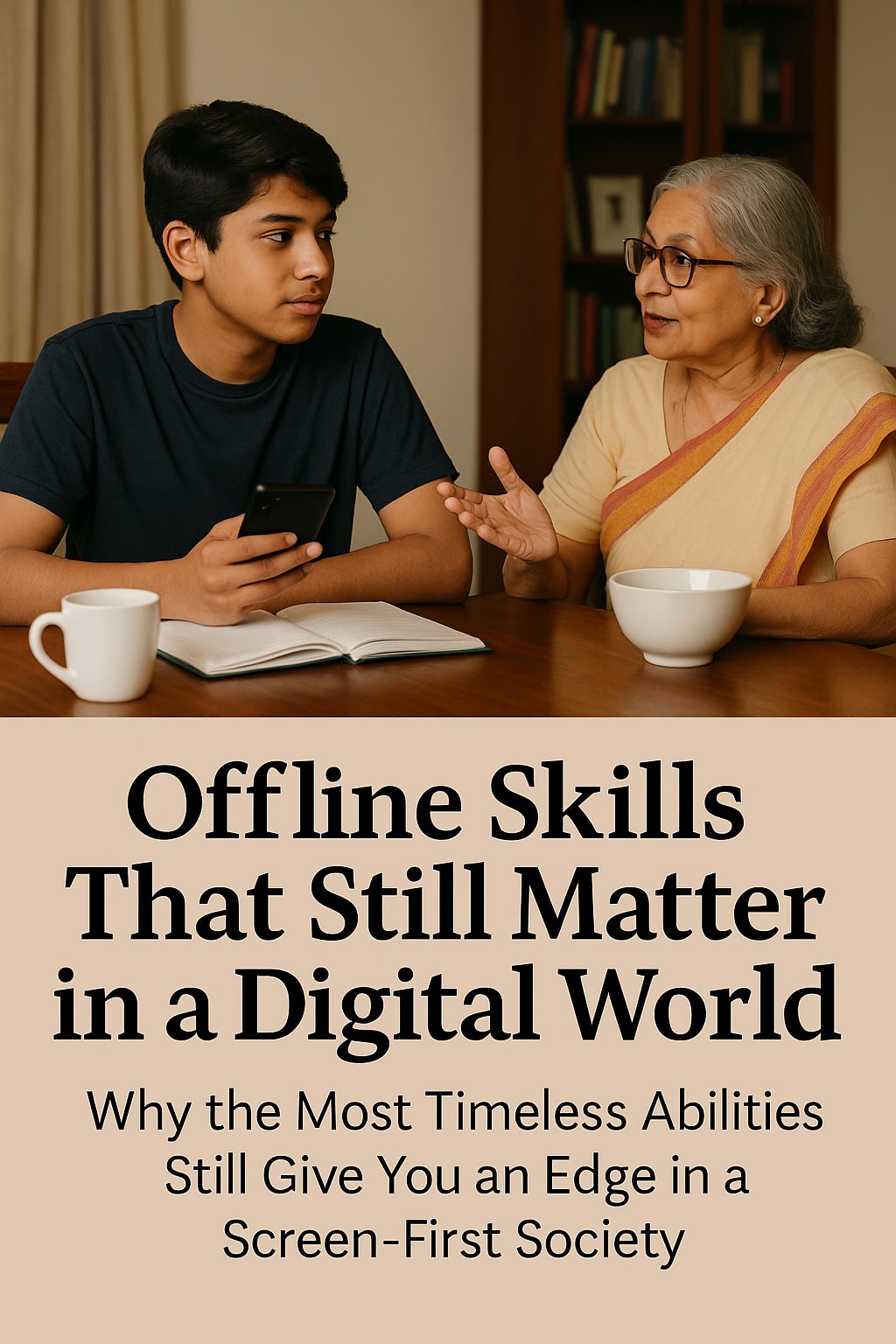
One evening, during a family dinner, 15-year-old Arif kept glancing at his phone, barely responding to his grandmother’s stories. Frustrated, his father gently said, “If you don’t learn how to listen with your eyes, you’ll miss what really matters in life.”
In a classroom across the city, Fatema, a university student, was the only one handwriting notes while everyone else typed. She wasn’t faster—but weeks later, during exams, she recalled more than any of her peers.
And in a job interview, Tanvir, who once struggled to speak in public, made it to the final round—not because of his GPA, but because he communicated clearly and confidently, face-to-face.
These moments aren’t rare. They remind us that some skills can’t be replaced by apps, shortcuts, or screens. In fact, as the world races toward digital everything, offline skills are quietly becoming our most valuable assets.
1. Deep Listening and Face-to-Face Communication
Messaging apps and social media have made communication faster, but not necessarily better. Online conversations often lack tone, empathy, and nuance. This is where deep, in-person listening shines.
Research from the Harvard Business Review shows that employees who felt “heard” by managers were 4.6 times more likely to feel empowered to perform their best work. Listening isn’t just polite—it’s a leadership skill. The ability to be present, read body language, and engage fully in face-to-face conversation builds trust in ways no emoji ever could.
2. Handwriting and Personal Note-Taking
Digital note-taking tools like Notion, Evernote, and Google Docs are powerful. But science suggests handwriting may still have a cognitive edge. According to a 2021 study by the University of Tokyo, students who took notes by hand retained more information and understood concepts better than those using keyboards.
Writing activates neural pathways linked to memory and understanding. For creators, students, or professionals brainstorming ideas, pen and paper still offer unmatched focus and creativity.
3. Critical Thinking Without Search Engines
Search engines offer answers instantly—but that convenience often short-circuits independent thought. Offline critical thinking—the ability to analyze, evaluate, and solve problems without instantly Googling—develops deeper intellectual independence.
Psychologist Daniel Kahneman’s work on cognitive bias shows how overreliance on digital shortcuts can reinforce shallow thinking. Offline problem-solving sharpens our ability to deal with ambiguity and complexity, traits that algorithms cannot replicate.
4. Manual Skills: From Cooking to Fixing Things
Hands-on skills like cooking, sewing, woodworking, or basic home repair may seem outdated. But these practices offer more than practicality—they build patience, self-reliance, and even mental health.
A study published in the Journal of Positive Psychology found that people who engaged in creative manual activities like baking or gardening reported higher levels of daily happiness and purpose. These tactile, physical experiences ground us in the present moment, offering a break from the constant stimuli of screens.
5. Reading Physical Books for Deeper Comprehension
E-books and audiobooks are accessible and efficient—but reading physical books still leads in retention and comprehension. A 2019 study by the American Psychological Association found that students who read print texts had a better grasp of detail and structure compared to digital readers.
The slower pace of physical reading encourages reflection. It allows the brain to build connections and store knowledge more deeply—something especially important in an age of endless scrolling.
6. Empathy and Emotional Intelligence
Digital communication often removes emotional nuance. Offline social interactions help people build emotional intelligence—the ability to recognize, interpret, and respond to emotions in real time.
Dr. Sherry Turkle, author of Reclaiming Conversation, argues that the rise of digital communication has led to a decline in empathy. But it’s through in-person interaction—seeing someone’s eyes, feeling their tone—that we develop genuine empathy and emotional resilience. These are the traits that form strong leaders, partners, and communities.
Why Offline Skills Are Becoming Competitive Advantages
Paradoxically, the more digital our world becomes, the more valuable these analog skills are. In the workplace, emotional intelligence, verbal communication, and manual problem-solving are increasingly seen as "soft skills" that deliver hard results.
According to the World Economic Forum, top future job skills include active listening, creativity, critical thinking, and people management—all of which are grounded in offline experiences.
Moreover, offline skills protect us from burnout. They reconnect us with nature, others, and ourselves—helping to create balance in a hyperconnected world.
Conclusion: Don't Abandon the Analog
The message isn’t to reject technology—it’s to remember the power of what exists beyond it. Offline skills are not relics of the past. They are timeless tools for personal growth, career success, and human connection.
In an age obsessed with automation, those who cultivate presence, patience, and purpose—skills you can't download—will quietly lead the way.
So, write a letter. Listen without checking your phone. Fix something with your hands. Read something that doesn't scroll. In doing so, you’re not stepping back. You’re stepping deeper into a world that still values what it means to be fully human.
Read same type of storys: Tiny Habits, Massive Impact: The Quiet Path to Real Change
About the Creator
Natik Ahsan
Welcome to a world of wonder, curiosity, and nature's quiet magic.
Here, I explore stories that open minds, spark thought, and invite gentle conversation.
Thank you for being here—your presence means everything.
Keep reading
More stories from Natik Ahsan and writers in Education and other communities.
Adding Tech to Ed
Technology is reshaping education in ways that were unimaginable just a generation ago. While access to quality learning was once limited by geography, income, language, or physical ability, digital innovation is steadily removing many of those barriers. Today, technology is not simply enhancing classrooms—it is expanding who education is for, when it happens, and how it is experienced. By increasing flexibility, personalization, and inclusion, technology is making education more accessible to learners of all ages and backgrounds.
By Dennis Muizers Lovejoy3 days ago in Education
How smart are crows?
In one of Aesop’s 2,500-year-old fables, a crow is searching for water. It spies a pitcher and discovers liquid inside— but it's beyond reach. Soon, the crow begins dropping pebbles into the pitcher. One by one, they displace the water, and the crow quenches its thirst. Interestingly, this fable turns out to be pretty accurate. In a 2014 experiment, scientists placed a food reward in a tube partially filled with water and watched as crow after crow dropped stone after stone in until the food was in beak-snatching distance.
By Munesh Yadav2 days ago in Education



Comments
There are no comments for this story
Be the first to respond and start the conversation.