
Neuro-symbolic AI: Bridging Human Logic and Machine Learning
Revolutionizing Artificial Intelligence with Hybrid Intelligence Systems

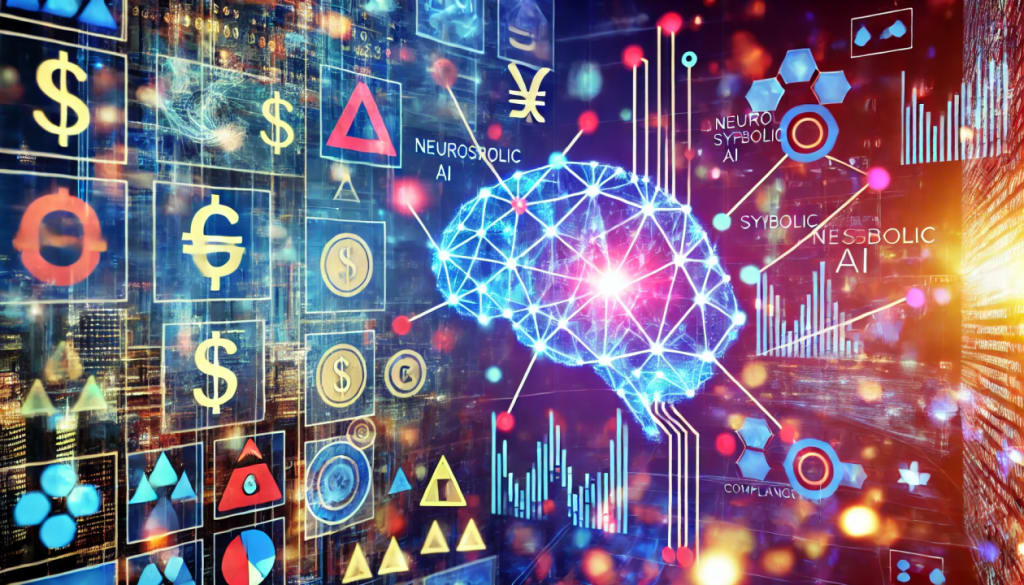
Neuro-symbolic AI is an emerging field combining the strengths of neural networks and symbolic reasoning to build more robust, interpretable, and intelligent AI systems. This hybrid approach mimics how humans use both experience and logic to make decisions.
Introduction
Artificial Intelligence (AI) has traditionally evolved along two distinct paths:
- Neural Networks – which learn patterns from data.
- Symbolic AI – which uses rules and logic for reasoning.
Both approaches have achieved success in different domains, but also faced limitations. Neural networks are often black-box models—powerful but hard to interpret. Symbolic AI, while transparent and explainable, struggles with flexibility and learning from raw data.
Enter Neuro-symbolic AI—a powerful blend that aims to combine the best of both worlds. This paradigm is gaining attention for its potential to create smarter, more adaptable, and human-like AI.
What is Neuro-symbolic AI?
Neuro-symbolic AI refers to systems that integrate:
- Neural Networks: Sub-symbolic systems that learn from data using statistical methods.
- Symbolic Reasoning: Rule-based logical reasoning systems that manipulate symbols and follow explicit instructions.
The goal is to allow machines to both learn from experience (like deep learning) and apply logical reasoning (like symbolic AI), resulting in a more powerful, generalizable form of intelligence.
Why Combine Neural and Symbolic Approaches?
Each approach has strengths and weaknesses:
Feature Neural Networks Symbolic AI
Strengths Pattern recognition, learning from raw data, adaptability Logic, transparency, explainability, reasoning
Weaknesses Black-box behavior, lack of reasoning, poor data efficiency Inflexible, brittle to new/unseen data, manual rule engineering
By combining both, Neuro-symbolic AI addresses key issues in today’s AI:
- Data Efficiency: Learn better from small datasets.
- Explainability: Provide transparent reasoning.
- Commonsense Reasoning: Understand rules, relationships, and logic.
- Generalization: Better performance across varied tasks.
How Neuro-symbolic AI Works
A typical neuro-symbolic system involves the following architecture:
- Perception Module (Neural) – Uses deep learning to interpret sensory inputs (e.g., images, text, audio).
- Symbol Extraction – Converts perceptual output into symbolic representations.
- Symbolic Reasoning Module – Applies logical rules or constraints to reason about the symbols.
- Decision Making – Combines both learned patterns and symbolic logic to produce final output.
Real-World Example: Visual Question Answering (VQA)
In VQA tasks, a system is asked a question about an image.
Example:
Image: A picture showing a red cube on top of a blue sphere.
Question: What is on top of the blue sphere?
Traditional Deep Learning may recognize objects but struggle with relationships.
- Neuro-symbolic Approach:
- Neural network recognizes objects and spatial features.
Symbolic module interprets spatial relationships and answers logically: “red cube.”
This approach mirrors human reasoning—seeing, interpreting, and logically deducing answers.
Key Components of Neuro-symbolic Systems
Knowledge Representation
- Uses graphs, ontologies, or first-order logic to represent information.
- Helps AI to understand structured facts (e.g., “All birds can fly, except penguins”).
Neural Perception Models
- CNNs for images, RNNs/Transformers for text/audio.
- Extract features for further reasoning.
Symbolic Logic Engines
- Rule-based systems like Prolog or logic programming languages.
- Apply deductive reasoning.
Learning Mechanisms
- Integrates reinforcement learning or supervised learning for feedback and adaptation.
Use Cases of Neuro-symbolic AI
1. Healthcare Diagnostics
Combining deep learning (for reading scans) and symbolic reasoning (for medical guidelines) can result in more accurate diagnoses.
2. Robotics
Robots using neuro-symbolic systems can understand environments (via sensors) and make decisions (via logic), allowing for safer navigation in unpredictable conditions.
3. Fraud Detection
AI systems can learn patterns of fraudulent behavior and apply rules for anomaly detection, improving reliability in financial systems.
4. Education and Tutoring Systems
AI tutors can both read handwritten equations (neural) and verify logical correctness (symbolic), offering personalized feedback.
Infographic: Symbolic vs Neural vs Neuro-symbolic AI
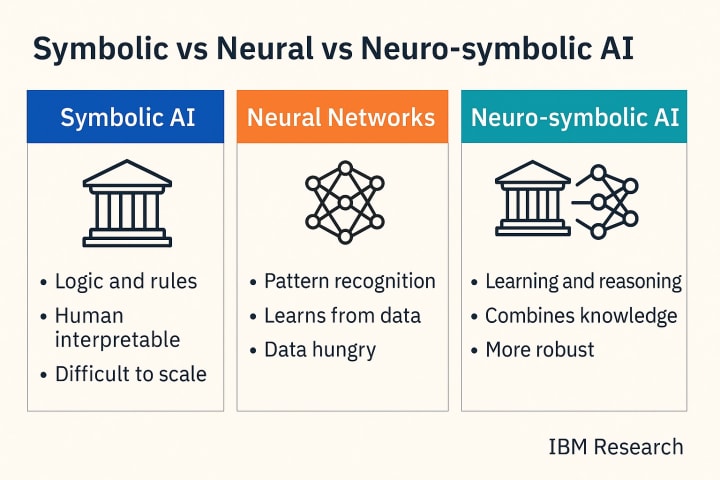
Advantages of Neuro-symbolic AI
- Interpretability: Easier to explain outcomes.
- Robustness: Better error handling through rules.
- Generalization: Applies knowledge to unseen scenarios.
- Commonsense: Enables understanding of “if-then” logic and exceptions.
- Efficiency: Reduces data-hungriness by leveraging prior knowledge.
Challenges in Neuro-symbolic AI
Challenge Description
Integration Complexity Combining neural networks and logic modules is non-trivial.
Symbol Grounding Mapping continuous input to discrete symbols accurately.
Scalability Symbolic reasoning may not scale easily in large systems.
Data Annotation Requires careful training data design to support both models.
Research & Tools in Neuro-symbolic AI
- Neuro-Symbolic Concept Learner (NSCL) – Developed by MIT and IBM for visual reasoning.
- Logic Tensor Networks (LTN) – Framework combining logic with tensors for reasoning over data.
- DeepProbLog – Merges Prolog logic with probabilistic learning.
Comparison Chart
Feature Neural Networks Symbolic AI Neuro-symbolic AI
Learning From Data From Rules Both
Explainability Low High Medium–High
Adaptability High Low Medium–High
Data Needs High Low Medium
Commonsense Reasoning Poor Strong Strong
Error Handling Black-box Rule-based Hybrid
The Future of Neuro-symbolic AI
The next generation of AI will not rely solely on big data. It will combine structured reasoning, world knowledge, and data-driven perception to build systems that understand, explain, and adapt.
Researchers are now exploring:
- Large Language Models + Symbolic Logic
- Self-supervised neuro-symbolic architectures
- Hybrid hardware systems
Neuro-symbolic AI could pave the way for AGI (Artificial General Intelligence) by creating systems that think more like humans.
Conclusion
Neuro-symbolic AI represents an important shift in how machines can think and learn. By combining perception (neural) and reasoning (symbolic), it creates a new breed of intelligent systems—more capable, explainable, and human-like.
It addresses the major pitfalls of current AI: lack of understanding, poor generalization, and opaque decision-making. While challenges remain, the progress made so far promises a more powerful and ethical AI future.
Stay Ahead in AI Innovation
If you found this article insightful, share it with your tech-savvy peers and AI enthusiasts.
📬 Subscribe to our Newsletter for more deep-dive articles on cutting-edge technologies.
💬 Comment below with your thoughts or questions about Neuro-symbolic AI.
🔄 Share this post to support quality tech education at TechThrilled.com
This blog was originally published on https://techthrilled.com/
About the Creator
Tech Thrilled
TechThrilled is your go-to source for deeply explained, easy-to-understand articles on cutting-edge technology. From AI tools and blockchain to cybersecurity and Web3, we break down complex topics into clear insights, complete
Keep reading
More stories from Tech Thrilled and writers in Education and other communities.
LTC Blockchain: A Complete Guide to Litecoin’s Technology and Future
In this article, we’ll explore everything you need to know about the LTC blockchain: how it works, what makes it different from Bitcoin, the benefits it offers, and the challenges it faces. We’ll also look at real-world examples of its use, future developments, and why Litecoin still matters in a world now filled with thousands of cryptocurrencies.
By Tech Thrilled5 months ago in Education
The One Lighting Move That Instantly Makes Your Photos Look Better
Photography advice often focuses on complex settings, advanced editing, or buying better equipment. While those things can help, they often distract from something far more powerful and immediate. One simple lighting habit can dramatically improve almost every photo you take, whether you’re shooting with a phone or a professional camera.
By Kelln Small4 days ago in Education
Managing Anxiety During Exams: A Student’s Guide
Exams are one of the most common sources of stress for students at every level. Even the most prepared individuals often feel nervous before or during a test. Exam anxiety is natural — it’s the body’s way of preparing for a challenge — but excessive stress can interfere with focus, memory recall, and overall performance. Understanding the causes of anxiety and learning effective coping strategies can make a significant difference. This guide provides practical, evidence-based techniques to manage stress before, during, and after exams.
By Games Mode On5 days ago in Education
Affection and Healing for Yourself
During the night of the last quarter moon, I gathered my ritual supplies. I carefully handled the chunk of black tourmaline that would protect me from your overall negative and narcissistic energy. I carefully walked the house with my stick of selenite in hand, asking the universe to cleanse our working space.
By Alisha Wilkins ✒️🦋🖋️4 days ago in Fiction




Comments
There are no comments for this story
Be the first to respond and start the conversation.