
Mastering X-Bar Theory in Grammar in 10 Minutes
"A Quick and Clear Guide to Understanding Sentence Structure Using X-Bar Theory"

Grammar can often feel like a maze of confusing rules, especially when we dive into syntax — the study of sentence structure. One of the foundational tools in modern linguistics is X-Bar Theory, a framework that helps explain how words and phrases combine to form sentences. While it might sound intimidating, understanding X-Bar Theory can become straightforward if approached step by step.
What Is X-Bar Theory?
X-Bar Theory, developed in the 1970s, is a way to analyze sentence structure hierarchically. Instead of seeing sentences as flat strings of words, X-Bar Theory breaks them into layers of phrases, showing how smaller units (words) combine to form larger units (phrases and clauses). The “X” represents any syntactic category (like N for noun, V for verb, A for adjective), and the “bar” indicates levels within the phrase.
In essence, the theory gives us a blueprint for understanding how phrases are built, making it easier to parse complex sentences.
The Basic Structure
In X-Bar Theory, each phrase has three levels:
X⁰ (Head): The core word of the phrase.
Example: In a Noun Phrase (NP) like “the cat,” the head is cat.
X′ (Intermediate level): Combines the head with complements (words that complete its meaning).
Example: In “cat on the mat,” on the mat is the complement modifying the head.
XP (Phrase level): The full phrase, including specifiers and the head with complements.
Example: “The black cat on the mat” is the complete NP (specifier + head + complement).
This hierarchical structure allows linguists and students to visualize how sentences are constructed from smaller units, which is especially useful in syntax analysis.
How X-Bar Theory Simplifies Grammar
X-Bar Theory makes complex sentences easier to understand because it:
Shows the relationship between words and phrases: You can see which words act as heads, which as modifiers, and how complements attach.
Predicts grammatical patterns: Once you understand the structure, you can determine what combinations are allowed in a language.
Supports universal grammar: X-Bar Theory is a tool that works across languages, showing that deep structures in syntax follow similar patterns.
Applying X-Bar Theory in 10 Minutes
Here’s a quick step-by-step approach to analyze a sentence using X-Bar Theory:
Identify the head of the phrase.
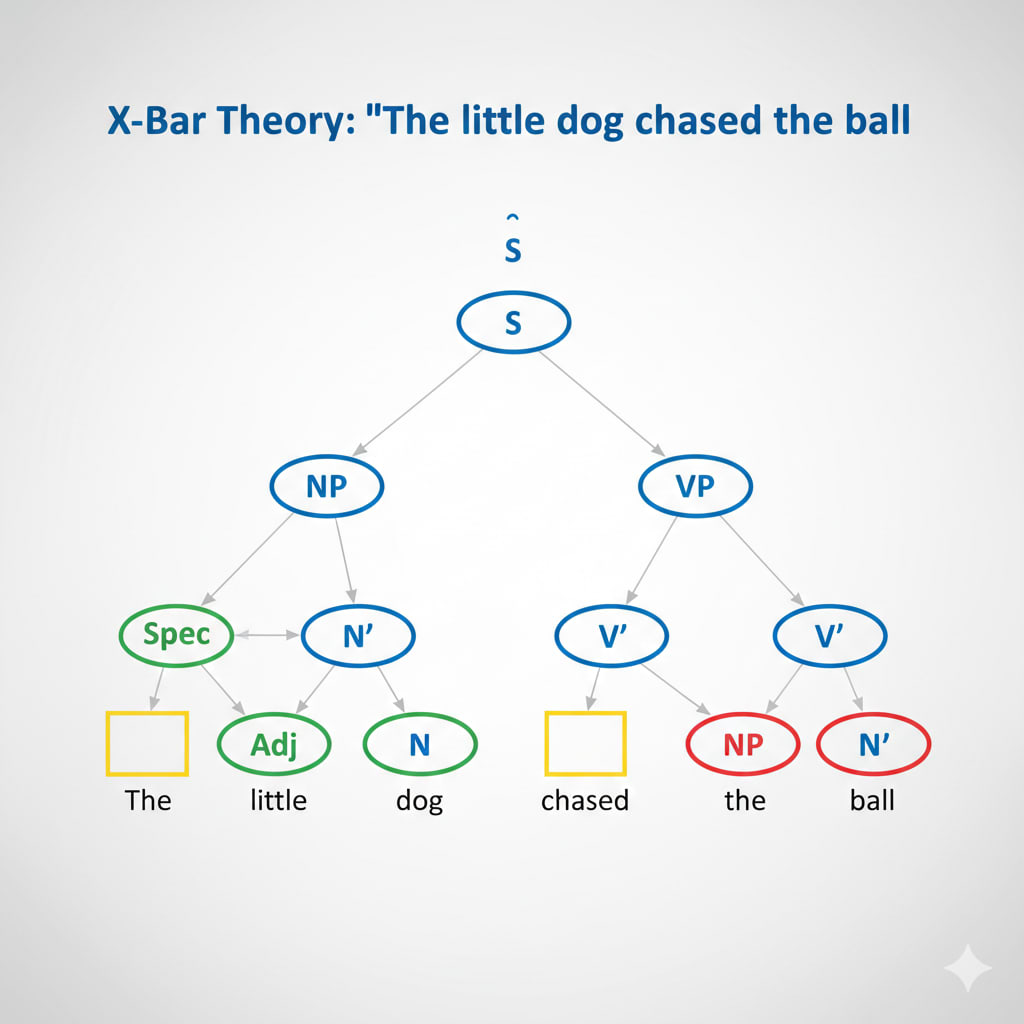
Sentence: “The little dog chased the ball.”
NP1: “The little dog” → Head = dog
NP2: “the ball” → Head = ball
VP: “chased the ball” → Head = chased
Find complements of the head.
VP complement: “the ball” completes the verb chased
NP modifiers: “the little” modifies dog
Add specifiers (optional words that add detail).
NP1 specifier: “The”
NP2 specifier: “the”
Draw the hierarchical structure.
[S
[NP [Spec The] [N' [Adj little] [N dog]]]
[VP [V' [V chased] [NP [Spec the] [N' ball]]]]]
This tree diagram shows exactly how the sentence components relate to each other.
Tips for Fast Mastery
Start with simple sentences: Practice with “The dog runs” before moving to compound sentences.
Use tree diagrams: Visual representation helps internalize the hierarchy of phrases.
Focus on heads first: Once you identify the head, adding modifiers, complements, and specifiers becomes much easier.
Practice across categories: Analyze Noun Phrases (NP), Verb Phrases (VP), and Prepositional Phrases (PP) to see patterns emerge.
Why It Matters
Even if you never become a linguist, mastering X-Bar Theory:
Improves grammar intuition for writing and editing.
Helps language learners understand sentence structure in a more scientific way.
Supports academic work in linguistics, cognitive science, or language education.
With just 10 minutes of focused practice, you can start parsing sentences like a linguist and gain confidence in analyzing complex syntax.
Conclusion
X-Bar Theory is more than a linguistic abstraction — it’s a practical framework that reveals the hidden structure of language. By breaking sentences into heads, phrases, and specifiers, you can see how words interact to create meaning. A little practice, some tree diagrams, and attention to structure are all you need to start mastering X-Bar Theory in 10 minutes.
About the Creator
Keep reading
More stories from Games Mode On and writers in Education and other communities.
How Neuroscience Is Changing the Way We Learn
In recent decades, advances in neuroscience have reshaped our understanding of human learning. Rather than viewing learning as merely memorizing facts, researchers now see it as a biological process that physically and functionally changes the brain. This shift in perspective — from teaching content to understanding how the brain learns — is transforming educational theory, classroom practice, and lifelong learning strategies across the globe.
By Games Mode Ona day ago in Education
Taher Saifuddin: Transforming Toronto’s Classrooms with Inclusive and Future-Focused Education
In the heart of Canada’s most diverse city, Toronto educator Taher Saifuddin is quietly leading a transformation in the way learning is delivered, measured, and experienced. With over two decades of experience, Taher is recognized for his dynamic role in teaching, academic leadership, and digital innovation across Toronto’s private and independent schools.
By Dena Falken Esq7 days ago in Education
What People Get Wrong About Consulting
Many people talk about consulting, but few understand what it truly involves. Movies, social media, and word of mouth often shape a narrow view. This creates confusion for students, business owners, and even new consultants. The topic of common misconceptions about consulting matters because these beliefs affect career choices and business decisions. When ideas are wrong, expectations break down fast.
By Nicole Metz6 days ago in Education
Silver Screen Magic with Mae West
American actress and singer Mae West became a popular film actress during the Great Depression. She started entertaining in vaudeville, then performed on Broadway, and finally went to Hollywood. She signed up with Paramount Pictures and made her debut in the 1932 film “Night After Night.” She also starred in musicals, comedies, and crime dramas. The American Film Institute named her one of the best classic Hollywood actresses.
By Rasma Raisters6 days ago in Geeks


Comments
There are no comments for this story
Be the first to respond and start the conversation.