
Many more unspoken of Shipping disasters happened apart from the Titanic
Here the details ..............
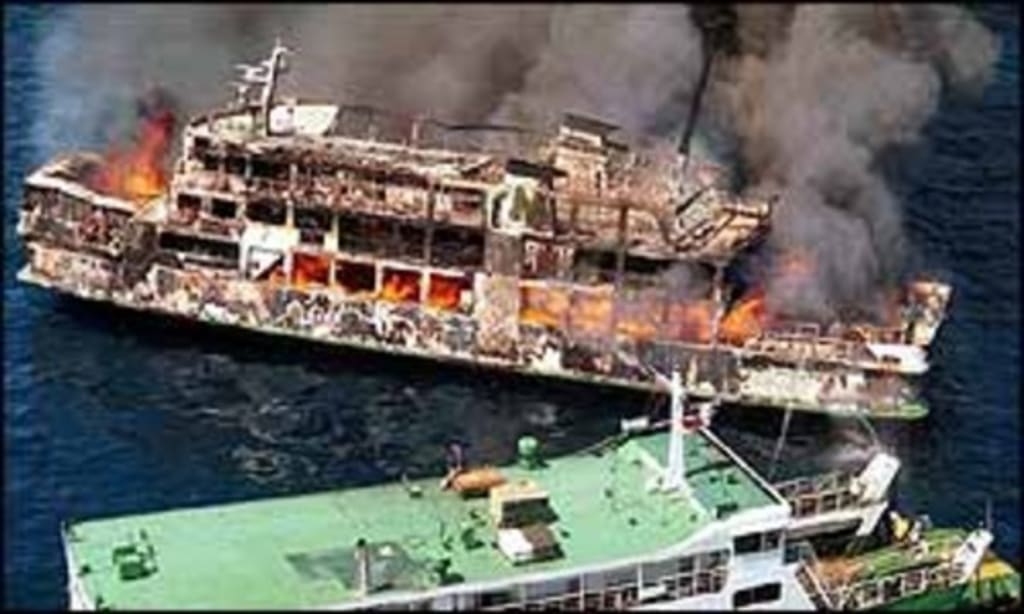
However, the Titanic disaster is not the only significant shipwreck, and sadly, there have been cases much worse than the tragedy of the Titanic. They claimed it was the most technologically advanced, they claimed it was unsinkable, and when it sank, they made a movie about it.
The first of them happened on April 27, 1865. Every day, the Sultana Steamboat transported people and goods between St. Louis and New Orleans.
It could hold about 350 passengers, but on that unfortunate day, more than 2000 people boarded the boat, which had three decks and was 260 feet long and 70 feet wide, almost twice the size of a basketball court. On April 23, the boat was making a routine trip out of New Orleans when it broke down; There was a problem with the boiler, so it docked in Vicksburg for repairs.
James Cass Mason, the ship's captain, learned of a great opportunity to make a lot of money at the port; all he had to do was transport a sizable number of former prisoners to the north. The captain agreed to do it, but the boiler needed a lot of time to be repaired. Mason was concerned that his rivals would take the job, so he decided to sail despite the malfunction the ship had; he patched up the holes in the boiler rather than having it properly repaired and invited the ex-prisoners on board.
The Sultana embarked on a voyage and sailed up the river for two days at the same time one of the worst Mississippi floods in recorded history began. As a result, there were strong chances for a shipwreck due to the broken boiler, the excess number of passengers, the lack of lifeboats, and the poor river conditions. In addition, the captain refused to send the ex-prisoners to the hold, so they were all with regular passengers.
The Sultana set out on a journey and sailed up the river for two days. At this time, one of the worst floods in the history of the Mississippi River began. The river overflowed its banks, and as a result, the water level rose several feet. All of the trees along the shore disappeared, leaving only their tops above the water. The Sultana sailed against this strong current, which made the boiler work too hard. On the evening of April 26, the Sultana arrived in Memphis, Tennessee.
200 people and 120 tons of sugar were added, and the aircraft became tremendously heavy.
Around midnight, the ship continued its perilous course. At one in the morning, the captain sailed to a barge to load a shipment of coal. At two in the morning, the ship departed the barge when the broken boiler, unable to support the load, suddenly exploded. The Sultana was only seven miles north of Memphis at the time. Few people survived that day because passengers were trying to flee the fire by jumping into a chilly river with a strong current.
According to a number of accounts, the Sultana disaster is regarded as the most catastrophic shipwreck in American history; the precise number of individuals who perished is still unclear.
There were 961 to 1800 people on board.
Don't be shocked that so few people are familiar with this tale. The Titanic disaster had many more survivors, and everyone was aware of it, but the Sultana sank during a single high-profile event. 12 days before the country's loss at sea People in Abraham Lincoln hadn't yet recovered from this news, therefore, they weren't very interested in the Sultana disaster.
Many tragedies occurred recently by historical standards, but one of them happened in 2002. The Senegalese ferry called the Fairy Le Joola carried people who traded mango and palm oil twice a week, primarily along the coast of Dakar. It made daily voyages and never encountered serious problems thanks to modern rescue tools and reliable repair services, but one day the ship's crew discovered a problem and sent the boat to port for nearly a year.
After neglecting maintenance, the ferry embarked on its final trip on September 26, 2002, sailing between Southern Senegal and Dakar. At 11 p.m., it sailed toward Gambia, where a severe storm had just started. The wind had raised high waves, but the large passenger ship wasn't in danger as long as the number of passengers didn't exceed the established norm.
Le Joola was only built for sailing in coastal waters, but that day it sailed far from the shore, big waves started rocking the boat, and at some point it just turned upside down. The ship's deck went underwater, and its lower parts stuck above the water. The Le Joola was supposed to carry about 500 passengers.
The Le Joola was only built for coastal waters, but that day it sailed far from the shore, big waves started rocking the boat, and at some point it just turned upside down. The ship's deck went underwater, and its lower parts stuck above the surface like an iceberg. All the passengers sitting in cabins fell on the ceiling and lost their lives. That day, poor repairs and a strong storm caused serious problems for the ship.
There were no holes or other damage in the ship's hall, and water filled the lower decks for a considerable amount of time before the boat simply turned upside down, its deck submerged, and its lower parts stuck above the surface like an iceberg. The boat stood in this twisted position for a number of hours before it started to sink when the water level dropped. The passengers had to wait over four days to be rescued, even though the ocean was warm, and only a few of them made it out alive.
In the Philippines, which is made up of thousands of islands and a large area with shallow water, ships can run aground and sustain hull damage from reefs and pitfalls.
On September 20, 1987, a Philippine passenger ferry called the Dona Paz departed from one of the islands and sailed toward Manila. The weather was perfect—the sun was shining, the ocean was calm, and visibility was excellent—but for some reason, the crew members failed to notice how the tanker Vector was approaching them. The two ships collided at a low speed. It was one of the worst disasters in navigational history.
There, a Philippine passenger ferry called the Dona Paz departed from one of the islands and sailed toward Manila. The weather was clear, the sea was calm, and visibility was good, but for some reason, the crew members failed to notice how the tanker Vector was approaching them. The two ships collided at a low speed, but the problem was that the vector had a large amount of oil on board, and the Dona Paz crashed into the cargo hold where that oil was stowed. So it spilled all over the ocean, and when a spark got through, both ships caught fire and sank in a matter of seconds, with only a handful of people managing to escape the catastrophe.
The French steamer Vesta appeared out of the dense white haze on September 27, 1854, as the passenger ship Arctic sailed from Liverpool to New York. As the fog rolled in and visibility became extremely poor, a collision between the two vessels was unavoidable. However, because the French vessel was smaller, the Arctic's captain thought Vesta had sustained significant damage, and as he was staring at the other ship, his boat quickly filled with water.
The crew began to lower lifeboats with women and children after receiving the order to sail as quickly as possible to the shore, but the ship's engines stopped working due to the flood. When rescuers discovered lifeboats with people, they discovered that only 87 out of 400 people had survived, including 5 crew members and 22 passengers, all of whom were surprisingly grown men. The ship's captain managed to survive by clinging to the wreckage.
The crew members were accused of breaking the law because the safety of passengers should take precedence over the safety of sailors, and the survivors were criticized for failing to save women and children, but none of them were ever held accountable despite the fact that all newspapers described this story as one of the most terrible and shameful tragedies in navigation history.
However, because of modern navigation systems and radar, there are fewer shipwrecks than in the past. However, no technology can guarantee that there won't be a super-strong storm or any other emergency that no one can foresee..
About the Creator
Keep reading
More stories from writers in Education and other communities.
The Unique Case of Alma Mater TV
(A Review of Charmaine Voigt's Dissertation on Practical Media Training) Abstract This review examines the Bulgarian case study of Alma Mater TV as discussed in Charmaine Voigt's doctoral dissertation College Television: Practical Media Training in US and German Higher Education. While Voigt's work focuses primarily on Anglo-American and German contexts, the Bulgarian example stands out as an exceptional and largely unmatched model of student television in Europe. Alma Mater TV, based at the Faculty of Journalism and Mass Communication at Sofia University 'St. Kliment Ohridski', functioned not merely as a training platform but as a fully operational public-facing television project. Students produced and aired original programmes on Bulgaria's largest national broadcasters without censorship or editorial interference, while simultaneously participating in the creation of a European student television network. This review argues that Alma Mater TV represented a globally unique pedagogical and institutional experiment whose decline resulted not from structural failure but from a lack of strategic vision at the university leadership level. Particular attention is paid to the decisive roles of Professor Svetla Bozhilova and Professor Peter Ayolov in establishing and sustaining this model.
By Peter Ayolov6 days ago in Education
The Blue Ridge Stalker
Tom had left the Ford down the way, its spark plugs finally exhausted and no mechanics for a dozen miles back through the foothills to Strossburg. No matter, he had worn his boots—almost as if he planned for this to happen. The puzzle he sought to solve emanated from the woods clinging to the slopes above; the valley behind held no mysteries.
By Stephen A. Roddewig3 days ago in Fiction



Comments
There are no comments for this story
Be the first to respond and start the conversation.