
The Unique Case of Alma Mater TV
A Singurar Model College Television

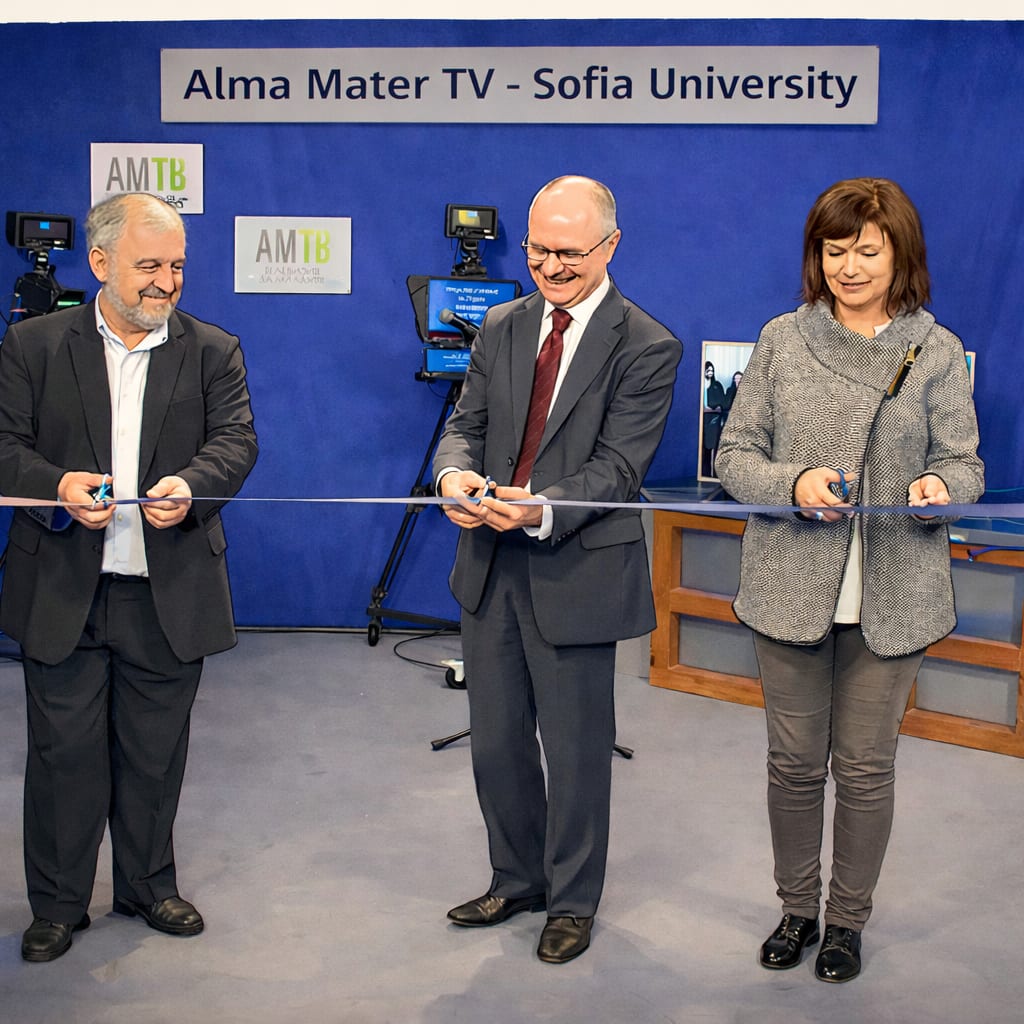
(A Review of Charmaine Voigt's Dissertation on Practical Media Training)
Abstract
This review examines the Bulgarian case study of Alma Mater TV as discussed in Charmaine Voigt's doctoral dissertation College Television: Practical Media Training in US and German Higher Education. While Voigt's work focuses primarily on Anglo-American and German contexts, the Bulgarian example stands out as an exceptional and largely unmatched model of student television in Europe. Alma Mater TV, based at the Faculty of Journalism and Mass Communication at Sofia University 'St. Kliment Ohridski', functioned not merely as a training platform but as a fully operational public-facing television project. Students produced and aired original programmes on Bulgaria's largest national broadcasters without censorship or editorial interference, while simultaneously participating in the creation of a European student television network. This review argues that Alma Mater TV represented a globally unique pedagogical and institutional experiment whose decline resulted not from structural failure but from a lack of strategic vision at the university leadership level. Particular attention is paid to the decisive roles of Professor Svetla Bozhilova and Professor Peter Ayolov in establishing and sustaining this model.
Key words
College television, Alma Mater TV, journalism education, practical media training, student television, European student media, editorial autonomy
Introduction
Charmaine Voigt's dissertation offers a valuable comparative analysis of college television as a form of practical media education, with a focus on the United States and Germany. Within this framework, the inclusion of the Bulgarian case of Alma Mater TV is especially significant, not because it fits neatly into existing models, but because it disrupts them. Alma Mater TV emerges in the dissertation as an anomaly: a university-run television station that achieved a level of public visibility, editorial freedom, and international integration rarely seen even in countries with far longer traditions of college media.
Established in 2010 at the Faculty of Journalism and Mass Communication, Alma Mater TV was conceived as a practical extension of academic training. Unlike most student media outlets, however, it did not remain confined to internal university circulation. Journalism students produced television programmes that were broadcast on Bulgarian National Television and other major national channels. Crucially, this took place without censorship or external editorial control, granting students real responsibility, real audiences, and real professional consequences for their work. At the time, this made Alma Mater TV not only unique in Bulgaria, but arguably one of the most advanced college television models globally.
Voigt rightly situates Alma Mater TV within the broader deficiencies of the Bulgarian media landscape, particularly the concentration of media ownership in Sofia and the lack of regional and thematic diversity. Yet the true significance of Alma Mater TV goes beyond compensating for media gaps. It functioned as a living laboratory in which students moved seamlessly between theory and practice, producing cultural, educational, satirical, and investigative content under professional conditions. Over 350 television programmes were aired nationally, providing students with experience that far exceeded simulated classroom exercises.
Equally important was the station's international orientation. Alma Mater TV played a central role in the creation of a European student television network, supported by the Youth in Action programme of the European Commission. Students travelled to France, the United Kingdom, and Italy, participating directly in transnational productions and editorial exchanges. These experiences placed Bulgarian journalism students on equal footing with their Western European counterparts and fostered a genuinely European media perspective long before such initiatives became common.
The dissertation also documents the organisational structure that enabled this success. Alma Mater TV operated with a professional core team and institutional support from the university, while production was carried out through coursework and voluntary participation. This balance ensured both pedagogical coherence and creative freedom. The leadership of Professor Svetla Bozhilova as director of the television and Professor Peter Ayolov as director, writer, and strategic organiser was decisive. Their vision combined academic rigor with practical ambition, insisting that students be treated not as trainees but as emerging professionals.
The eventual decline of Alma Mater TV, as Voigt notes, was not the result of pedagogical failure or audience disengagement. Rather, it followed changes in university management and a growing lack of institutional vision. Projects slowed, international cooperation ceased, and a globally unique model was gradually dismantled. From a comparative perspective, this outcome is particularly striking: while Voigt's dissertation emphasises the scarcity of college television in Europe, one of the most successful existing examples was allowed to wither.
Conclusion
Viewed through the lens of Voigt's dissertation, Alma Mater TV represents a missed opportunity not only for Sofia University but for European journalism education as a whole. It demonstrated that college television could operate simultaneously as a pedagogical tool, a public broadcaster, and an international network, without sacrificing editorial independence. The experience generated by Alma Mater TV set a benchmark for future student media projects, proving that meaningful practical training requires trust, autonomy, and institutional courage. Its history stands as both an inspiring model and a cautionary lesson about how easily educational innovation can be undone by short-sighted governance.
Bibliography
Voigt, C. (2019). College Television: Practical Media Training in US and German Higher Education. Doctoral dissertation. GESIS – Leibniz Institute for the Social Sciences.
Konrad Adenauer Foundation. (2017). Journalism Education and Media Practice in Southeast Europe. Conference report.
Erasmus Programme. (n.d.). Alma Mater TV project documentation.
Ayolov, P. (2017). Interview transcript, Alma Mater TV, Sofia University 'St. Kliment Ohridski'.
original text:
(from College Television: Practical Media Training in US
and German Higher Education
Voigt, Charmaine
Veröffentlichungsversion / Published Version
Dissertation / phd thesis
Zur Verfügung gestellt in Kooperation mit / provided in cooperation with:
GESIS - Leibniz-Institut für Sozialwissenschaften)
In a European context, CTV in Bulgaria is an interesting case because its only university-run television station initiated two nation-wide projects. Alma Mater TV is located at the Faculty of Journalism and Mass Communication at Sofia University in the capital of Bulgaria. The station was primarily arranged as a training field for journalism students in 2010. The web presentation claims its purpose is to present "[…] youth television for culture, education and youth policies with a status of 'national public television' in Bulgaria. It started with student TV shows on Bulgarian National Television [BNT]" (Erasmus, n.d.). In an interview from 2017, the station's TV director and staff member at the faculty, Peter Ayolov, described the station's license use in detail.
Alma Mater TV has a license from national broadcasting but we are not using it because it is very expensive if you want to start that sort of television. There was an idea to actually build a local Sofia TV with the help of the mayor of Sofia and the university together but again it is very expensive (see research documentation, transcript Peter Ayolov, para. 14)
The Bulgarian media landscape is very concentrated in Sofia and lacks diversity, especially in the regional sector. This overall situation gave the university cause to install a local television outlet where practical journalism education can take place. Alma Mater TV functions as a complement to the HEI. "[…] we help them with this because the faculty is giving [the students] all the theoretical stuff, but here they can
shoot and edit themselves" (see transcript Peter Ayolov, para. 18). Students also have the chance to focus on topics rarely covered by the national media. A conference report of the Konrad Adenauer Foundation (2017) states that journalism students in Southeast Europe need more practice. The report recognizes student newspapers that provide a field of training and recommends universities give greater acknowledgement to these outlets. Audiovisual media forms at colleges are not considered in the report, which speaks to the minimal existence of CTV. Despite some video
clubs at other Bulgarian universities, Alma Mater TV is the only CTV with its own license and staff. Professionals, including the TV director, a secretary, three permanent employees running the cameras and several available freelancers, oversee the operation and support the students. The productions are executed in classes and on a volunteer basis. Currently the station airs three weekly shows: Atelier covers art and culture, the show Viva Academia (formerly Pro Active) represents education and sci-
ence, and Ku-Ku Reloaded is a satire show. The sporadically-produced talk show HNE addresses student issues. According to Ayolov, the station relies "on the budget of the university and I can say it is enough for our basic needs and we have some additional projects or some sponsorships like this program with Erasmus […] and from Thomson Reuters […]" (see transcript Peter Ayolov, para. 74). The aforementioned program was an international cooperation with the aim of creating a student television network in Europe. It started in 2011 with a production excursion to Paris, con-
tinued in 2012 at Oxford Brooks University, UK, and intended to proceed to Leipzig, Germany and Portugal, financed by the Youth in Action program of the European Commission. Unfortunately, the extension request was denied and the cooperation ended after two years. The originated shows Atelier and Pro Active are still available on Alma Mater TV's YouTube channel. The team continues its effort to generate more funding in order to restart the network. Due to university management changes, the
project was forced to slow down its operations in 2018.
About the Creator
Peter Ayolov
Peter Ayolov’s key contribution to media theory is the development of the "Propaganda 2.0" or the "manufacture of dissent" model, which he details in his 2024 book, The Economic Policy of Online Media: Manufacture of Dissent.
Keep reading
More stories from Peter Ayolov and writers in Education and other communities.
Propaganda 2.1 Model, Manufacture of Dissent and Monetisation of Outrage
Abstract This article introduces the Propaganda 2.1 model as a theoretical extension of the author’s earlier Propaganda 2.0 framework, arguing that contemporary online media ecosystems are no longer governed primarily by political, ideological or cultural objectives but by a dominant economic policy of platform capitalism. In this regime, revenue optimisation trumps belief formation, identity construction and persuasive coherence, transforming propaganda from a project of ideological influence into an infrastructure for affect extraction. The model identifies three core mechanisms structuring this new phase. First, rage-baiting or the monetisation of outrage becomes the central commodity form of public discourse, replacing persuasion with the algorithmic optimisation of irritation, humiliation and moral injury. Second, the proliferation of AI ‘slop’ produces a regime of semantic banalisation in which meaning is not distorted but dissolved through excess, flooding the public sphere with syntactically fluent yet cognitively weightless content that exhausts attention rather than informing it. Third, parasociality functions as simulated intimacy, substituting civic belonging and social reciprocity with managed emotional attachment to influencers, automated agents and personalised feeds. Together these mechanisms describe a propaganda system that no longer requires belief, truth or ideological consistency. Outrage replaces conviction, automation replaces meaning, and artificial intimacy replaces sociality, marking the transition from the manufacture of dissent to the liquidation of public opinion itself. Does a media system that no longer seeks to persuade but to provoke still qualify as propaganda, or has it become a different technology of power altogether? If outrage is now more profitable than truth, what remains of public opinion as a democratic force? Can meaning survive in a communicative environment flooded by automated, semantically empty content? And when artificial intimacy replaces social relations, is the public sphere still a space for politics, or only a marketplace for emotions?
By Peter Ayolov2 months ago in Education
Breaking Spiritual Strongholds
Many believers love God and sincerely desire to live victorious lives, yet they sometimes feel trapped by recurring struggles. These struggles may appear as persistent fear, discouragement, addiction, negative thinking, or spiritual oppression. No matter how much someone prays or tries to move forward, certain battles seem to repeat themselves.
By Errick Ruffina day ago in Education




Comments
There are no comments for this story
Be the first to respond and start the conversation.