
IUL vs. ROTH IRA:
Which Actually Builds More Wealth? (PART THREE)

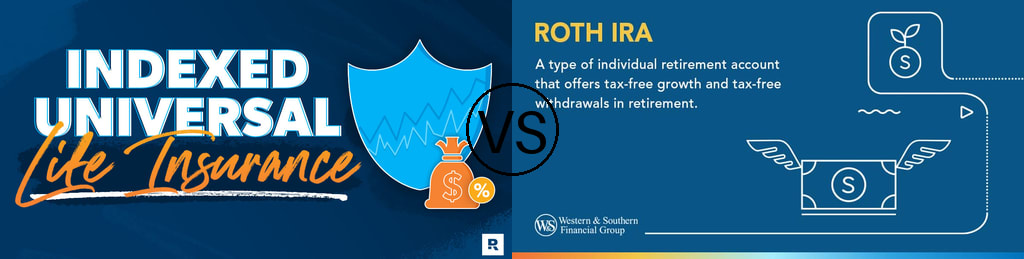
Welcome to part THREE of this THREE part article series where we deep dive into the two most debated topics in the retirement world. IUL or Roth IRA?
Last week we reviewed market returns and credits, limits, risk features and the downside of each type of account. This week we are concluding our three part series by looking at long- term wealth preservation, tax implications, rules/withdrawals and cost analysis.
Let's begin shall we?
Long-term Wealth Preservation
Each investment vehicle presents distinct approaches to preserving long-term wealth. IUL policies combine death benefits with investment features, offering tax-free payouts that surpass estate tax limits (13). This characteristic makes them particularly effective for multi-generational wealth transfer (4).
For IUL policyholders, wealth preservation manifests through:
- Consistent withdrawal capabilities
- Protected income base maintenance
- Predictable retirement planning options (4)
Alternatively, Roth IRAs preserve wealth through strategic asset allocation. Regular portfolio rebalancing helps maintain alignment with long-term goals and risk tolerance (12). This approach involves shifting funds between over-performing and under-performing sectors, ensuring portfolio stability over time.
Certain financial advisors advocate that market downturns present opportunities for Roth IRAs, enabling strategic conversions at discounted valuations 12. Yet, this strategy proves most effective for investors with sufficient time horizons to recover from potential losses (14).
IUL policies offer additional flexibility through policy loans or withdrawals, maintaining tax efficiency throughout retirement (1). These features enable policyholders to access funds without triggering tax consequences, provided the policy remains active (1). Correspondingly, Roth IRAs permit penalty-free withdrawal of contributions, offering liquidity without compromising long-term wealth preservation (7).
Still have questions? We'd love to talk to you.
Tax Implications and Benefits
Tax advantages shape the wealth-building potential of both IULs and Roth IRAs, yet each follows distinct rules for maximizing tax benefits.
Tax-free Growth Rules
IUL policies offer tax-deferred growth on cash value accumulation 15. Subsequently, policyholders access these funds through tax-free loans against the policy's value 15. For instance, a USD 50,000 annual withdrawal through policy loans remains invisible to Modified Adjusted Gross Income (MAGI) calculations 4.
Roth IRAs maintain specific requirements for tax-free distributions:
- Five-year holding period from first contribution
- Age requirement of 59½ for earnings withdrawal (1)
A notable distinction lies in contribution sources. IULs accept premium payments from various retirement accounts, including:
- Traditional IRAs
- SEP IRAs
- SIMPLE IRAs
- 401(k)s
- 403(b)s (16)
Both options eliminate Required Minimum Distributions (RMDs), granting account holders control over distribution timing (7). This flexibility proves valuable for estate planning, as inherited Roth IRAs avoid federal estate taxes up to substantial thresholds exceeding USD 11 million (13).
Withdrawal Strategies
IUL policies present unique withdrawal advantages through participation loans. These loans allow borrowed funds to continue earning index credits, effectively reducing net loan costs (4). For example, a USD 100,000 participation loan earning 8% index credits maintains growth potential even after withdrawal (4).
Roth IRA withdrawal rules follow stricter guidelines:
- Contributions withdrawn anytime without penalties
- Early earnings withdrawals (before 59½) incur 10% penalty plus taxes
- Exceptions exist for first-time home purchases and education expenses (7)
IUL withdrawal benefits extend beyond basic access:
- No impact on social security taxation
- Death benefit preservation
- Flexible withdrawal adjustments
- Zero required distributions (4)
Estate planning considerations favor IULs regarding death benefits. Beneficiaries receive payouts surpassing estate tax limits without triggering federal estate taxes, attributable to the policy's life insurance nature (13). Alternatively, lump-sum distributions from Roth IRAs might attract federal estate taxes beyond certain thresholds (13).
The tax efficiency of IULs manifests through policy loans, considered returns of premium payments rather than taxable events (13). This structure enables strategic retirement income planning without affecting tax status or triggering early withdrawal penalties (4). Notably, borrowed funds maintain growth potential within the policy, unlike Roth IRA withdrawals which cease earning tax-advantaged returns (4).
Real Cost Analysis
Understanding the true costs associated with IULs and Roth IRAs reveals substantial differences in fee structures and long-term financial implications.
IUL Fee Structure
IUL policies incorporate multiple layers of charges that affect overall returns. Premium expense charges function as an upfront "sales tax," typically ranging from 5% to 8% of each premium payment (17). These charges offset costs incurred from state insurance departments.
The cost structure includes several components:
- Coverage charges lasting 5-15 years for marketing and distribution
- Monthly administrative fees between USD 5-15
- Cost of Insurance (COI) charges based on age and health (17)
Insurance agents receive commissions on first year's premium (2). Additionally, marketing expenses and distribution costs pass directly to policyholders through coverage charges (2).
Still have questions? We'd love to talk to you.
Roth IRA Management Costs
Roth IRA fees generally prove more straightforward and often lower. Account maintenance fees typically range from USD 25 to USD 50 annually, yet many providers waive these charges (3). Transaction costs vary between USD 5 to USD 20 per trade, depending on the investment type (3).
Investment-related expenses primarily stem from mutual fund expense ratios:
- Passive index funds: approximately 0.25%
- Average across all funds: 0.50%
- Active funds: up to 2% or higher (3)
According to SEC research, a mere 0.25% difference in fees can reduce portfolio value by USD 10,000 over 20 years (3). This impact grows substantially with higher fee differentials, potentially decreasing returns by USD 30,000 under a 1% fee structure (3).
Hidden Expenses to Consider
Beyond obvious costs, IUL policies contain several concealed charges affecting long-term performance. Surrender charges, particularly punitive in early years, may exceed paid premiums, resulting in zero cash value (2). These charges typically persist for the first decade, discouraging early policy termination (2).
Cost of Insurance charges increase annually as policyholders age, potentially becoming unsustainable during retirement (18). This escalation often necessitates reducing death benefits to maintain policy viability 18. Furthermore, insurance companies retain the right to modify fees and performance caps at their discretion (19).
Roth IRAs might incur additional expenses through:
- Inactivity fees for dormant accounts
- Account closure charges
- Wire transfer costs
- Special investment handling fees (3)
Certain mutual funds within Roth IRAs carry front-end loads or sales charges, further impacting investment returns (3). Nonetheless, numerous low-cost investment options exist, enabling investors to minimize expenses through careful selection (3).
The complexity of IUL fee structures often leads to misunderstandings during sales presentations. Illustrations frequently showcase returns before accounting for various internal charges (2). Consequently, actual performance may fall significantly short of projected results, primarily due to the cumulative impact of multiple fee layers (2). NOTE: most illustrations are based on trends in the market as are market safe. It's important to keep that in mind when looking into IUL's.
Conclusion
The comparison between IULs and Roth IRAs reveals distinct advantages and trade-offs for long-term wealth building. IULs stand out through zero-floor protection, flexible contributions, and tax-free policy loans, though their complex fee structures and rising insurance costs demand careful consideration. Roth IRAs offer straightforward management, direct market participation, and lower overall costs, albeit with strict contribution limits and full market exposure.
Risk management approaches differ significantly between these options. While IULs protect against market downturns through guaranteed minimum returns, Roth IRAs rely on strategic asset allocation and diversification. The tax treatment also varies - IULs provide tax-free access through policy loans without affecting MAGI calculations, whereas Roth IRAs require specific age and holding period requirements for tax-free withdrawals.
The choice between these investment vehicles ultimately depends on individual financial goals, risk tolerance, and income levels. High-income earners might benefit from IULs' unlimited contribution potential and downside protection. Alternatively, investors comfortable with market volatility and seeking lower costs could find Roth IRAs better suited to their needs.
Both options serve as valuable tools for retirement planning, though each requires thorough understanding of its features, limitations, and true costs. The optimal strategy might involve using both vehicles as part of a comprehensive financial plan, balancing their respective strengths to build lasting wealth.
Still have questions? We'd love to talk to you.
Laura Munoz, Senior Advisor with Financial Advantage Consultants
References
[1] - https://ogletreefinancial.com/blog/roth-ira-vs-indexed-universal-life-whats-the-best-choice/
[2] - https://investorlosscenter.com/iul-fees-explained/
[3] - https://www.investopedia.com/fees-roth-ira-5220092
[4] - https://www.insurancegeek.com/iul/iul-vs-roth-ira/
[5] - https://www.annuityexpertadvice.com/iul-vs-roth-ira/
[6] - https://www.capitalforlife.com/iul-vs-roth-ira
[7] - https://smartasset.com/retirement/iul-vs-roth-ira
[8] - https://www.nationallife.com/resource-center/indexed-life-insurance-volatility-controlled-indexes
[9] - https://www.modernlife.com/article/indexed-universal-life-insurance-benefits-risks
[10] - https://www.zagconsultgroup.com/blog/iul-vs-roth-ira
[11] - https://www.investopedia.com/articles/personal-finance/103114/roth-iras-investing-and-trading-dos-and-donts.asp
[12] - https://www.nasdaq.com/articles/how-protect-your-roth-ira-stock-market-crash
[13] - https://www.healthcareretirementplanner.com/2023/09/18/indexed-universal-life-vs-roth-ira/
[14] - https://www.aol.com/protect-roth-ira-stock-market-200025458.html
[15] - https://ogletreefinancial.com/blog/tax-treatment-of-iul-cash-value/
[16] - https://thequantum.com/doing-roth-conversions-for-your-clients-consider-an-iul-alternative/
[17] - https://azewebp03sa.blob.core.windows.net/ashbrokerage-web/uploads/40086-Cost-Transparency-How-IUL-Policy-Charges-Work.pdf
[18] - https://bankingtruths.com/indexed-universal-life-insurance-pros-cons/
[19] - https://youstaywealthy.com/podcasts/why-iul-is-a-bad-investment/
About the Creator
Laura E. Munoz
Sr. Advisor at Financial Advantage Consultants, specializing in 403(b)'s, tax advisory, rollovers, IRAs, Roth IRAs, financial planning, Wills, and Trusts. Backed by 50+ years of team expertise, helping clients secure their financial future.
Keep reading
More stories from Laura E. Munoz and writers in Education and other communities.
Frontier Strategies: Navigating Global Markets with Data-Driven Risk Management Solutions
Global companies face increasing uncertainty as they expand across continents, and they depend on sophisticated analytics to understand the forces shaping international performance. Moreover, leaders strengthen competitive positioning by integrating global risk signals into their planning, helping them anticipate disruptions before they intensify. Additionally, data tools reveal patterns across regulatory systems, regional economies, and supply chains that manual analysis would overlook. Consequently, organizations gain the clarity they need to make informed decisions as they adapt to rapidly changing global environments.
By Ehab Al Kuttubabout 17 hours ago in Education
Active Bodies, Brave Minds: How Exercise Helps Children Grow Strong From the Inside Out
Raising children who are confident, adaptable, and emotionally strong is a goal shared by parents, educators, and communities alike. While many factors contribute to healthy development, regular exercise stands out as one of the most effective and natural ways to shape resilient, confident kids. Physical activity influences not only how children grow but also how they think, feel, and respond to the world around them.
By Marissa Haughabout 18 hours ago in Education


Comments
There are no comments for this story
Be the first to respond and start the conversation.