
How AI Learns from Data: An Overview of the Learning Process
AI learns
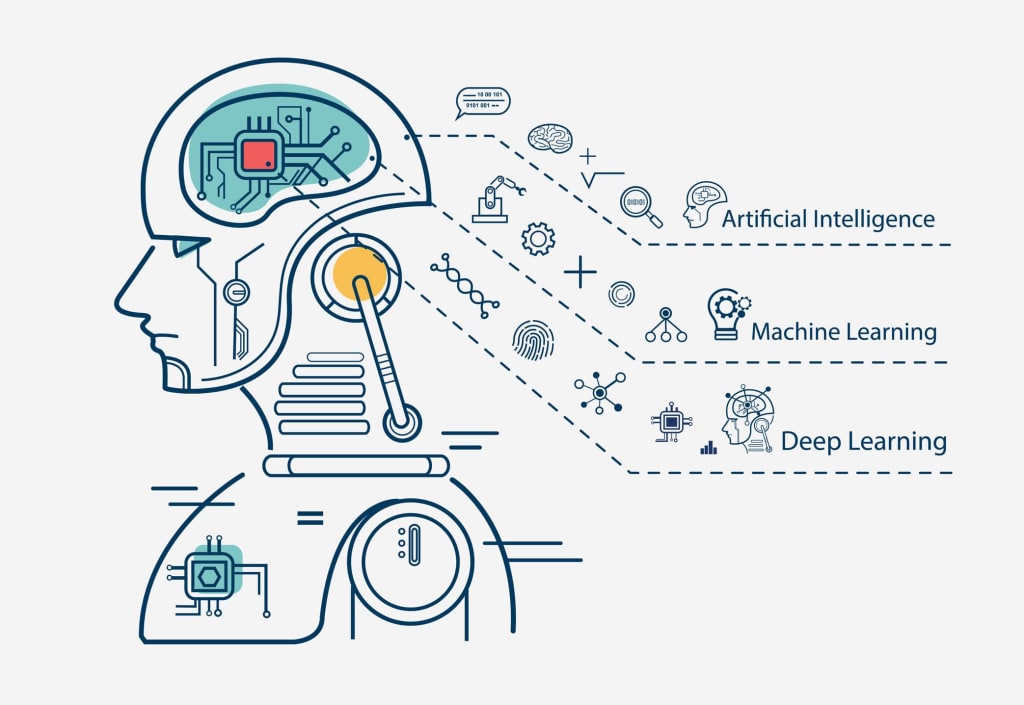
AI learns from data through a process called machine learning, which enables systems to improve their performance on specific tasks without being explicitly programmed. Here’s an overview of how AI learns from data:
1. Data Collection
The first step in AI learning is gathering data. This can be any type of data, such as:
Structured Data: Organized data like tables, spreadsheets, or databases.
Unstructured Data: Text, images, audio, videos, etc.
2. Data Preprocessing
Before learning, the data needs to be cleaned and prepared:
Cleaning: Removing noise (irrelevant or corrupted data), filling missing values, or correcting errors.
Normalization/Scaling: Ensuring the data is in a similar range, especially for algorithms sensitive to input magnitude.
Feature Engineering: Selecting or transforming input data to help the model understand the underlying patterns better.
3. Learning Process (Training the Model)
The core of AI learning happens here, where algorithms are used to find patterns or relationships within the data. This process is referred to as training. There are several types of learning:
Types of Learning
Supervised Learning:
The AI is trained on a labeled dataset, meaning each input has a corresponding output (target). The algorithm learns to predict the output for unseen data by recognizing patterns in the input.
Example: Training a model to recognize images of cats and dogs by feeding it labeled images and their correct classifications.
Unsupervised Learning:
In this case, the AI is given data without explicit labels. The algorithm tries to learn the underlying structure of the data, finding patterns or groupings (clustering).
Example: Grouping customers based on purchasing behavior without knowing in advance what categories exist.
Reinforcement Learning:
The AI learns through trial and error. It interacts with an environment, receiving feedback (rewards or penalties), and optimizes its actions to maximize cumulative reward over time.
Example: Teaching a robot to navigate a maze by rewarding it for reaching the exit.
Model Selection and Algorithm
The AI uses various algorithms based on the task and data type. Some common algorithms include:
Linear Regression: Predicts continuous outcomes (like price) based on input features.
Decision Trees: Makes decisions by splitting data into branches based on feature values.
Neural Networks: Mimic the human brain’s structure to recognize complex patterns in data, used in deep learning.
Support Vector Machines: Finds boundaries that best separate classes in the data.
4. Model Optimization
During training, AI algorithms try to find the best parameters (or weights, in the case of neural networks) to minimize errors. This process is called optimization. Common techniques include:
Gradient Descent: Adjusting parameters to minimize the error between predictions and actual values.
Regularization: Preventing the model from becoming too complex (overfitting) by penalizing certain model behaviors.
5. Validation and Testing
After the model is trained, it's essential to check how well it performs on unseen data. This is done through:
Validation Set: A portion of the data is set aside to tune the model's hyperparameters and evaluate performance.
Test Set: A final evaluation is done using completely unseen data to ensure the model generalizes well.
6. Predictions and Continuous Learning
Once trained, the AI can make predictions on new data. In some cases, AI models continue learning from new data as they interact with the real world:
Online Learning: The model continuously updates itself as it receives new data.
Transfer Learning: The model reuses learned patterns from one task to solve a related task with minimal additional training.
7. Feedback Loop and Model Refinement
AI learning is often an iterative process. Based on the model's performance, engineers or data scientists might:
Gather more data to improve the model.
Fine-tune the model by adjusting hyperparameters (like learning rate or tree depth).
Change or improve the features used by the model.
Example: How AI Learns to Classify Images
Step 1: Collect a dataset of labeled images (e.g., cats and dogs).
Step 2: Preprocess the images by resizing, normalizing pixel values, and labeling them.
Step 3: Choose a neural network (deep learning model) to train.
Step 4: Train the model by feeding it images and comparing its predictions with the correct labels. The model adjusts its internal parameters to improve its predictions.
Step 5: Validate the model using a separate set of images to check if it generalizes well.
Step 6: Once satisfied, deploy the model to classify new images it has never seen before.
Key Concepts
Features: Attributes or variables in the data that the AI model uses to make predictions (e.g., pixel values in an image).
Labels: The target output used in supervised learning (e.g., "cat" or "dog").
Loss Function: A metric that the algorithm optimizes during training (e.g., the difference between predicted and actual output).
Overfitting: When the model performs well on training data but poorly on unseen data, meaning it has memorized the data rather than learned general patterns.
In essence, AI learns from data by recognizing patterns, refining predictions, and continuously improving its accuracy as it encounters more data. The combination of algorithms, data, and feedback enables the model to become more intelligent over time.
About the Creator
Suresh Devendran
Tech writer exploring AI's impact on startups and innovation. Dive into stories of transformation and success in the tech world.
Keep reading
More stories from Suresh Devendran and writers in Education and other communities.
Decision Scientist vs. Data Scientist: Understanding the Key Differences and Roles
Data Scientist: A data scientist is a professional who focuses on extracting insights from structured and unstructured data using a combination of statistical methods, machine learning, and programming. Their role is often exploratory, aimed at uncovering hidden patterns, trends, and correlations in data that can inform business decisions.
By Suresh Devendranabout a year ago in Education
The Night of Mi‘rāj: A Journey Beyond Time, Space, and Human Imagination
Mi‘rāj — A Night That Reshaped Human Understanding Among all the extraordinary events recorded in Islamic tradition, Mi‘rāj stands as one of the most profound. It is not merely a journey; it is a moment when the boundaries of time, space, and perception were transcended by the Prophet Muhammad ﷺ through the will of God.
By Muhammad Islam khan swati5 days ago in Education
How Milwaukee Businesses Misjudge Mobile App Timelines?
Timeline optimism is one of the most expensive habits in software. In Milwaukee, it shows up quietly. A launch date is set to align with a trade show. A quarter-end deadline is chosen to please leadership. A six-month roadmap is approved because “the features aren’t that complex.” On paper, everything looks reasonable.
By Mary L. Rodriquez7 days ago in Education




Comments
There are no comments for this story
Be the first to respond and start the conversation.