
Decision Scientist vs. Data Scientist: Understanding the Key Differences and Roles
Decision Scientist vs. Data Scientist
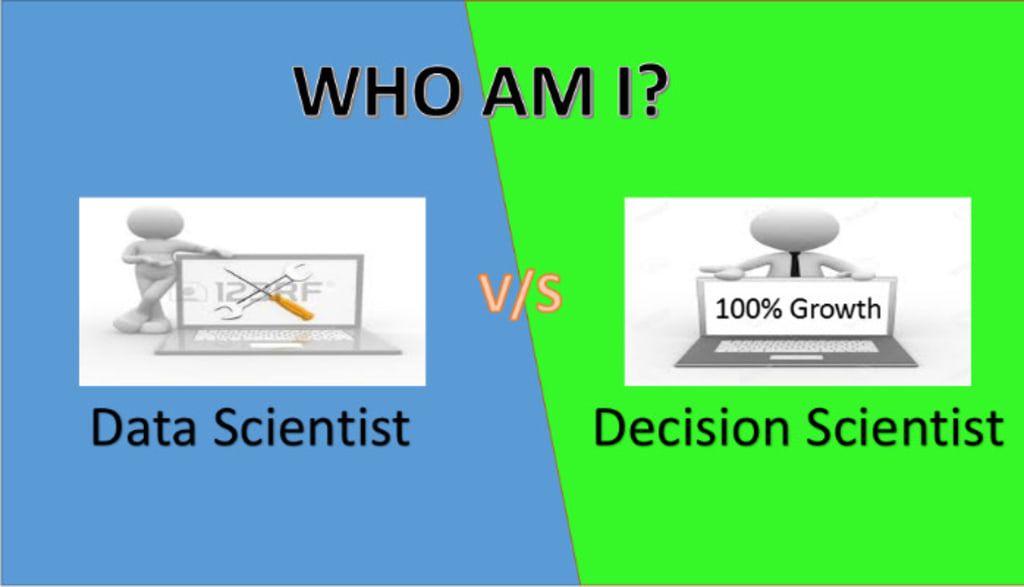
Data Scientist:
A data scientist is a professional who focuses on extracting insights from structured and unstructured data using a combination of statistical methods, machine learning, and programming. Their role is often exploratory, aimed at uncovering hidden patterns, trends, and correlations in data that can inform business decisions.
Decision Scientist:
A decision scientist, while also working with data, is more focused on applying data-driven insights to solve specific business problems. Their role combines data analysis with an understanding of decision-making processes, aiming to guide or optimize decision-making in an organization. They often work at the intersection of data science, business strategy, and behavioral science.
2. Key Responsibilities
Data Scientist:
Data Collection & Cleaning: Gathering data from various sources and ensuring it is clean and usable.
Exploratory Data Analysis: Identifying patterns, trends, and anomalies within the data.
Model Building: Developing predictive models using machine learning or statistical methods.
Interpretation: Translating model outputs into actionable insights.
Data Visualization: Creating charts, graphs, and dashboards to communicate findings to stakeholders.
Research: Exploring new algorithms, tools, and techniques to improve analysis.
Decision Scientist:
Problem Framing: Defining the business problem in a way that can be addressed using data.
Data-Driven Decision Support: Using data to support or automate business decisions.
Optimization: Identifying the best course of action given various constraints (e.g., resources, time).
Behavioral Analysis: Understanding how decisions are made within an organization and how they can be influenced.
Strategic Guidance: Advising on policy or strategy changes based on data-driven insights.
Impact Measurement: Assessing the impact of decisions made using data to continuously refine and improve decision-making processes.
3. Skills Required
Data Scientist:
Technical Skills: Strong programming skills (Python, R), proficiency in data manipulation (SQL), and experience with machine learning libraries (e.g., TensorFlow, Scikit-learn).
Statistical Knowledge: Deep understanding of statistical methods and how to apply them.
Machine Learning: Ability to design and implement machine learning algorithms.
Data Visualization: Proficiency with tools like Tableau, Power BI, or Matplotlib.
Problem-Solving: Strong analytical skills to solve complex data-related problems.
Decision Scientist:
Business Acumen: A deep understanding of business processes, strategy, and economics.
Decision Theory: Knowledge of decision-making models, optimization techniques, and behavioral economics.
Data Analysis: Ability to analyze data and translate findings into practical recommendations.
Communication: Strong skills in communicating complex concepts to non-technical stakeholders.
Cross-Disciplinary Knowledge: Understanding of psychology, sociology, and organizational behavior.
4. Tools Used
Data Scientist:
Programming Languages: Python, R, SQL.
Data Visualization: Tableau, Power BI, Matplotlib, Seaborn.
Machine Learning: TensorFlow, Scikit-learn, Keras, PyTorch.
Data Processing: Pandas, Numpy, Apache Spark.
Big Data Tools: Hadoop, Spark, AWS, Google Cloud.
Decision Scientist:
Data Analysis: Python, R, SQL.
Optimization Tools: Excel Solver, Gurobi, IBM CPLEX.
Business Intelligence (BI) Tools: Tableau, Power BI, QlikView.
Behavioral Analysis: A/B testing platforms, behavioral science frameworks.
Simulation & Modeling: Monte Carlo simulations, decision trees, and risk analysis software.
5. Career Path and Opportunities
Data Scientist:
Typical Roles: Junior Data Scientist, Data Scientist, Senior Data Scientist, Lead Data Scientist.
Advanced Roles: Machine Learning Engineer, Data Science Manager, AI Specialist.
Industries: Tech, finance, healthcare, e-commerce, and any data-driven industry.
Decision Scientist:
Typical Roles: Decision Analyst, Decision Scientist, Senior Decision Scientist.
Advanced Roles: Chief Data Officer (CDO), Director of Analytics, Strategy Consultant.
Industries: Finance, consulting, operations, marketing, and sectors requiring data-driven decision-making.
6. Outcome Focus
Data Scientist:
Primarily focused on generating insights and predictions from data. The emphasis is on understanding the “what” and “why” behind the data.
Output: Predictive models, data-driven insights, research findings.
Decision Scientist:
Focused on using data to directly influence or automate decision-making. The emphasis is on the “how” and “what if” scenarios related to business decisions.
Output: Decision models, optimization strategies, actionable recommendations.
7. Collaboration and Workflow
Data Scientist:
Often works with data engineers to gather and preprocess data. Collaborates with machine learning engineers and software developers for deploying models. Interacts with business analysts to understand requirements and communicate results.
Decision Scientist:
Collaborates closely with business leaders, strategists, and other decision-makers. May work with data scientists to develop models, but their primary focus is on applying these models to business scenarios. Often bridges the gap between technical teams and executive management.
While both data scientists and decision scientists work closely with data, their roles and focus areas are distinct. A data scientist is primarily concerned with extracting insights and building models, whereas a decision scientist applies these insights directly to optimize business decisions. Both roles are crucial in modern organizations, but the choice between them depends on whether your interest lies more in data exploration and model building or in applying data to solve practical business problems.
About the Creator
Suresh Devendran
Tech writer exploring AI's impact on startups and innovation. Dive into stories of transformation and success in the tech world.
Keep reading
More stories from Suresh Devendran and writers in Education and other communities.
Leveraging AI for Stock Market Success: A Modern Investor's Guide
Artificial Intelligence (AI) is transforming the way investors approach the stock market. From analyzing large datasets to predicting trends, AI is becoming an invaluable tool for traders seeking to maximize returns and minimize risks. But how can AI help you win in the stock market?
By Suresh Devendranabout a year ago in Education
The Comfort of Arrival: Why Certain Destinations Instantly Feel Familiar
There are moments in travel that defy logic. You arrive in a place you have never visited before, step onto its streets, breathe in its air, and suddenly feel at ease. There is no adjustment period, no sense of being out of place. Instead, there is a quiet recognition, as if the destination has been waiting for you. This feeling of instant belonging is not accidental, nor is it purely romantic imagination. It is the result of emotional, cultural, psychological, and environmental factors working together to create a sense of home far from home.
By Producer James Simon6 days ago in Education
The Proven Natural Skincare Secret with Healthy Skin
Healthy skin does not come from harsh products or complicated routines. It comes from working with nature, not against it. The natural skincare secret that many people overlook is the power of raw honey as a daily skin ally. This simple ingredient has been used for generations, yet many still do not understand its effectiveness. When used correctly, raw honey can change how your skin looks and feels.
By Kelln Small6 days ago in Education



Comments
There are no comments for this story
Be the first to respond and start the conversation.