
From Complex to Simple: The Key to Effective Learning with the Feynman Technique
We accept the reality that learning is a lifelong process to keep up with change. The most urgent task is to teach people about effective learning methods.


"We accept the reality that learning is a lifelong process to keep up with change. The most urgent task is to teach people about the method of learning."
-Peter Ducke -
Have you ever felt confused and frustrated when faced with difficulties in remembering knowledge? This is indeed a common issue that most of us encounter in the process of studying and acquiring knowledge.
Fortunately, there is a useful learning method that can help you remember information effectively and for the long term: the Feynman Technique.
The Feynman Technique, named after Nobel laureate physicist Richard Feynman, focuses on deepening understanding rather than rote memorization, as is common with traditional methods.
A Bit About the Author
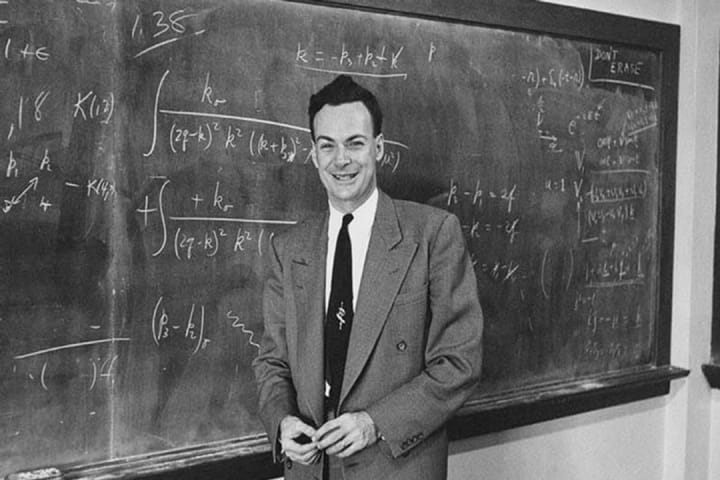
Richard P. Feynman was born in New York City on May 11, 1918. From a young age, Feynman was particularly passionate about repairing radios. At that time, calling a radio repairman was not cheap. So whenever people had broken radios, they would ask young Feynman to help fix them.
In his teenage years, Feynman worked as a waiter in a restaurant, occasionally causing some trouble at work with his “disastrous” inventions that were unlike anything else. Perhaps it was this spirit of exploring new experiments that led Feynman to enter the world of science, becoming a brilliant physicist later on. Feynman chose to study physics at the Massachusetts Institute of Technology. In 1939, Feynman graduated with a Bachelor’s degree, and soon after, in 1942, he earned his Ph.D. from Princeton University.
Feynman achieved great accomplishments in his career. He served as a research assistant at Princeton (1940-1941), became a Professor of Physics at Cornell University (1945-1950). From 1950 to 1959, he was appointed as a professor at the California Institute of Technology. Feynman was a member of many prestigious organizations such as the American Physical Society and the National Academy of Sciences. He received many prestigious awards, including the Albert Einstein Award (1954), the Einstein Award (Albert Einstein Award from the Medical College), and the Lawrence Award (1962). He also won the Nobel Prize in Physics in 1965.
Core Values and Application of the Feynman Technique
“You just keep learning and learning, and before long, you will learn something that no one has ever learned before.”
-Richard Feynman -
Not encouraging rote memorization, the Feynman Technique focuses on simplifying complex concepts into easy-to-understand language. You use your own language to explain all the knowledge you have learned. This process turns fragmented knowledge into a sustainable system of knowledge, stored in long-term memory.
With the Feynman Technique, learning is not just about acquiring information, but also about actively building and organizing knowledge.
The Feynman Method includes the following basic steps:
Step 1: Identify the concepts or areas you want to explore. Write them down to begin the process of explaining the knowledge.
For example, if you want to learn about the concept of self-awareness, you need to list the following information:
- Definition of self-awareness.
- Characteristics and roles of self-awareness.
- Methods to improve self-awareness.
Step 2: Read the theory carefully, then explain the concepts in simple language.
When explaining a concept, use simple words as if you are teaching a fifth grader or someone without a background in the subject so they can understand the issue.
For example, the concept of “Self-awareness” defined by psychologists Shelley Duval and Robert Wicklund: “Self-awareness is the ability to focus on yourself, on how your actions, thoughts, or emotions align or do not align with your internal standards. If you have high self-awareness, you can objectively evaluate yourself, manage your emotions, adjust your behavior according to your values, and understand exactly how others perceive you.”
It might sound complicated, right? You can explain the concept of self-awareness in simpler terms as follows:
“Self-awareness is your ability to understand yourself. It is when you know your thoughts, emotions, and behaviors. You understand your strengths, weaknesses, what you like, and dislike about yourself.”
Give a specific example for the concept of self-awareness: You know you are happy when you are an optimistic, cheerful person who helps others. You also know you will be very sad when you lose your temper or say hurtful things to those around you. This is an easy illustration of the process of self-awareness.
Step 3: During the explanation, if you encounter concepts or links that are still unclear, go back, take notes, and plan additional research accordingly.
Step 4: repeat the cycle of understanding - explaining - identifying knowledge gaps until you can explain fluently in your own language.
Steps 3 and 4 are for when you find you cannot explain or understand certain concepts, so you need to go back to Step 2, read the knowledge carefully to systematize it clearly.
Benefits of Applying the Feynman Technique in Knowledge Acquisition
According to the Learning Pyramid model developed by the National Training Laboratories in the United States:
If learners actively engage and apply knowledge, the retention rate will be higher. Specifically, the brain’s retention rate for knowledge acquisition is 5% through lecture, 10% through reading, 20% through media, 30% through immediate recall, 50% through discussion with others, 75% through practice, and 90% through teaching others.
The Feynman Technique Fully Meets the Criteria for Deep Knowledge Retention, including explanation, practice, discussion, and teaching others.
Here are some additional benefits of the Feynman Technique:
- Focus on Deep Understanding: The Feynman Method helps you uncover connections and correlations between concepts, rather than just memorizing theories mechanically.
- Enhanced Long-Term Memory: Continuously explaining concepts helps in storing information for the long term.
According to research on memory, the brain asks two basic questions when trying to remember something: Is the information logical? Does the information make sense? (Sousa 2017). If what you hear or read doesn’t make sense or you don’t understand it, the brain quickly places the information into the forgetting area.
- Improved Communication Skills: Practicing the explanation of concepts also helps improve your communication and presentation skills.
- Increased Active Learning: Active learning often accelerates the learning process. Actively participating in discussions, asking questions, or applying knowledge practically enhances understanding and retention.
A study in the Journal of Career Behavior indicates that people who are proactive in seeking knowledge often experience career advancement and achieve personal life balance.
Achievements from Applying the Feynman Technique
Richard Feynman himself applied the Feynman Technique in teaching and scientific research. For this brilliant physicist, he always viewed clear and understandable explanations as a crucial challenge in knowledge cultivation. Faced with a vast amount of information, Feynman would often ask himself, "Can I relate this to a simple example?" or "Can I explain this problem so that a first-year student can understand it?"
When confronted with complex theories, Feynman would take the time to explore, ponder, and find ways to express them in his own words. He believed that clarifying ambiguous concepts not only helped students understand better but also deepened his own understanding of the issues.
Dr. Leonard Mlodinow, who joined the California Institute of Technology (Caltech) in 1981, shared his enthusiasm for the Feynman method, saying, "Feynman not only made physics more engaging... he made physics important. It was as if a physicist with just one idea could change the world and transform people’s perceptions of it." Consequently, "whether driving to deliver eggs, tending cattle, or peeling potatoes in the kitchen, my mind is always occupied with the issues and questions raised in Feynman’s book."
American billionaire Bill Gates is so passionate about the Feynman method that he has referred to Feynman as "the greatest teacher I’ve ever had."
Personal Exerience with the Feynman Technique in Reading and Summarizing Books
On my website, Nhà Nhện, you’ll mostly find book reviews or summaries written by me. For books that are easy to understand, I typically only need to read them 3 to 4 times to write a summary. However, there are many “challenging” books that require multiple readings before I can understand and produce a complete draft.
For example, in the book The Art of Manipulation, when the summary was adapted into a video on the Spiderum Book channel, some readers commented that the summary accurately reflected their experiences, while others noted discrepancies between the summary and the book. Some readers even expressed regret over purchasing the book. I completely understand why people react this way.

There are two main reasons for this:
First, The Art of Manipulation is a difficult book to read. Despite having a background in psychology, I also struggled to understand the concepts presented in the book. Additionally, I acknowledge that the book has many limitations. Human psychology is a broad field, and the author's writing can be misleading. The distinction between "deliberate manipulation" and instances where harm is caused unintentionally, perhaps due to a lack of appropriate communication skills, can be unclear.
Second, in my summary, I did not rewrite the entire content of the book. Instead, I selected and presented the content with a focus on "providing strategies for victims who have been manipulated to overcome such manipulation."
I applied the Feynman Technique to the summary. First, I spent a considerable amount of time reading, understanding, and taking notes. Then, I aimed to simplify complex concepts using my own vocabulary and understanding.
Throughout the process, I wrote and revisited concepts, deleting and starting over when necessary. I also frequently checked whether the main ideas were reasonable. I asked myself if the rewritten concepts were clear and if a 12-year-old could understand what I had written.
For each summary, I consistently followed the four steps of the Feynman Technique: Reading - Note-taking - Explanation - Re-reading (if not understood). By adhering to this process, I eventually produced a complete summary. Although the summary still has certain shortcomings, I feel relatively satisfied with making the challenging concepts of the book more understandable.

As you can see, the Feynman Technique can be applied to any field you wish to study or explore.
Today, there are many different learning methods available, from books to platforms like YouTube and podcasts. However, if you only read or listen passively without actively reconstructing the knowledge system, the information will come and go like "water flowing past the window."
Therefore, it is crucial to be proactive in your learning process.
Here are some basic steps to help you apply the Feynman Technique to multimedia learning:
- Define Learning Objectives: Before starting, clearly define your learning goals—what topic you want to explore and what you want to learn. Setting objectives will help you focus on key content.
- Actively Take Notes and Reflect: When watching videos or reading materials, actively take notes, make suggestions, and relate new information to what you already know. Try to explain concepts in your own words.
- Organize and Connect Ideas: After gathering information, organize and group the main ideas together. Find ways to relate and explain the connections between concepts.
- Ask Questions and Find Answers: During the learning process, actively ask questions about what you don’t understand. Then, attempt to answer these questions using your own understanding.
- Share and Get Feedback: After learning, try to share what you’ve learned with others. This will help you test your understanding of the material. Additionally, you may receive feedback and suggestions to improve your knowledge.
Conclusion
The Feynman Technique offers many benefits for learning and understanding complex concepts, but it requires effort, persistence, spirit, and continuous improvement. This can be one of the significant challenges for learners when practicing the Feynman Technique.
However, with a willingness to commit to learning, the Feynman Technique can be a valuable tool to help you study effectively.
“In the struggle between the river and the rock, the river always wins—not by strength, but by perseverance.” – H. Jackson Brown.
Acquiring knowledge is like the river flowing upstream; it always requires diligence and persistence to overcome obstacles.
About the Creator
Taher Saifuddin: Transforming Toronto’s Classrooms with Inclusive and Future-Focused Education
In the heart of Canada’s most diverse city, Toronto educator Taher Saifuddin is quietly leading a transformation in the way learning is delivered, measured, and experienced. With over two decades of experience, Taher is recognized for his dynamic role in teaching, academic leadership, and digital innovation across Toronto’s private and independent schools.
By Dena Falken Esq3 days ago in Education
Silver Screen Magic with Mae West
American actress and singer Mae West became a popular film actress during the Great Depression. She started entertaining in vaudeville, then performed on Broadway, and finally went to Hollywood. She signed up with Paramount Pictures and made her debut in the 1932 film “Night After Night.” She also starred in musicals, comedies, and crime dramas. The American Film Institute named her one of the best classic Hollywood actresses.
By Rasma Raisters3 days ago in Geeks



Comments
There are no comments for this story
Be the first to respond and start the conversation.