
Everyday Life Aboard the International Space Station: Ordinary Days in an Extraordinary Place
Space

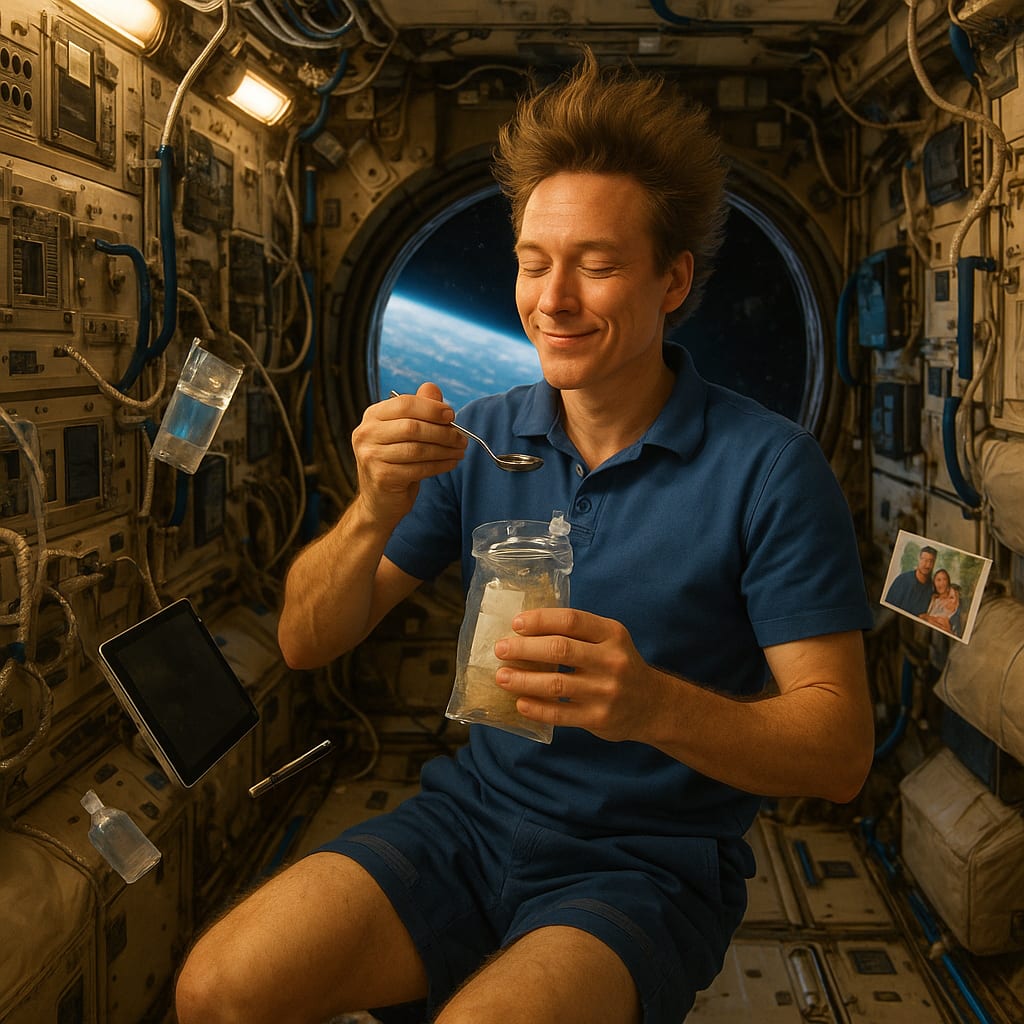
When most people think about the International Space Station (ISS), they picture astronauts floating in a silent, endless void — surrounded by high-tech panels and dazzling views of Earth. But beyond the science fiction image, the ISS is also something much more relatable: a home. For the astronauts who live there, orbiting 400 kilometers above our planet, daily life is surprisingly familiar — and yet utterly unlike anything on Earth.
Mornings Without Gravity
Imagine waking up without gravity. There’s no bed to roll out of, no floor to stand on, no “up” or “down” at all. On the ISS, astronauts sleep in small sleeping pods attached to the walls, each the size of a phone booth. Inside are sleeping bags that can be zipped and tethered to the wall — so you don’t drift into a crewmate in the middle of the night.
The day starts according to Greenwich Mean Time (GMT), not sunrise, because the ISS circles Earth every 90 minutes. That means the Sun “rises” and “sets” 16 times a day — beautiful, but totally impractical for keeping a schedule.
Morning hygiene looks a bit different too. There’s no running water in space, so astronauts use no-rinse shampoo, wet wipes for washing, and toothpaste that they either swallow or spit into a towel (since there’s no sink). Even the most basic routines become small experiments in physics.
Breakfast in Orbit
Breakfast on the ISS isn’t about taste as much as it is about nutrition and safety. Food has to be lightweight, long-lasting, and mess-free — because in zero gravity, a single floating crumb could short-circuit equipment or get into someone’s eye.
The menu includes familiar favorites: scrambled eggs, oatmeal, tortillas, soups, and even beef stew — all packaged in pouches or cans. Instead of bread, astronauts eat tortillas, which don’t produce crumbs.
Everything is heated using a small food warmer, and drinks — like coffee or juice — are sipped through straws from sealed plastic bags. Astronauts say that flavors taste duller in space, because fluid shifts toward the head in microgravity, making them feel “congested.” To fix that, they often crave spicy sauces — bottles of Tabasco are always in demand on the ISS.
A Day’s Work Among the Stars
After breakfast, the crew’s workday begins. The ISS isn’t just a home — it’s one of the most advanced research laboratories ever built. Astronauts conduct experiments that can’t be done on Earth: growing crystals in zero gravity, studying how space affects the human body, testing new materials, and even examining how fire behaves in space.
For example, scientists have grown protein crystals on the ISS that are larger and purer than those on Earth, helping researchers develop new medicines. Another study tested plant growth in microgravity — a crucial step toward future missions to Mars.
But science isn’t the only task. Astronauts spend hours maintaining the station: checking oxygen systems, updating software, replacing filters, and occasionally performing spacewalks — stepping outside the station to make repairs while floating above Earth in silence.
Fitness: The Fight Against Weightlessness
In space, your muscles and bones don’t have to support your weight — so they start to weaken quickly. To stay healthy, astronauts exercise for at least two hours every day.
The ISS gym includes a treadmill, a stationary bike, and a resistance machine that simulates lifting weights using vacuum cylinders instead of gravity. Each piece of equipment is equipped with straps or harnesses to keep the astronaut from floating away mid-workout.
It might look funny — running while literally tied down — but it’s vital. Without exercise, astronauts could lose up to 20% of their muscle mass during a six-month mission.
Evenings Above Earth
When the day’s experiments and maintenance are done, it’s time to relax. Astronauts might watch a movie, read, listen to music, or call their families through video link.
They also spend time simply looking out the window — through the Cupola, a panoramic observation dome with the best view in the universe. From there, they can watch auroras dance over the poles, lightning storms flash across continents, and the thin blue line of Earth’s atmosphere curve below them.
Astronaut Scott Kelly once said that his favorite pastime on the ISS was “Earth gazing.” He took thousands of photos — from glowing cities at night to vast deserts and ocean whirlpools — reminding everyone back home how small and connected our planet truly is.
Life Between Worlds
Living on the ISS is a paradox: it’s both routine and miraculous. The astronauts brush their teeth, eat breakfast, work, exercise, and sleep — just like we do — but every ordinary act is transformed by an extraordinary environment.
Birthdays are celebrated with freeze-dried cake; holidays are marked with video calls home. Some astronauts even bring instruments — guitars or flutes — and have played music that floats freely through the modules.
In many ways, life on the ISS mirrors life on Earth — teamwork, schedules, chores, laughter, and the occasional frustration. But up there, far above the clouds, every glance out the window is a reminder that home is the blue planet turning silently below.
Everyday life in space shows us something profound: no matter where humans go — whether across continents or into orbit — we bring a piece of Earth with us. And that makes even the cold emptiness of space feel a little like home.
About the Creator
Keep reading
More stories from Holianyk Ihor and writers in Education and other communities.
The “Black Abyss Syndrome”: When Astronauts Face the Fear of Infinite Space
When we gaze at the night sky from Earth, it feels magical — a canvas of stars that inspires dreams of exploration and wonder. But for those who actually venture beyond our planet, space can reveal a far darker, more unsettling side. Among astronauts and space psychologists, there’s an unofficial term that captures this haunting experience: the “Black Abyss Syndrome.” It describes the deep, instinctive fear that can emerge when a human mind is confronted with the endless, silent vastness of the cosmos.
By Holianyk Ihor3 months ago in Education
Expert Banking Digital Signage Energizes Customers
I'll never forget walking into my local branch last Tuesday morning, dreading the usual 20-minute wait just to deposit a check. Instead, I was greeted by a vibrant digital display showing my wait time (3 minutes!), current mortgage rates, and a helpful video about mobile banking features I didn't even know existed. That visit took seven minutes total, and I left with a new savings account. That's the power of banking digital signage done right.
By Jerry Kane 2 days ago in Education



Comments
There are no comments for this story
Be the first to respond and start the conversation.