
Essential Design Terminology for Professionals and Enthusiasts
A comprehensive guide to understanding and mastering key design concepts and terminology for both experienced professionals and design enthusiasts looking to expand their knowledge and skills.

Typography
The art and technique of arranging type in order to make written language legible, readable, and appealing when displayed.
Typography is an essential aspect of design that can greatly impact the readability and overall aesthetic of a piece of written content. Good typography can make text easy to read and understand, while poor typography can make it difficult and frustrating to read. It involves the selection and arrangement of typefaces, point sizes, line lengths, line-spacing, and letter-spacing. It also includes the use of color, imagery, and other design elements to enhance the overall visual appeal of the text. It's important to consider typography when creating any type of written content, from books and magazines to websites and marketing materials.

Grid System
A structured framework used in graphic design to align and organize content.
A grid system is a structured framework used in graphic design to align and organize visual elements in a consistent and orderly manner. It is a series of intersecting horizontal and vertical lines that divide a design space into a series of rows and columns. The grid serves as a visual guide for the placement of elements such as text, images, and other design elements, helping to create a cohesive and balanced layout. Grid systems can be used in a variety of design projects, including print and digital designs, such as brochures, websites, and mobile apps. It also helps to make the design process more efficient, by providing a clear set of guidelines for the designer to follow.
The grid system is one of the most important tools in graphic design, because it allows designers to create balanced and harmonious designs, which are easy to read and navigate.

Color Theory
The study of how colors interact and how they are used to create visual hierarchy and meaning in design.
Color theory is the study of how colors interact and how they can be used to create visually appealing designs. It encompasses a set of guidelines for the use of color in design, including the use of primary, secondary, and tertiary colors, as well as complementary and analogous color combinations.
The color wheel is a fundamental tool used in color theory, it shows the relationship between colors and how they relate to each other. The primary colors are red, yellow, and blue, and these are the colors that cannot be created by mixing other colors together. Secondary colors, green, orange and purple, are formed by mixing primary colors. Tertiary colors are created by mixing a primary and a secondary color together.
Complementary colors are colors that are opposite each other on the color wheel, such as red and green, blue and orange, purple and yellow. When used together, they create a strong contrast that can be visually striking. Analogous colors are colors that are next to each other on the color wheel, such as red, orange, and yellow. When used together, they create a harmonious and cohesive design.
Color theory also includes concepts such as saturation, value, and temperature. Saturation refers to the intensity of a color, value is the lightness or darkness of a color, and temperature is the warmth or coolness of a color.
In summary, color theory is the study of how colors interact and it provides guidelines for the use of color in design to create visually appealing compositions. It's fundamental for graphic designers, illustrators, and other professionals to have a deep understanding of color theory to be able to produce harmonious and effective designs.

Composition
The arrangement of visual elements in a design to create a cohesive and balanced overall look.
Composition refers to the way in which visual elements are arranged within a design, such as the placement of text, images, and other design elements on a page. Good composition creates a visually balanced and harmonious design that guides the viewer's eye through the piece.
There are several principles of composition that designers use to create effective designs, such as the rule of thirds, symmetry, and contrast. The rule of thirds is a principle in which a design is divided into thirds both horizontally and vertically, and the important elements are placed along these lines or at their intersections. Symmetry is the use of balance and repetition to create a sense of order and stability in a design. Contrast is the use of different elements that are different in size, color, or value to create visual interest and emphasis in a design.
Other principles include the use of negative space, which is the space around and between the elements in a design, and the use of hierarchy, which is the arrangement of elements in order of importance.
Composition is an essential aspect of graphic design and it's important to consider it in every design project. It helps to create a cohesive and visually pleasing design that effectively communicates the intended message.

Contrast
The use of different elements in design to draw attention and create visual interest.
Contrast is the use of different elements that are different in size, color, or value to create visual interest and emphasis in a design. It can be used to draw attention to specific elements, create a sense of hierarchy, or add visual interest to a design.
There are several types of contrast that can be used in design:
• Value contrast: refers to the use of light and dark colors to create contrast.
• Color contrast: refers to the use of different colors to create contrast.
• Size contrast: refers to the use of different sizes of elements to create contrast.
• Shape contrast: refers to the use of different shapes of elements to create contrast.
• Texture contrast: refers to the use of different textures to create contrast.
Contrast can be used to create a focal point in a design, by using it to draw attention to the most important element in a composition. It can also be used to create a sense of hierarchy by using it to create emphasis on certain elements and making them stand out more than others.
It's important to use contrast in a balanced way, too much contrast can create a chaotic and overwhelming design, while too little contrast can make a design appear flat and uninteresting.
In summary, contrast is an essential element in graphic design that can be used to create visual interest and emphasis in a design, draw attention to specific elements, and create a sense of hierarchy. It's important to use it in a balanced way, to create a cohesive and aesthetically pleasing design.
Hierarchy
The arrangement of elements in a design to indicate importance and guide the viewer's eye through the content.
Hierarchy refers to the arrangement of elements in a design, such as text, images, or other visual elements, in order of importance or priority. This can be used to guide the viewer's attention and make it clear where the most important information is located. Hierarchy can be created through the use of size, color, contrast, and placement of elements. This creates visual cues that help the viewer understand the relationship between different parts of the design and the overall message being conveyed.
Negative Space
The empty or unused space in a design, which can be used to create balance and visual interest.
Negative space, also known as white space, refers to the empty or unused space in a design. This can include the space between elements, around the edges of a design, or within an object. Negative space can be used to create visual balance, draw attention to specific elements, and add a sense of calm and simplicity to a design. It can also be used to create illusions of depth and movement. Negative space can be used in both graphic design and photography to create a more visually interesting composition.

Vector Graphics
Images created using mathematical equations to define shapes and lines, which can be resized without losing quality.
Vector graphics are digital images created using mathematical equations to define shapes and lines. These equations are used to create points, lines, and curves that are then connected to form shapes. Because vector graphics are created using mathematical equations, they can be easily scaled and modified without losing quality. This makes them well-suited for use in logos, illustrations, and other designs that may need to be resized or used in different contexts. Vector graphics are typically created using software such as Adobe Illustrator, Inkscape, or CorelDRAW. They are stored in file formats such as SVG, AI, and EPS.

Raster Graphics
Images created using pixels, which can become pixelated when resized.
Raster graphics, also known as bitmap images, are digital images created using pixels. A pixel is the smallest unit of a digital image, and each pixel is assigned a specific color or shade. Raster graphics are resolution dependent, which means that when you increase or decrease the size of the image, the pixels are either added or removed, which can cause the image to appear pixelated and lose quality. This makes them less suitable for designs that need to be resized frequently. Raster graphics are typically used for photographs, digital paintings, and other images that require a high level of detail. They are stored in file formats such as JPG, PNG, GIF and BMP. Raster graphics are created using software such as Adobe Photoshop, GIMP, and Corel Paint.
White Space
The unused or empty space in a design, which can be used to create a sense of simplicity and elegance.
White space, also known as negative space, refers to the unused or empty space in a design. It is the area around, between, and within elements of a design that helps to create visual balance, emphasis and hierarchy. White space can provide a sense of calm and simplicity to a design, making it more visually appealing and easy to read. It can also be used to separate different elements of a design, such as text and images, to make it more legible and easier to understand. White space is an important aspect of design and should be used deliberately and thoughtfully to improve the overall effectiveness of a design.
***___***___***
About the Creator
Satheesh Chandra Shetty
I am a Bangalore, India based Graphic designer and Content creator. I am specialized in Creative Jobs for various social media and publishing materials
Keep reading
More stories from Satheesh Chandra Shetty and writers in Education and other communities.
Exploring the Various Fields of Design: Opportunities for Creative Professionals
Graphic Design for Print and Digital Media • Graphic design for print and digital media involves creating visual content for a variety of mediums such as magazines, newspapers, billboards, brochures, posters, packaging, and more. Graphic designers in this field use typography, imagery, and color to communicate a message and create a specific aesthetic.
By Satheesh Chandra Shetty3 years ago in Education
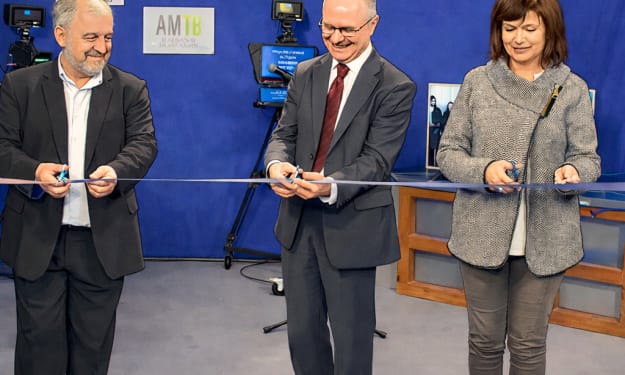
The Unique Case of Alma Mater TV
(A Review of Charmaine Voigt's Dissertation on Practical Media Training) Abstract This review examines the Bulgarian case study of Alma Mater TV as discussed in Charmaine Voigt's doctoral dissertation College Television: Practical Media Training in US and German Higher Education. While Voigt's work focuses primarily on Anglo-American and German contexts, the Bulgarian example stands out as an exceptional and largely unmatched model of student television in Europe. Alma Mater TV, based at the Faculty of Journalism and Mass Communication at Sofia University 'St. Kliment Ohridski', functioned not merely as a training platform but as a fully operational public-facing television project. Students produced and aired original programmes on Bulgaria's largest national broadcasters without censorship or editorial interference, while simultaneously participating in the creation of a European student television network. This review argues that Alma Mater TV represented a globally unique pedagogical and institutional experiment whose decline resulted not from structural failure but from a lack of strategic vision at the university leadership level. Particular attention is paid to the decisive roles of Professor Svetla Bozhilova and Professor Peter Ayolov in establishing and sustaining this model.
By Peter Ayolov2 days ago in Education



Comments
There are no comments for this story
Be the first to respond and start the conversation.