
ENHANCEMENT OF COP IN VAPOUR COMPRESSION REFRIGERATION SYSTEM WITH DC COMPRESSOR
Abstract

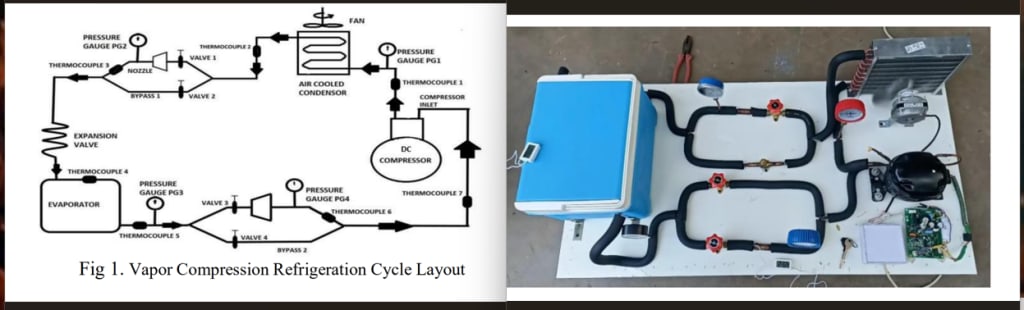
: Vapour compression refrigeration system is a high dimensional thermodynamic coupling system in which the coefficient
of performance (COP) is the area of interest and tremendous researches are going to increase the coefficient of performance (COP). In
this project a Vapour compression refrigeration system using R600a refrigerant as a working fluid and working based on a vapour
compression cycle is designed and fabricated. In this vapour compression refrigeration system, a nozzle is placed between condenser
and expansion valve and a diffuser is placed between evaporator and compressor. The diffuser placed is used to increase the pressure
of refrigerant gas flowing into the compressor and thereby decreasing the power input given to compressor. And also replacing the AC
Compressor with DC Compressor to decrease the power consumption. And also replacing the AC Compressor with DC Compressor
to decrease the power consumption. The nozzle placed is used to increase the velocity of refrigerant liquid going from condenser to
expansion valve. An experimental investigation has been performed on this system with concentrating variables like coefficient of
performance (COP), compressor power consumption and cooling capacity. The performance of the simple vapour compression
refrigeration system and the system with nozzle, diffuser and DC compressor is compared and the best system is evaluated.
KEYWORDS - DC Compressor (Inverter), Nozzle, Diffuser and Coefficient of Performance (COP)
I. INTRODUCTION
Refrigeration is the science of the producing and maintaining temperatures below that of the surrounding atmosphere. This means
the removing of heat from a substance to be cooled. Heat always passes downhill, from a warm body to a cooler one, until both bodies
are at the same temperature. Not only perishables today many human work spaces in offices and factory buildings are air- conditioned
and a refrigeration unit is the heart of the system. Before the advent of mechanical refrigeration water was kept cool by storing it in
semiporous jugs so that the water could seep through and evaporate. The evaporation carried away heat and cooled the water. This system
was used by the Egyptians and by Indians in the Southwest. Natural ice from lakes and rivers was often cut during winter and stored in
caves, straw-lined pits, and later in sawdust insulated buildings to be used as required.
The Romans carried pack trains of snow from Alps to Rome for cooling the emperor's drinks. Though these methods of cooling all
make use of natural phenomena, they were used to maintain a lower temperature in a space or product and may properly be called
refrigeration. In simple, refrigeration means the cooling or removal of heat from a system. The equipment employed to maintain the
system at a low temperature is termed as refrigerating system and the system which is kept at lower temperature is called refrigerated
system.
Refrigeration is generally produced in one on the following three ways:
(1) By melting of a solid,
(2) By sublimation of a solid, and
(3) By evaporation of a liquid.
Most of the commercial refrigeration is produced by the evaporation of a liquid called refrigerant Mechanical refrigeration depends
upon the evaporation of liquid refrigerant and its circuit includes the equipment's naming evaporator, compressor, condenser and
expansion valve. It is used for preservation of food, manufacture of ice, solid carbon-dioxide and control of air temperature and humidity
in the air-conditioning system. All refrigeration systems must include at least four basic units as given below:
A low temperature thermal "sink" to which heat will flow from the space to be cooled.
Means of extracting energy from the sink, raising the temperature level of this energy, and delivering it to a heat receiver.
A receiver to which heat will be transferred from the high temperature high pressure refrigerant.
Means of reducing pressure and temperature of the refrigerant as it returns from the receiver to the "sink".
. METHODOLOGY
In the vapor compression refrigeration system, the refrigerant always undergoes the phase change from liquid to vapour and then
vapour to liquid during a closed cycle by absorbing the heat or warmth from the products to be refrigerated within the evaporator and
reject the heat or warmth at condenser. The coefficient of performance (cop), that may be a magnitude reaction of heat transfer rate at
the evaporator to the ability input to the compressor within the refrigeration system. The COP will be increased either by decreasing
the compressor work or by increasing the refrigeration effect. Completely different ways are tried for improving the cop of the VCR
system, as according to literature a setup was fabricated by placing a nozzle in between condenser outlet and expansion valve and
performance was measured in four cases: i) Simple VCR ii) VCR with nozzle iii) VCR with diffuser iv) VCR with nozzle and diffuse.
Nozzle
A nozzle is often a pipe or tube of varying cross-sectional area and it can be used to direct or modify the flow of a fluid (liquid or
gas). Nozzles are frequently used to control the rate of flow, speed, direction, mass, shape, and/or the pressure of the stream that
emerges from them. In a nozzle, the velocity of fluid increases at the expense of its pressure energy.
Diffuser
A diffuser is "a device for reducing the velocity and increasing the static pressure of a fluid passing through a system”. The fluid's
static pressure rises as it passes through a duct is commonly referred to as pressure recovery. In contrast, a nozzle is used to increase
the discharge velocity and lower the pressure of a fluid passing through it
The main working is as follows
The refrigerant enters the DC compressor at low temperature and low pressure .It is in a gaseous state. Here,
compression takes place to raise the temperature and refrigerant pressure. The refrigerant leaves the DC
compressor and enters to the condenser.
The vapor travels through part of the condenser which removes the superheat by cooling the vapor with constant
pressure
The saturated liquid refrigerant passes through the expansion valve and undergoes an abrupt decrease of pressure.
That process results in the adiabatic flash evaporation and auto-refrigeration of a portion of the liquid, the
adiabatic flash evaporation process is isenthalpic.
The cold and partially vaporized refrigerant travels through the coil or tubes in the evaporator where it is totally
vaporized by the warm air (from the space being refrigerated) that a fan circulates across the coil or tubes in the
evaporator. The evaporator operates at essentially constant pressure and boils off all available liquid vapour . The
required circuit is obtained by using the given valve configurations. Then the compressor is supplied.
About the Creator
veeranki ratna ramesh
Be happy
Keep reading
More stories from writers in Education and other communities.
Is Someone Tracking You? How a GPS Tracker Detector Can Help
In a world where information reaches all corners of the globe, the issue of privacy is getting all the more serious. Phones, applications, and cars are transmitting information, not always with explicit permission. Creepy tracking devices are now more widespread, sneaking into cars or personal journeys to track movement without any notice.
By Arfa Gravityabout 7 hours ago in Education
Before Time Began: The Astonishing Story of the Big Bang and the Birth of Our Universe
What if everything you have ever known—every star in the sky, every planet, every grain of sand, and even time itself—once existed inside a space smaller than a single atom? This breathtaking idea is not science fiction. It is the foundation of the Big Bang theory, the scientific explanation for how our universe began nearly 13.8 billion years ago.
By Antonuos Zarey2 days ago in Education
Nancy Guthrie: Is a miracle still possible after close to two weeks?
Close to two weeks since Nancy Guthrie's abduction As of February 12, 2026, Nancy Guthrie remains classified as missing for 12 days, but there is no official confirmation that she is deceased. Blood matching Guthrie’s DNA was found on her front porch, indicating she likely suffered an injury during the abduction.
By Cheryl E Prestona day ago in Geeks



Comments
There are no comments for this story
Be the first to respond and start the conversation.