
Before Time Began: The Astonishing Story of the Big Bang and the Birth of Our Universe
The explosive origin of space, time, and all existence.

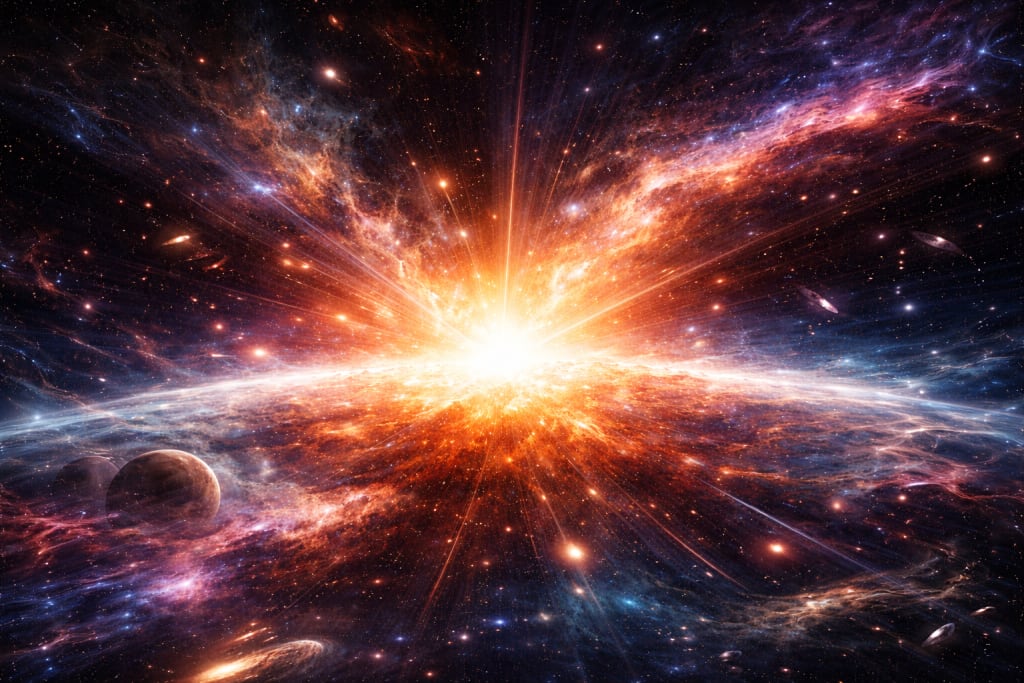
What if everything you have ever known—every star in the sky, every planet, every grain of sand, and even time itself—once existed inside a space smaller than a single atom? This breathtaking idea is not science fiction. It is the foundation of the Big Bang theory, the scientific explanation for how our universe began nearly 13.8 billion years ago.
The Big Bang was not an explosion in empty space, as many people imagine. Instead, it was the rapid expansion of space itself from an incredibly hot, dense state. In the earliest moment we can describe, the universe was unimaginably small, filled with energy so intense that the laws of physics as we know them struggled to apply. Then, in less than a second, the universe expanded faster than the speed of light in a phase scientists call cosmic inflation. This sudden growth set the stage for everything that would follow.
As the universe expanded, it also cooled down. Within the first few minutes, the simplest elements—mainly hydrogen and helium—began to form. For hundreds of thousands of years, the universe remained a glowing fog of particles and radiation. Eventually, it cooled enough for atoms to form, allowing light to travel freely through space for the first time. That ancient light still exists today and is known as the cosmic microwave background radiation, one of the strongest pieces of evidence supporting the Big Bang theory.
Over millions of years, gravity slowly pulled matter together, forming the first stars and galaxies. Inside stars, nuclear fusion created heavier elements like carbon, oxygen, and iron—the same elements that make up planets and even the human body. In a very real sense, we are made of star stuff, connected to the earliest moments of the universe.
But how do scientists know all of this happened?
One major clue came from astronomer Edwin Hubble in the 1920s. He discovered that distant galaxies are moving away from us, and the farther they are, the faster they recede. This observation revealed that the universe is expanding, suggesting that everything must once have been much closer together. Later discoveries, especially the detection of cosmic microwave background radiation in 1965, confirmed that the universe truly had a hot, dense beginning.
Despite its success, the Big Bang theory does not answer every question. Scientists still wonder what caused the Big Bang and what existed before it—if “before” even makes sense when time itself began at that moment. Some theories propose quantum fluctuations, others suggest cyclic universes or even a multiverse where many universes exist beyond our own. These ideas remain mysterious, reminding us that the universe still holds secrets waiting to be discovered.
The Big Bang is more than a scientific theory; it is a story about origins. Every atom in your body was forged in ancient stars born from that first cosmic moment. Every night sky you look at is a window into billions of years of history. Understanding the beginning of the universe helps us understand our own place within it.
And perhaps the most astonishing truth is this: the universe is still expanding today. Galaxies continue drifting apart, space keeps stretching, and the future of the cosmos is unfolding right now. Some scientists believe expansion will continue forever, leading to a cold, dark universe known as the Big Freeze. Others imagine different endings, but the final fate remains unknown.
From a tiny, blazing beginning to the vast universe we see today, the journey of the cosmos is the greatest story ever told—a story written in light, gravity, and time. And as our technology improves and our curiosity grows, humanity moves one step closer to answering the ultimate question:
Why did the universe begin at all?
Until that mystery is solved, the Big Bang remains both a triumph of science and a reminder of how much wonder still lies beyond the stars.
About the Creator
Keep reading
More stories from Antonuos Zarey and writers in Education and other communities.
Hepatitis C: The Silent Virus That Affects Millions Worldwide
What if you were carrying a dangerous virus for years without knowing it? Millions of people around the world are living with Hepatitis C without showing any clear symptoms. This silent virus slowly attacks the liver and can remain undetected for decades, causing serious health problems if left untreated. Despite its severity, Hepatitis C is now considered one of the most curable viral diseases thanks to modern medical advancements.
By Antonuos Zarey10 days ago in Education
Thriving for the Future: Modern Personal Development Trends That Drive Long-Term Success
Personal development continues to evolve as people seek effective, sustainable ways to improve their lives. Modern trends focus on practical strategies, science-backed methods, and tools that promote long-lasting growth. These approaches support a healthier mindset, stronger skills, and more productive habits. In a world that changes rapidly, people want development methods that help them stay adaptable, confident, and prepared for future challenges. Modern personal development trends meet these needs by offering flexible, accessible, and transformative solutions.
By Alfonso Kennard6 days ago in Education



Comments
There are no comments for this story
Be the first to respond and start the conversation.