
Earth’s Uncharted Path
Navigating Earth’s Hurtling Path in 2024

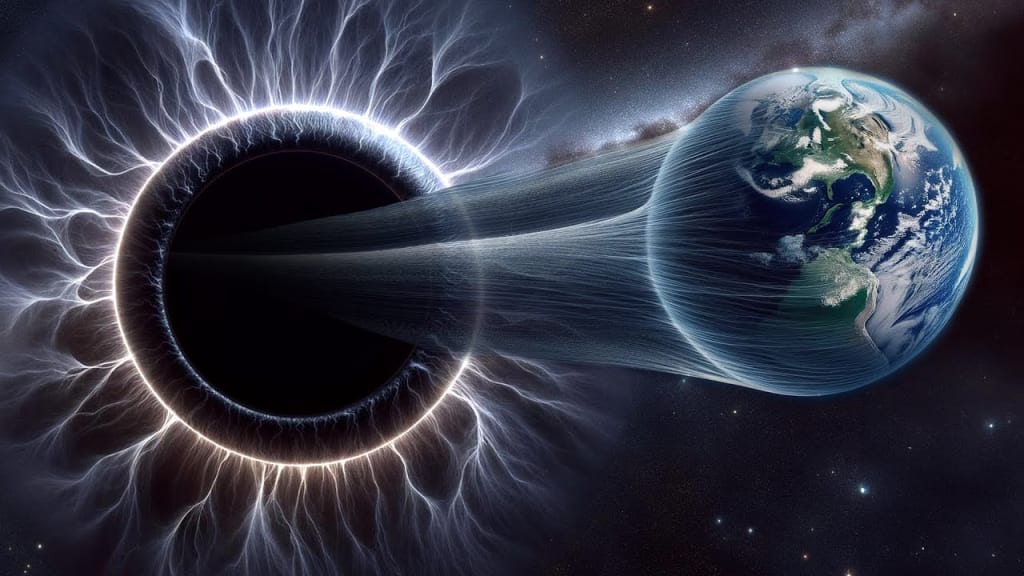
In the 1970s, astronomers studying the Cosmic Microwave Background (CMB)—the leftover light from the birth of the universe—made a remarkable discovery. Our galaxy, the Milky Way, and everything in it, including you, is hurtling through the universe at an astonishing 390 kilometers per second. To put that into perspective, since you started reading this article, you've physically traveled more than 11,000 miles. Measuring the speed of our galaxy accurately for the first time was a big deal, but it was also a little bit scary because nobody really knew exactly why the Milky Way was moving so quickly.
A significant chunk of our velocity can be explained by the expansion of the universe, which causes all astronomical objects to move at rates described by something called the Hubble flow. Some of the rest is accounted for by the interplay of gravity between the Milky Way and our nearest galactic neighbors, like Andromeda. But something was still missing. We appeared to be moving at a speed and in a direction that we just couldn't quite explain. It was almost as though our entire galaxy was being dragged off course by some vast, distant object. This was disconcerting, to say the least.
But there was more. It turned out it wasn't just the Milky Way that was being pulled towards this mysterious unseen object. Every single galaxy in our little corner of the universe—around 100,000 of them in a region spanning more than 500 million light years—is being pulled inexorably towards the same unknown thing. This was downright terrifying. Astronomers decided to call this mysterious object the "Great Attractor." But coming up with such an ingenious name was the easy part; the hard part was determining just what it could possibly be.
There's only one force in the universe capable of nudging entire galaxies off course over distances of hundreds of millions of light years: gravity. Gravity is created by mass. The more mass an object has, the stronger the gravitational force it exerts. In order to attract 100,000 galaxies over a distance of hundreds of millions of light years, the Great Attractor has to be big. And when I say big, I mean unimaginably, mind-bogglingly, rules-of-the-universe-breakingly colossal.
The question is, what is it? And more importantly, what's going to happen to us when it finally reels us in?
Let's start with the first question. We typically learn about distant objects in space by training our telescopes on them and having a good look around. But just to amp up the mystery even more, when astronomers first tried to probe the Great Attractor with their trusty telescopes, they quickly realized that wasn't going to work. The Milky Way is a spiral galaxy about 100,000 light years across, and its 100 billion or so stars are concentrated along a plane 1,000 light years thick. Unfortunately, our view of deep space through the plane of our own galaxy is almost entirely obscured by vast clouds of interstellar dust and gas. This section of the night sky, obscured by the plane of the Milky Way, is known as the Zone of Avoidance, and it obscures our view of about 10% of the universe. And you guessed it: the Great Attractor just so happens to lie smack bang in the middle of it.
For several decades after the Great Attractor was first discovered, its true nature remained a total mystery to us. We could only study it indirectly by measuring its gravitational impact on the galaxies around it. It wasn't much to go on, but it did allow us to determine the Great Attractor's approximate location: between 150 and 250 million light years away, in the direction of the Norma constellation. And for the first time, we got a hint at its massive size. According to our current best estimates, the Great Attractor contains mass equivalent to 10 quadrillion suns. At the time, that number just didn't make any sense. Nothing in our universe is even close to being that size.
As of today, the biggest single entity ever discovered is an ultra-massive black hole called Ton 618, which powers a quasar that burns with the light of 140 trillion suns. It may well be the biggest thing that has ever or will ever exist in our universe. Yet, it's estimated to weigh in at just 66 billion solar masses, around 150,000 times less massive than the monstrosity that is the Great Attractor.
Using the new technology of radio and infrared telescopes, we finally peered through the Zone of Avoidance to catch a glimpse of the patch of sky containing the Great Attractor. What we found there was more galaxies—loads of them. While it might sound like an anticlimax, seeing beyond the Zone of Avoidance helped us understand the true nature of the Great Attractor. It turned out to be a place, not a thing. Specifically, it's the gravitational center of the Laniakea Supercluster, a massive structure containing about 100,000 galaxies spread over 520 million light years.
So, what's going to happen to us when we get there? The Great Attractor is located about 200 million light years away. Traveling towards it at 390 kilometers per second, we should expect to arrive in about 95 billion years. Except we won't. The universe is expanding, and the rate of that expansion is increasing. Thanks to this accelerating expansion, the distance to the Great Attractor will eventually begin to grow, even as our speed towards it increases. Imagine two ants crawling towards each other on the surface of a balloon. If the balloon stays at a fixed volume, the ants will meet. But if you start inflating the balloon, the distance between the ants will increase. Blow the balloon up fast enough, and no matter how quickly the ants scurry towards each other, they will continue to get further apart.
This is essentially what will happen with the Milky Way and the Laniakea Supercluster. Our descendants will never reach the Great Attractor. The expansion of the universe will eventually cut us off from everything else. The observable universe, currently 93 billion light years across and containing an estimated 200 trillion galaxies, will fade away as galaxies recede into the cold, dark reaches of space at a rate faster than the speed of light. Only the galaxies in our local group will remain with us.
In the end, the grand cosmic web of the universe we know today will fade away to nothing.
About the Creator
Horace Wasland
Research analyst, writer & mystical healer. Exploring the edge where science meets mystery. From mystery/the mystical, to facts, news & psychology. Follow for weekly insights on all four and please leave a tip if you like what you read :)
Keep reading
More stories from Horace Wasland and writers in Education and other communities.
Paradise Lost
John Milton's Paradise Lost is regarded by many as one of the greatest poems ever written in the English language. This epic poem follows two different narratives: the biblical story of Adam and Eve as they fall from grace and are expelled from the Garden of Eden, and the story of Satan, or Lucifer, who, along with the other fallen angels, must create their own home after being expelled from Heaven.
By Horace Waslandabout a year ago in Education
Image-to-text technology, also known as Optical Character
Image-to-text technology, also known as Optical Character Recognition (OCR), has transformed the way we interact with visual information. It allows machines to extract text from images, enabling various applications across multiple industries. From digitizing printed documents to reading text from scanned images, OCR plays a vital role in making printed content accessible, editable, and searchable. The need for such technology has grown exponentially with the increasing reliance on digital data and the rapid shift from physical to digital content in nearly all sectors of life. As the digital world continues to expand, image-to-text technology has paved the way for more seamless workflows, enabling businesses and individuals alike to save time, effort, and resources.
By Alexander Jackson5 days ago in Education
Most Sales Deals Fail Because Sellers Talk to the Wrong People
There is a quiet reason many sales conversations feel productive but go nowhere. Everyone leaves the call optimistic. Emails move back and forth. Documents get shared. Then momentum fades. Weeks pass. The deal stalls without a clear explanation.
By Armi Ponsica3 days ago in Education



Comments (3)
Thanks for sharing
wow
Excellent written