
Dust of Unseen Shores
A spectral city whispered to him across millennia, a home he'd never known, yet remembered in the marrow of his bones.

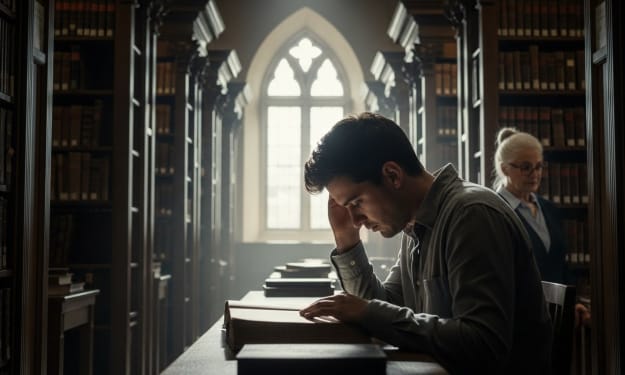
Leo smelled the dust before he saw it, a fine, ancient powder settling on the spines of forgotten tomes in the university’s deepest archive. Fluorescent lights hummed a low, sickly drone overhead, a modern blight on what felt like sacred ground. He preferred the dim corners, where slivers of weak morning sun cut through grime-streaked windows, illuminating motes that danced like tiny, forgotten spirits. The world outside, the hurried students, the blare of city traffic, it all felt distant, a fuzzy broadcast from another channel. His reality was here, between the crumbling pages of history.
Dr. Sharma’s voice, a gravelly river stone polished smooth by countless lectures, was the first thing that snagged him. She spoke of Alexandria, not as a chapter in a textbook, but as a living, breathing beast of a city. She described its light, the particular quality of the sun off the Mediterranean, the cacophony of languages, the scent of spices and salt and papyrus. Most professors recited facts. Dr. Sharma painted murals. For Leo, it wasn't just interesting. It was like a key turning in a lock he hadn't known was there, deep inside his ribs.
A shiver, not from cold, traced a line up his spine. He remembered. That was the only way to describe it. A faint, almost imperceptible *memory* of something he had never experienced. The feeling wasn't logical, wasn't academic curiosity. It was a ache, a longing that pulsed like a phantom limb. He found himself sketching in the margins of his notes: crude lines, attempts to capture the silhouette of a harbor, the impossibly tall Lighthouse, the stacked scrolls in a great hall. His hand moved almost on its own, guided by an intuition that felt older than him.
He drowned himself in the archives. Every spare hour, every dollar from his part-time barista job, went into old maps, translated fragments, archaeological reports. He learned about the Library, not just as a collection of scrolls, but as a buzzing hive of minds, a place where ideas clashed and bloomed. He saw the scholars, the mathematicians, the poets, their faces etched with the same intellectual hunger he knew too well. He saw the ships, laden with grain and exotic goods, docking at the busy port. He could almost taste the figs, the wine, the sea spray.
And the scent. Oh, the scent was the strongest. A blend of dry papyrus, a faint whiff of burning lamp oil, the sharp tang of the sea carried on the wind, and something else, something undefinable, like old ambition and vibrant debate. He’d close his eyes, hunched over a cracked leatherbound volume, and he was there. The dust in the archive transformed into the sun-warmed grit of Alexandria’s streets, the hum of the fluorescent lights became the murmur of a thousand tongues in the agora. He felt the weight of a scroll in his hands, the rough texture of the reed fibers, the smell of the ink. He was walking through a colonnade, the sun baking the stone, the air thick with the promise of discovery.
His friends, the few he had, stopped trying to drag him out. 'Still in ancient Egypt, Leo?' they'd quip, a mixture of amusement and concern in their voices. He just offered a weak smile. How could he explain that he wasn't *in* ancient Egypt, he *was* ancient Egypt, or at least a tiny, aching fragment of it? That he didn't just read about it, he *felt* it, like a ghost living in his own skin, whispering stories of a vibrant, lost city into his consciousness?
He started having dreams. Not like dreams you forget upon waking, but full, vivid experiences. He'd walk through the Library, its labyrinthine shelves stretching into impossible distances, the gentle rustle of scholars turning pages, the low, intense hum of intellectual pursuit. He'd sit by a window, the Mediterranean shimmering blue-green, the Pharos piercing the sky, and a profound, quiet peace would settle over him. Then he'd wake up, the harsh reality of his cramped dorm room a cruel shock, and the ache in his chest would intensify, a deep, mournful throb for a place that was now just ruins and whispers.
The most vivid 'memory' was of a specific scholar, a man with a tired face and ink-stained fingers, bent over a parchment, the lamplight throwing long shadows across his brow. Leo felt a kinship with him, a deep, silent understanding across two millennia. It wasn't pity, or admiration. It was recognition, like looking at an old photograph of a distant relative and seeing yourself reflected there. He knew that man's exhaustion, his fierce joy in uncovering a new truth.
It was a beautiful, heartbreaking feeling. To love a place so intensely, to miss it with every fiber, and to know it was utterly gone, save for the echoes he felt in his soul. It made him restless, made him feel out of sync with his own time. He’d sit in modern lectures, the words washing over him, his mind miles away, centuries away, trying to catch a glimpse of the great Mouseion, the grand halls, the bustling streets, before the fires, before the destruction. Before the silence.
One afternoon, during Dr. Sharma's office hours, he stood at her door, knuckles hovering. He wanted to tell her. To try and articulate this phantom memory, this exquisite pain. She looked up, her glasses perched on her nose. 'Leo? Everything alright?' He just shook his head, mumbled something about a bibliography, and backed away. How could he explain? It wasn't a question you could answer with sources.
He went back to the archives, the dust settling on him like a shroud. He pulled out a volume, a collection of fragments from a minor Alexandrian poet, and opened it to a random page. His eyes fell on a line, translated carefully: 'The ghosts of knowledge linger, if only we listen.' He traced the words with a shaky finger, a quiet acceptance settling over him. He knew what he had to do. He had to keep listening.
About the Creator
HAADI
Dark Side Of Our Society
Co-Parenting in the Digital Age
Co-Parenting in the Digital Age: Shared Circles, Alerts, and Neutral Tech Tools Modern co-parenting requires a modern toolkit. Beyond shared calendars, technology offers powerful ways to foster cooperation, ensure consistency, and prioritize your child's safety. The right digital approach can reduce conflict and create a more stable environment for everyone.
By Olivia Martinez4 days ago in Education
10 Unconventional but Highly Effective Ways to Learn French Faster
Most people who want to learn French all start in the same place. Grammar books, rules, written exercises, conjugation tables, structured courses, and the reassuring feeling of “making progress.” Yet after months, sometimes years, many are still unable to hold a real conversation. They hesitate, translate in their head, search for words, lose confidence, and eventually conclude that French is simply too complicated for them.
By Bubble Chill Media 3 days ago in Education


Comments
There are no comments for this story
Be the first to respond and start the conversation.