
The Weight of Dust and Whispers
In the hushed halls of forgotten stories, a subtle presence held the key.
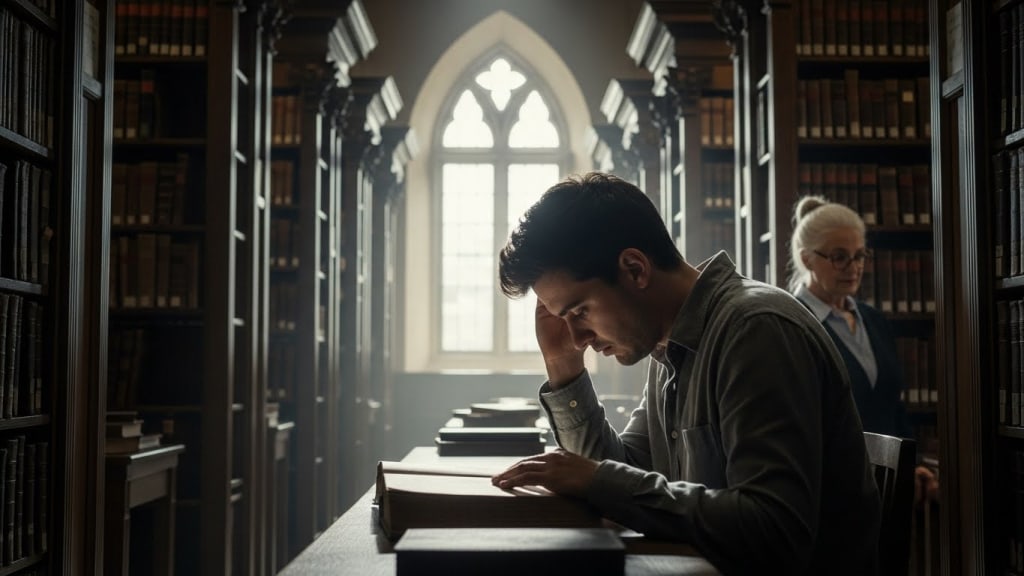
Leo sagged against the oak table, his neck stiff, eyes gritty from hours of staring at the same damn page. Sunlight, thick with dust motes, slanted through the tall arched windows of the old university library, illuminating nothing useful in his desperate search. The smell of old paper, leather, and something faintly metallic – maybe just the iron of the shelves rusting slow – clung to everything, even to his hair, he thought. Three weeks. Three weeks of this. He pressed the heels of his hands into his eye sockets until phantom stars exploded behind his lids, then dragged them down his face. Fatigue made his jaw ache. The blank spot in his thesis, this one single, critical missing link on the obscure Victorian botanist, felt like a hole burned straight through his brain, mocking him.
The section, "Archaic Natural Histories," was a mausoleum of forgotten theories and faded ink. Row after row of heavy, leather-bound volumes, some with brittle paper so yellow it looked like dried parchment. Nobody ever came back here, not really. Students preferred the bright, sterile glow of the digital commons, the instant gratification of a search bar. Not Leo. He believed the answer, if it existed, would be tucked away, hidden by time and neglect, in the physical weight of these forgotten books. His professor, Dr. Albright, had just looked at him with that quiet, disappointed gaze last week. "Leo," he'd said, "you're nearly there. Just this one final thread. Don't falter now." Don't falter. Easy for him to say. Albright had tenure, a string of published papers. Leo had crippling student debt and a deadline that loomed like an executioner.
He reread the last paragraph of the article he'd been dissecting. "…the elusive 'Winterbloom Journal,' rumored to contain specific details of Thistlewaite's expedition to the Scottish Highlands, remains uncatalogued, its existence a matter of academic speculation." Speculation. Right. He'd scoured every possible keyword, every index, every dusty card catalog drawer that still existed. Nothing. He leaned back in his chair, the wood groaning softly, a lonely sound in the cavernous silence. His stomach growled. Lunch forgotten. Everything forgotten but this gnawing emptiness where the answer should be. He felt a cold knot tighten in his gut. What if it wasn't here? What if Albright was wrong? What if *he* was just not good enough for this? The thought, cold and sharp, cut through the academic fog.
That’s when he saw her, or rather, felt her presence. Mrs. Gable. The archivist. She moved through the stacks like a whisper herself, her sensible shoes making no sound on the polished wooden floor. Silver hair pulled back in a severe bun, spectacles perched on the end of her nose, she was as much a fixture of this section as the books themselves. She rarely spoke, merely glided, adjusting a displaced volume here, straightening a leaning stack there, her movements economical, almost ritualistic. Today, she was working her way along the row directly opposite Leo, a few aisles over. He watched her for a moment, a strange comfort in her quiet, methodical presence. A constant in a world of variables.
He returned to his futile search, pulling down another heavy volume titled "Flora of the Northern Isles," its pages smelling faintly of mildew. He flipped through it, the faint hope he’d felt extinguishing with each dense, botanical entry. Not here. Of course not here. He closed it with a soft thud and pushed it aside. That’s when he heard it. A faint, almost imperceptible *shk-thump*. Not loud enough to be a dropped book, more like something being nudged, gently, deliberately. He looked up. Mrs. Gable was two aisles down now, her back to him, reaching up to a shelf that was nearly eye-level for Leo. She was doing something with a book there, not pulling it, but repositioning it. A dark, unremarkable volume.
His eyes lingered on her, then on the book she’d just touched. It wasn't anything he recognized, certainly not the flamboyant, gilt-edged style of the more important 'specimen' books. This one was plain, unassuming, bound in a dark, worn cloth. Almost indistinguishable from a hundred other neglected tomes. He’d probably walked past it a dozen times without a second glance. Why had she bothered with that one? It was already perfectly straight. The *shk-thump* repeated, softer this time, as if she were settling it back into place, giving it a final, almost affectionate pat. Then she moved on, gliding around the corner, out of sight.
Curiosity, a tiny ember of it, flickered amidst his despair. He got up, slowly, his legs stiff. He shuffled over to the aisle, his gaze landing on the spot where Mrs. Gable had been. The plain dark book sat exactly as all the others, no more prominent, no less. But something. Something about the way she'd lingered, the specific, quiet sound. He reached for it, his fingers brushing against the rough, dusty cloth. It wasn't heavy, felt ordinary. He pulled it out. *The Lesser Known Botanists of the Mid-Victorian Era*. He almost put it back. Lesser known. What good was lesser known when he needed the *Winterbloom Journal*? But something held him. He flipped it open right there in the aisle, the pages crackling softly.
He skimmed the introduction, then the table of contents. No mention of Thistlewaite directly, not in the main sections. Just as he was about to sigh and put it back, his eyes caught on a footnote, tiny script at the bottom of page 117. A reference. Not to the *Winterbloom Journal* itself, but to a *letter*, written by a contemporary of Thistlewaite, mentioning a *copy* of parts of the journal, bound separately, privately, and given to a small, provincial historical society in the Orkneys, just off the Scottish coast. A copy. A privately bound copy. Not a journal to be cataloged, but a collection of letters, a gift. A whisper from a long-dead academic, a clue so specific, so utterly obscure, it made his breath catch. He looked up, heart hammering, a dizzying rush.
The library was still. The sunbeams still danced with dust. But the silence now felt different. It hummed, not with emptiness, but with possibility, with connections, with the faint, persistent voices of those who’d come before. He clutched the book, the plain dark cloth warm against his suddenly damp palms. He looked down the aisle, where Mrs. Gable had disappeared. He could almost feel her presence, a warmth in the air. He didn't see her, not really. But he knew. It wasn't just a book. It was a nudge, a guidance, a silent transfer of something profound.
He walked back to his table, the book held tight. He didn't sit. He just stood there, looking out the arched window at the world beyond the library walls, a world that suddenly felt within his reach again. His eyes burned, but not from fatigue this time. He knew what he had to do. The Orkneys. He’d start making calls first thing tomorrow.
About the Creator
HAADI
Dark Side Of Our Society
How Snowboarding Supports Mental Focus and Stress Relief
Snowboarding is more than a winter sport. It is also a powerful way to support mental focus and reduce daily stress. Many people turn to snowboarding for the thrill. Others discover that it helps them feel calm, clear, and balanced. Time on the mountain can quiet the mind in ways few activities can match.
By Dr. Shawn Keller7 days ago in Education
Competitive Distance Running Excellence Built on Repeated High Race Placements
Competitive distance running rewards athletes who can perform well again and again. One strong finish is impressive, but multiple high placements in recent races show true consistency. These results point to smart training, clear focus, and the ability to manage pressure over time. This article explores how competitive distance running athletes achieve repeated success, why high placements matter, and what helps runners stay near the front of the field.
By Daniel Podora day ago in Education


Comments
There are no comments for this story
Be the first to respond and start the conversation.