
10 Unconventional but Highly Effective Ways to Learn French Faster
Without Traditional Teaching

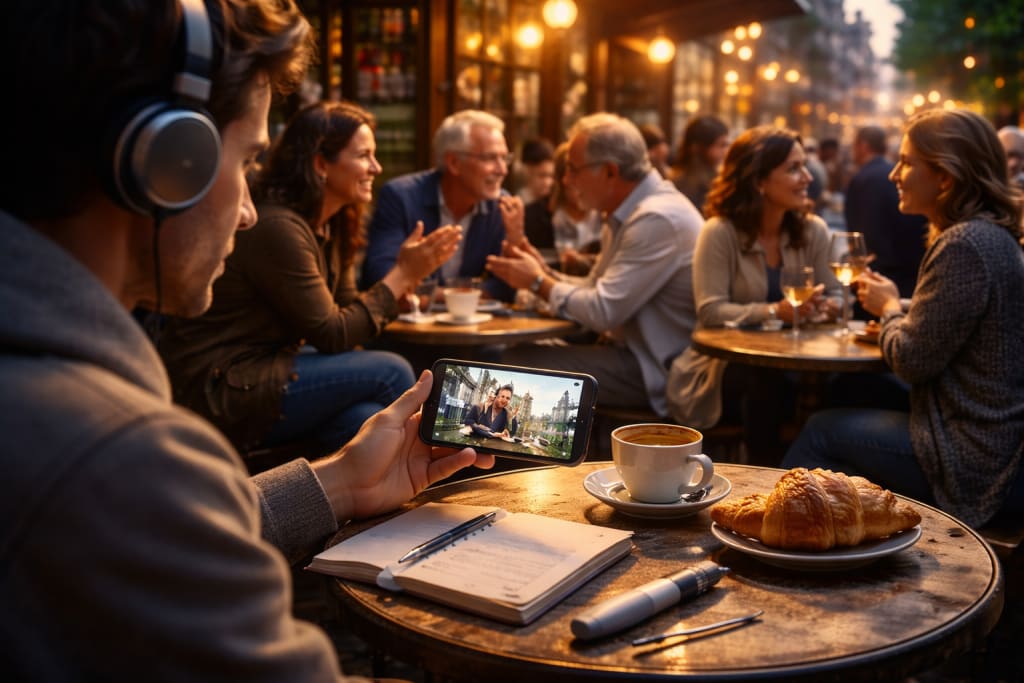
Most people who want to learn French all start in the same place. Grammar books, rules, written exercises, conjugation tables, structured courses, and the reassuring feeling of “making progress.” Yet after months, sometimes years, many are still unable to hold a real conversation. They hesitate, translate in their head, search for words, lose confidence, and eventually conclude that French is simply too complicated for them.
The reality is simpler, and also more uncomfortable: the problem is not the learners, but the methods. French is not a school subject. It is a living language. It is not learned primarily through rules, but through the ear, the mouth, rhythm, emotion, and real repetition. Learning French quickly therefore requires leaving the academic framework and entering a logic of immersion, conversation, and lived experience.
Here are ten unconventional, sometimes surprising, but genuinely effective ways to learn French faster — precisely because they move away from traditional teaching.
1. Immerse yourself in real French, not simplified French
Beginners are often advised to start with slow, simplified, artificial French. This type of content feels reassuring, but it delays real adaptation. The brain does not learn language through comfort; it learns through exposure.
Listening regularly to real French — even without understanding everything — trains the ear far more effectively than fabricated dialogues. Debates, long interviews, documentaries, spontaneous discussions… Over time, the brain begins to recognize sounds, structures, and intonation patterns. Understanding comes later. Familiarity comes first.
2. Use YouTube as an immersion tool, not a classroom
YouTube is one of the most powerful language-learning tools ever created, as long as it is used intelligently. Not to watch grammar lessons, but to consume content made for native speakers.
Politics, culture, society, philosophy, humor, personal testimonies, long discussions. By regularly watching this type of content, learners absorb French as it is actually spoken. They learn expressions, speed, irony, hesitation, emotion. French stops being an object of study and becomes an environment.
3. Put yourself in situations where French is necessary, not optional
Nothing accelerates learning like necessity. As long as French remains optional, the brain can avoid it. When it becomes necessary to interact, understand, or participate, everything changes.
Philosophy cafés, cultural meetups, public talks, associations, real social contexts — these situations force the use of French without safety nets. Perfection disappears. Effectiveness takes over. And it is precisely in these moments that language becomes fluid.
4. Accept not understanding everything and stop translating
One of the greatest obstacles to learning is the obsession with understanding every word. Translation feels safe, but it traps the learner. It prevents French from existing as an autonomous language in the brain.
The learners who progress fastest accept imprecision. They understand intention, general meaning, emotion, without demanding perfection. This tolerance for discomfort is a crucial skill. Fluency is born from accepting ambiguity, not from eliminating it.
5. Work with an independent conversation coach or tutor
This is often the decisive turning point. Conversation is not a bonus. It is the core of learning.
Independent conversation coaches, free from academic programs, focus on real speech, confidence, rhythm, and spontaneity. They adapt to the person, not to a textbook. They correct when useful, but above all they make the learner speak.
Traditional teaching explains a lot, but makes people speak very little. Conversational coaching does the opposite. And this difference changes everything. To learn quickly, speaking is the most powerful method that exists.
6. Learn French through disagreement and debate
Language is born in tension, not in artificial politeness. School dialogues are neutral, bland, and unrealistic. Real language lives in opinion, argument, and emotion.
Debating, even simply, forces learners to react, structure their thoughts, and defend an idea. Philosophy cafés, social or cultural discussions create a linguistic intensity that accelerates learning far more than any written exercise.
7. Connect French to identity, not performance
Many learners experience French as a permanent exam. This mindset creates fear, silence, and self-censorship. Progressing quickly requires something else: existing in French.
Who are you in French? Curious? Reserved? Direct? Ironic? When the language becomes an extension of identity, mistakes stop being failures. They become part of a personal voice. And this is often when fluency finally appears.
8. Use natural repetition, not mechanical exercises
Repetition is essential, but not mechanical repetition. Hearing the same words, expressions, and structures repeatedly in real contexts anchors the language deeply.
Watching similar content, following the same speakers, staying within familiar themes creates natural repetition. The brain loves recognition. Grammar drills cannot compete with living repetition.
9. Remove grammar from the center of learning
Grammar is not useless, but it should never be central. It should come after usage, not before. Introduced too early, grammar paralyzes speech.
Fast learners speak first and analyze later. They use grammar as a clarification tool, not as a foundation. Spoken French is far simpler than textbooks suggest.
10. Build a life around French, not a schedule
The most successful learners do not “study” French. They live with it. Podcasts while walking, videos while eating, conversations instead of exercises, curiosity instead of obligation.
When French becomes a daily presence rather than a task, learning accelerates naturally. Consistency matters more than intensity. Pleasure matters more than discipline.
Conclusion
Learning French faster does not require more effort, but a different philosophy. A philosophy that prioritizes exposure over explanation, conversation over correction, identity over performance. Traditional teaching often creates the illusion of progress while delaying real communicative ability.
If you want French to become natural, spontaneous, and alive, you must stop studying it like a school subject and start living it like a world.
About the Creator
Bubble Chill Media
Bubble Chill Media for all things digital, reading, board games, gaming, travel, art, and culture. Our articles share all our ideas, reflections, and creative experiences. Stay Chill in a connected world. We wish you all a good read.
Keep reading
More stories from Bubble Chill Media and writers in Education and other communities.
How to Become a Super Tutor on Preply
Teaching online is now accessible to almost anyone. Creating a profile, offering lessons, and waiting for students is easy. What is much harder is becoming a tutor who is trusted, visible, and stable over time. On Preply, the Super Tutor status is not a cosmetic label. It is a strong signal sent to students, to the platform, and to the tutor themselves. It reflects seriousness, consistency, and a deep understanding of what makes online learning work.
By Bubble Chill Media 12 days ago in Education
Competitive Distance Running Excellence Built on Repeated High Race Placements
Competitive distance running rewards athletes who can perform well again and again. One strong finish is impressive, but multiple high placements in recent races show true consistency. These results point to smart training, clear focus, and the ability to manage pressure over time. This article explores how competitive distance running athletes achieve repeated success, why high placements matter, and what helps runners stay near the front of the field.
By Daniel Podor4 days ago in Education
Is Pharmacy Tech a Good Career Choice for 2026?
Given the recent shifts in the market and AI automation, people are now well aware that economic shakeups can drastically hinder their income sources. This is causing a lot of people to switch careers, and a majority of people are targeting healthcare roles. However, not all allied healthcare roles are created equal. Also, you can aim to become a medical assistant, but if you do not want to deal with patients, the ideal role for you is that of a Pharmacy Technician.
By Meaghan Howe4 days ago in Education




Comments
There are no comments for this story
Be the first to respond and start the conversation.