
Can Black Holes Collide and Merge? Exploring One of the Universe’s Most Violent Events
Black holes are often imagined as isolated cosmic monsters, silently devouring anything that comes too close. But the universe is not static. Galaxies collide, stars interact, and black holes—despite their extreme nature—are no exception to cosmic motion. This leads to an extraordinary question: Can black holes collide and merge with each other? The answer is a resounding yes—and not only is it possible, but it has already been observed. In fact, black hole mergers are among the most powerful events ever detected, releasing enormous amounts of energy and reshaping spacetime itself.

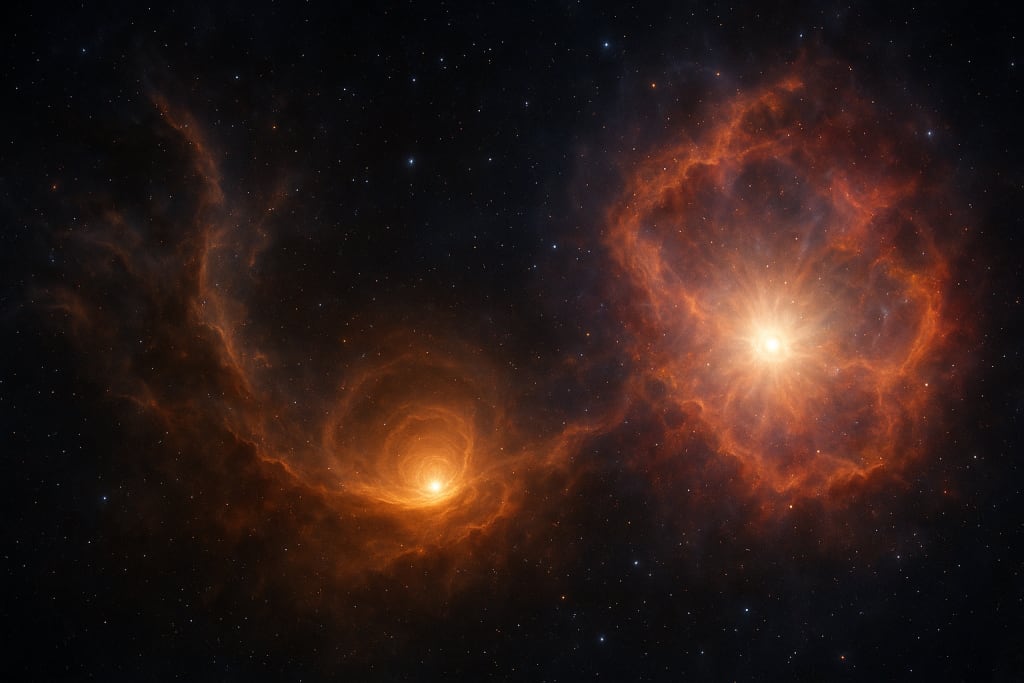
What Does It Mean for Black Holes to Merge?
A black hole merger occurs when two black holes:
• Become gravitationally bound
• Orbit each other in a binary system
• Gradually spiral inward
• Collide and combine into a single, larger black hole
This process releases energy in the form of gravitational waves, ripples in spacetime predicted by Einstein over a century ago.
________________________________________
How Do Black Hole Binaries Form?
1. From Binary Star Systems
Many stars are born in pairs. If both stars are massive enough:
• Each can collapse into a black hole
• The two black holes remain gravitationally bound
• A binary black hole system is created
Over millions or billions of years, these black holes spiral together.
________________________________________
2. Through Galactic Mergers
Almost every large galaxy contains a supermassive black hole at its center.
When galaxies collide:
• Their central black holes sink toward the merged galaxy’s center
• They form a supermassive black hole binary
• Eventually, they merge
These are among the largest mergers in the universe.
________________________________________
3. In Dense Star Clusters
In crowded environments:
• Black holes frequently interact
• Gravitational encounters can form binaries
• Repeated interactions harden the orbit
• A merger becomes inevitable
________________________________________
The Three Stages of a Black Hole Merger
1. Inspiral Phase
The black holes orbit each other:
• Gradually losing energy
• Emitting gravitational waves
• Orbiting faster and closer over time
This phase can last billions of years.
________________________________________
2. Merger Phase
At the final moment:
• Event horizons touch
• The black holes combine
• Spacetime violently reshapes
This brief phase releases enormous energy—more than all the stars in the observable universe combined (momentarily).
________________________________________
3. Ringdown Phase
The newly formed black hole:
• Vibrates like a struck bell
• Emits gravitational waves as it settles
• Reaches a stable shape
This confirms predictions of general relativity.
________________________________________
Have We Actually Observed Black Hole Mergers?
Yes—Directly
In 2015, the LIGO observatory made history by detecting gravitational waves from two merging black holes.
This discovery:
• Confirmed Einstein’s theory
• Provided the first direct evidence of black hole mergers
• Opened a new field: gravitational wave astronomy
Since then:
• Dozens of mergers have been observed
• Including stellar and intermediate-mass black holes
________________________________________
What Happens to Matter During a Merger?
Surprisingly:
• Most black hole mergers occur in empty space
• There is little or no matter involved
• No bright light is produced
However, in some cases:
• Gas and dust may surround the black holes
• The merger can produce electromagnetic radiation
• These rare events are studied intensely
________________________________________
Do Event Horizons Actually “Collide”?
This is a deep and subtle question.
From an external perspective:
• Event horizons merge smoothly
• No physical surface collision occurs
• Spacetime geometry simply reshapes
From inside:
• Physics is unknown
• Information about the interior remains inaccessible
________________________________________
What Happens to Information?
During a merger:
• Information about each black hole’s mass, spin, and charge remains
• Fine-grained information is encoded in gravitational waves
• This connects to the black hole information paradox
Mergers help physicists test ideas about information conservation.
________________________________________
Can Supermassive Black Holes Merge?
Yes—But Slowly
Supermassive black hole mergers:
• Occur after galaxy mergers
• Can take hundreds of millions of years
• Face the “final parsec problem”
Future space-based detectors will observe these events.
________________________________________
How Much Energy Is Released?
During a merger:
• Several solar masses are converted into energy
• Released as gravitational waves
• Power output briefly exceeds all stars combined
Yet:
• The effect is only noticeable nearby
• Earth is completely safe
________________________________________
Do Black Hole Mergers Create Bigger Black Holes?
Yes:
• Masses add (minus energy lost to waves)
• Spins combine
• A larger black hole forms
Over cosmic time:
• Mergers help grow supermassive black holes
• Shape galaxy evolution
________________________________________
Could Black Hole Mergers Affect Earth?
No realistic threat exists.
Gravitational waves:
• Pass through Earth harmlessly
• Stretch spacetime by less than a proton’s width
• Are detected only by extremely sensitive instruments
________________________________________
What Can We Learn From Black Hole Collisions?
Black hole mergers allow scientists to:
• Test general relativity under extreme conditions
• Measure black hole masses and spins
• Study the nature of spacetime
• Search for new physics beyond Einstein
________________________________________
Common Myths About Black Hole Collisions
❌ Black hole collisions cause explosions
✔ They emit gravitational waves, not blasts
❌ Event horizons crash like solid objects
✔ They merge as spacetime geometries
❌ Mergers destroy galaxies
✔ They occur quietly on cosmic scales
________________________________________
Future Observations and Missions
Upcoming detectors will expand our view:
• LISA (space-based observatory)
• Einstein Telescope
• Cosmic Explorer
These will detect:
• Supermassive black hole mergers
• Early-universe events
• New gravitational phenomena
________________________________________
Why Black Hole Mergers Matter
They represent:
• The most extreme tests of physics
• The dynamic nature of spacetime
• A new way of “listening” to the universe
They transform astronomy from seeing light to hearing gravity.
________________________________________
Final Conclusion
So, can black holes collide and merge?
Absolutely—and they do so regularly across the universe.
Black hole mergers:
• Are real, observed phenomena
• Release immense energy
• Reshape spacetime itself
• Confirm deep predictions of relativity
Far from being rare or impossible, black hole mergers are fundamental engines of cosmic evolution, silently shaping galaxies and revealing the deepest laws of nature.
About the Creator
Keep reading
More stories from shahkar jalal and writers in Education and other communities.
Avoiding Common Counterfeit U.S. Coins: Expert Tips from Laura Bennett
Expert Guide to Spotting Fake U.S. Coins I’ve handled tens of thousands of coins in my career, and that moment of doubt—the gut feeling something isn’t right—is something every collector experiences. That feeling isn't a weakness; it's your best line of defense. This guide is your toolkit to turn that doubt into decisive action. I’ll share the same systematic approach I use to separate the real treasures from the clever fakes, so you can build your collection with confidence.
By Laura Bennett7 days ago in Education
How to Succeed at the Benson Directory®
Congratulations and welcome to the Benson Directory® employee #22391! As our newest call handler, you will have the privilege of speaking with dozens of unique and interesting people on a daily basis as well as the opportunity to earn bonuses for high performance. Contained within this handbook you will find a set of ease to follow instructions designed to help you settle in to your new role and begin paving the way to success.
By S. A. Crawford3 days ago in Fiction



Comments
There are no comments for this story
Be the first to respond and start the conversation.