
Beyond the One-Size-Fits-All Classroom: How Personalized Learning is Redefining Education for a Diverse Generation
Unlocking Unique Potential: How Personalized Learning Transforms Education for Today’s Diverse Learners
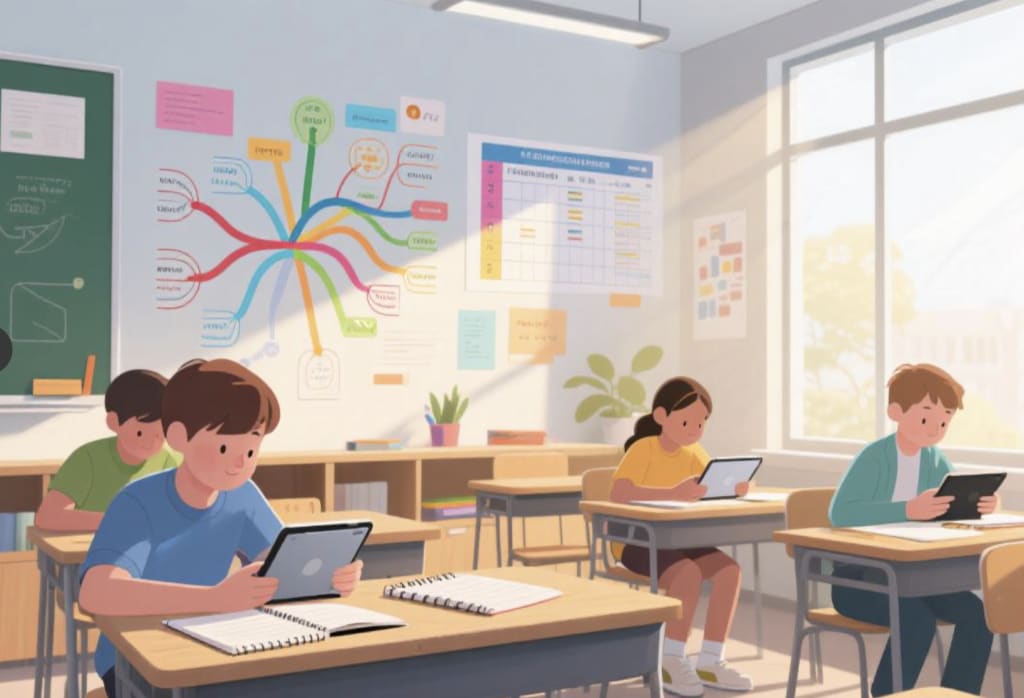
Let’s start with a scene that feels eerily familiar: A 9th-grade math class, 30 students, one teacher. The lesson is on quadratic equations. The student in the front row scribbles notes furiously, already solving bonus problems in their head. The student next to them stares at the board, brow furrowed—last week’s algebra basics still feel shaky. By the time the bell rings, the teacher has rushed through examples, answered two questions, and mentally noted: “I need to send extra worksheets to Maria, but wait, where did I put Javi’s makeup work from last month?”
This isn’t a story from a textbook—it’s the daily reality of millions of classrooms worldwide. For decades, education operated on a “one-size-fits-all” model, assuming all students learn the same way, at the same pace, with the same interests. But today’s learners are anything but uniform. Gen Z and Alpha students bring with them a mosaic of learning styles, cultural backgrounds, and life experiences. They’re digital natives who grew up swiping through apps, solving puzzles in video games, and collaborating on global projects—yet many still sit in classrooms that treat them like cogs in a machine.
The good news? A quiet revolution is underway. Personalized learning, once a buzzword confined to progressive schools, is now being adopted by mainstream education systems, tech innovators, and classroom teachers alike. At its core, it’s about shifting the focus from what we teach to how and when each student learns best. Let’s unpack why this shift matters—and how tools (and a little creativity) are making it possible for every learner to thrive.
Why “One Size” Never Fit All
Research has long shown that students learn differently. Some thrive with visual aids; others need hands-on experiments. A 2023 study by the National Center for Education Statistics found that 68% of high school students report feeling “bored or unchallenged” in class, while 55% say they’d engage more if lessons aligned with their personal interests. Traditional methods struggle to bridge these gaps because they rely on a single pace (the teacher’s) and a single metric (standardized tests) to measure success.
Take Mia, a 10th-grader I met last year. She hated math—until her school introduced a personalized learning pilot. Using an adaptive platform (more on that later), her teacher discovered Mia excelled at spatial reasoning but struggled with abstract formulas. Instead of forcing her through lectures, the class shifted: Mia spent mornings working on geometry projects (designing a community garden layout) and afternoons using interactive tools to build foundational skills at her own pace. By semester’s end, her math grade jumped from a C- to an A, and she joined the robotics club. “I finally felt like math was mine,” she told me. “Not just something the teacher wanted me to do.”
Personalization in Action: Tools That Empower, Not Just Teach
Critics often argue that personalized learning requires endless resources or 1:1 tutoring—a luxury most schools can’t afford. But technology has democratized this. Today, tools designed with learner agency in mind are making it easier for teachers to tailor instruction without drowning in paperwork. Here are a few I’ve seen work wonders:
• Adaptive Learning Platforms: Programs like DreamBox Learning (math) and Newsela (literacy) use algorithms to adjust content in real time. If a student masters fractions quickly, the platform serves up more challenging problems; if they stumble, it revisits concepts with interactive games or videos. Teachers get actionable data (e.g., “70% of the class needs review on linear equations”) without grading stacks of papers. https://www.dreambox.com (disclaimer: I’ve seen it transform classrooms—I’m not paid to say this).
• Project-Based Learning (PBL) Tools: Platforms like PBLWorks or Edutopia’s PBL Guide help teachers design projects that let students explore topics they care about. For example, a biology class might let students choose between researching renewable energy, designing a sustainable city, or testing water quality in a local river. These tools don’t just teach science—they teach critical thinking, collaboration, and how to apply knowledge to real-world problems.
• AI-Powered Tutoring: Tools like Khanmigo (from Khan Academy) act as 24/7 study buddies. Unlike generic chatbots, they adapt to a student’s learning style: If a learner prefers analogies, Khanmigo explains fractions using pizza slices; if they like logic, it breaks problems into step-by-step flowcharts. Best of all, they free up teachers to focus on high-impact interactions (like mentoring or creative projects) instead of repetitive drills.
The Human Side of Personalization: Why Tech Alone Isn’t Enough
Of course, tools are only as good as the humans using them. Personalized learning isn’t about replacing teachers—it’s about empowering them. When I visited a school in Oakland using these methods, what struck me most wasn’t the apps, but the relationships. Teachers spent morning “check-ins” asking students not just, “How’s your homework?” but, “What’s got you excited this week?” or “What’s something that’s been confusing, and how can I help?” Technology handled the data; teachers handled the heart.
This balance is key. A 2024 report by OECD found that schools combining tech tools with “relationship-driven pedagogy” saw 30% higher student engagement and 25% better retention than those relying solely on tech. Why? Because learning isn’t just cognitive—it’s emotional. A student who feels seen, heard, and supported will always outperform one who’s just “checking boxes.”
Challenges and the Road Ahead
Of course, personalized learning isn’t without hurdles. Many schools lack funding for devices or training. Others worry about equity: Will students from low-income families get access to the same tools as their wealthier peers? There’s also the question of over-reliance on data—can algorithms capture the nuance of a student’s creativity or resilience?
But progress is happening. Governments are investing in edtech grants (the U.S. Department of Education’s 2024 Digital Equity Act allocated $2.7 billion for this). Teachers are sharing best practices via communities like #PersonalizedLearning on Twitter. And students themselves are advocating for change—many of the teens I’ve interviewed say they’d choose a school that lets them “learn what I want, when I want” over a traditional one.
Final Thoughts: Education, Unplugged
Imagine a world where every student’s education feels like a custom playlist: some tracks are fast-paced and high-energy (hello, coding bootcamps!), others are slow and melodic (art classes, anyone?), and all of them are tailored to what makes that learner tick. That’s the promise of personalized learning.
It won’t happen overnight. But as more teachers, parents, and students demand it—and as tools evolve to support it—we’re moving closer every day. The future of education isn’t about screens or algorithms; it’s about unlocking potential. And that, to me, is the most human thing we can do.
So, whether you’re a teacher looking to experiment, a parent advocating for change, or a student hungry for more, start small. Ask a learner what they care about. Try a new tool. Challenge the status quo. After all, education isn’t just about preparing kids for the future—it’s about letting them build it.
What’s one small step you’d take to personalize learning for someone you know? Let’s discuss in the comments—I’d love to hear your ideas!
---
Note: Links to tools are included for readers interested in exploring solutions, not as promotional content. All experiences shared are based on real classroom observations.
About the Creator
Keep reading
More stories from liang ming and writers in Education and other communities.
Beyond the One-Size-Fits-All Classroom: How Personalized Learning is Redefining Education for Real Kids
Let me tell you about Mia. Last fall, I sat in on a 7th-grade math class at Oakwood Middle School in suburban Texas. Mia, a quiet 12-year-old with a passion for drawing (her notebook margins were filled with intricate sketches of dragons), was staring at her worksheet, erasing a wrong answer for the third time. Her teacher, Ms. Carter, noticed and pulled her aside. “You’re not dumb, Mia,” she said gently. “This algebra just isn’t clicking for you yet. Let’s try a different approach.”
By liang ming6 months ago in Education
Casie Hynes and the Future of Math Education Reform
Mathematics has always been a cornerstone of formal education. It strengthens reasoning, supports problem solving, and underpins critical fields such as science, technology, engineering, and economics. Yet despite its importance, math remains one of the most challenging subjects for students across the globe. Many learners struggle not because they lack ability, but because the way math is taught no longer aligns with how students learn or how the world now functions.
By Casie Hynesabout 18 hours ago in Education
Connected Wealth: Why Strong Networks Are Essential to Smarter Financial Planning
Financial planning is often associated with spreadsheets, forecasts, and long-term projections. While these technical elements are essential, they represent only one side of the process. Relationships, shared knowledge, and access to broader communities strengthen a truly effective financial plan. Networks—both personal and professional—play a critical role in shaping smarter, more resilient financial strategies.
By Lee Generous7 days ago in Education


Comments
There are no comments for this story
Be the first to respond and start the conversation.