
Best practices in supplier rationalization
Supply Chain Procurement

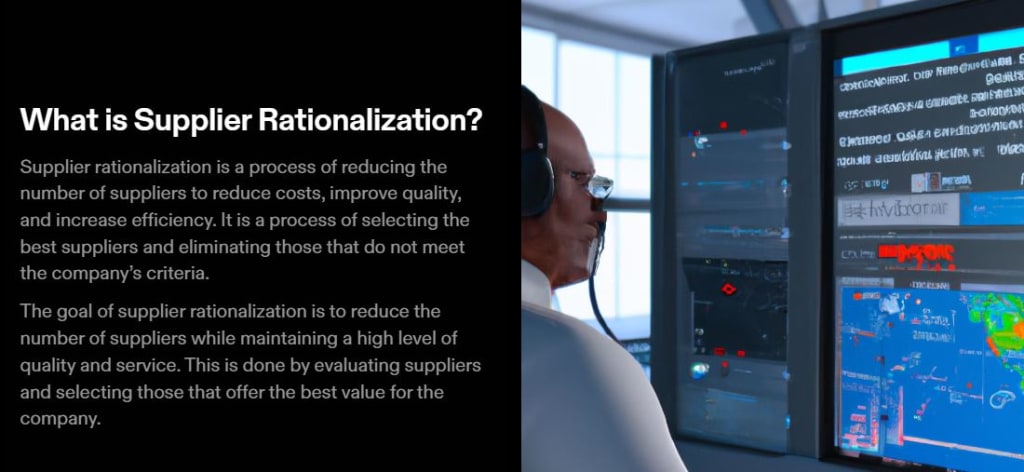
Supplier rationalization is one of the most strategic yet enduring activities in a procurement organization. Most of the organizations are at a stage where they have very little visibility into their supplier base.
Supplier rationalization, also known as supply base reduction, is the process of shrinking the supply base by reducing the number of active suppliers. The primary agenda of supplier rationalization is to streamline the organization’s spend to fewer suppliers and drive better value from those relationships.
Supplier base reduction may not be a new procurement concept, but it is an enduring, challenging and strategic one. The benefits of supplier rationalization are immense.
Having fewer suppliers simplifies process automation which in turn reduces procure to pay costs. However, procurement team faces a constant challenge when it comes to reduction in the number of suppliers.
The four-step approach to supplier rationalization would give the organizations a clear guidance to implement and maintain the rationalization process in-house.
It is also important to sign long-term contracts or undertake collaboration exercises with selected suppliers to achieve their full potential.
In the following the best-in-class supplier rationalization process identified in the industry has been discussed.
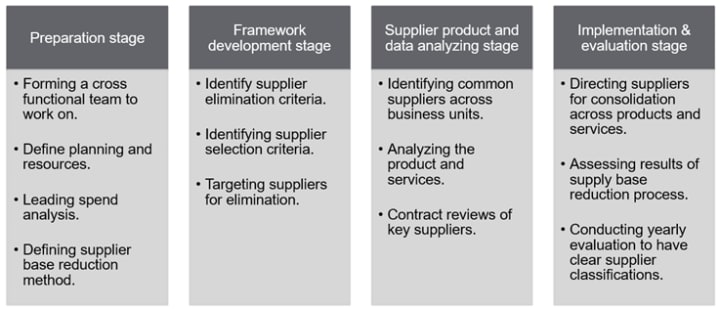
Targeting suppliers for the elimination criteria:
The elimination criteria are applied to the supplier data base. The outcomes of this step are as follows:
• a preliminary list of targeted suppliers for elimination and
• a preliminary list of targeted suppliers that require further detailed product and service analysis.
From the below illustration you can understand the supplier consolidation drivers and the benefits of supplier consolidation or concentration and also wider used term Supply base optimization.
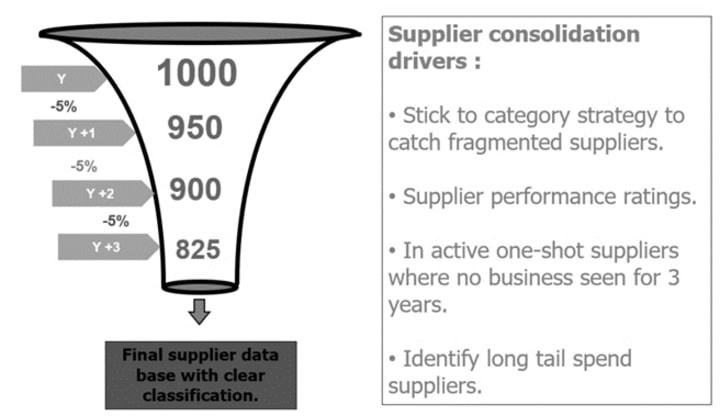
“Supplier consolidation consists of assigning the total spend to limited suppliers.”
This will provide greater leverage for:
• supplier negotiation
• lower total cost
• strengthening our supplier relationship
Do’s and Dont’s in implementing supplier rationalization process
DO's :
• Well-defined supplier evaluation/selection system to reward selected suppliers with long-term contract.
• Getting the right level of inputs and ensuring the concerned persons’ participation from cross-functions is important for the implementation phase of the supplier rationalization program.
• While moving business from high-volume suppliers to low/medium suppliers, buyers need to ensure the selected suppliers have the capacity and capability of supporting correctly and meet the quality and also the time requirements.
• Updating supplier data base with clear supplier classifications as a result from the supplier rationalization program and communicated to your internal users’ concern about this change.
DONT's
• Reducing the supplier base without establishing contractual relationships with suppliers could disrupt the supply of products.
• Companies should not give high priority to price criterion in the initial phase of supplier elimination.
Customer-imposed suppliers and contractors are the best for all time
In numerous circumstances, we are strained to go after customers and/or end user’s Approved Vendor List (AVL) as AVLs are already prequalified by them and we are required to work with them. Even though they are customer–Approved Suppliers, it’s our conscientiousness to qualify them based on the project and converse with them about our requirements of supplier selection and related contract terms & conditions.
A detailed supplier assessment is required to identify the gaps and address all the risks that need to be mitigated before moving forward with those suppliers. According to my experience, customer-imposed suppliers/suppliers/contractors are not the best always.
It’s our own responsibility to carry out the selection process of the suppliers. If required, we need to challenge customers to choose our own best fit suppliers for the given project.
Customer may not be pleased at the beginning, but we can prove them that our choice has executed the work well and thus directly results into satisfaction of end customers.
Benefits brought by your own vendor:
1. Mutual understanding helps quick strategic alignment with your vendor.
2. Awareness of strength and weakness of suppliers helps to focus only on the required areas.
3. Pre-establishments minimize upstream tender activities.
4. They support smooth and risk-free execution.
5. They help in continuous improvement opportunity (utilizing the experience from the past).
About the Creator
Sendil Arasu Vijaya Kumar
I attained bachelor degree in mechanical engineering and master degree in marketing management, having 21 Years of professional work experience. International exposure in Supply Chain Procurement domain. Author of "The Procurement Acumen"
Keep reading
More stories from Sendil Arasu Vijaya Kumar and writers in Education and other communities.
Building your own guided buying engine (supplier data base)
A supplier database is a collection of information about the vendors or suppliers that a company uses to procure goods or services. It can include data such as the supplier's name, contact information, products or services offered, pricing, delivery times, and any other relevant details.
By Sendil Arasu Vijaya Kumar3 years ago in Education
Avoiding Common Counterfeit U.S. Coins: Expert Tips from Laura Bennett
Expert Guide to Spotting Fake U.S. Coins I’ve handled tens of thousands of coins in my career, and that moment of doubt—the gut feeling something isn’t right—is something every collector experiences. That feeling isn't a weakness; it's your best line of defense. This guide is your toolkit to turn that doubt into decisive action. I’ll share the same systematic approach I use to separate the real treasures from the clever fakes, so you can build your collection with confidence.
By Laura Bennett7 days ago in Education
My New Book is Finally Here
My poetry collection Beautiful and Brutal Things is done. It's actually done and finally published over 270 pages. Over a year of my life went into this book. More than a year, really. Long days at my computer, sometimes seven days a week because I couldn't stop even when I probably should have. Then two months of editing that felt harder than the writing itself. But it's finished, and I'm still standing, and the book is real.
By Tim Carmichael3 days ago in BookClub



Comments
There are no comments for this story
Be the first to respond and start the conversation.