
ARE PEOPLE REALLY LEFT BRAINED OR RIGHT BRAINED .FIND OUT !!!!
BRAIN DEVELOPMENT
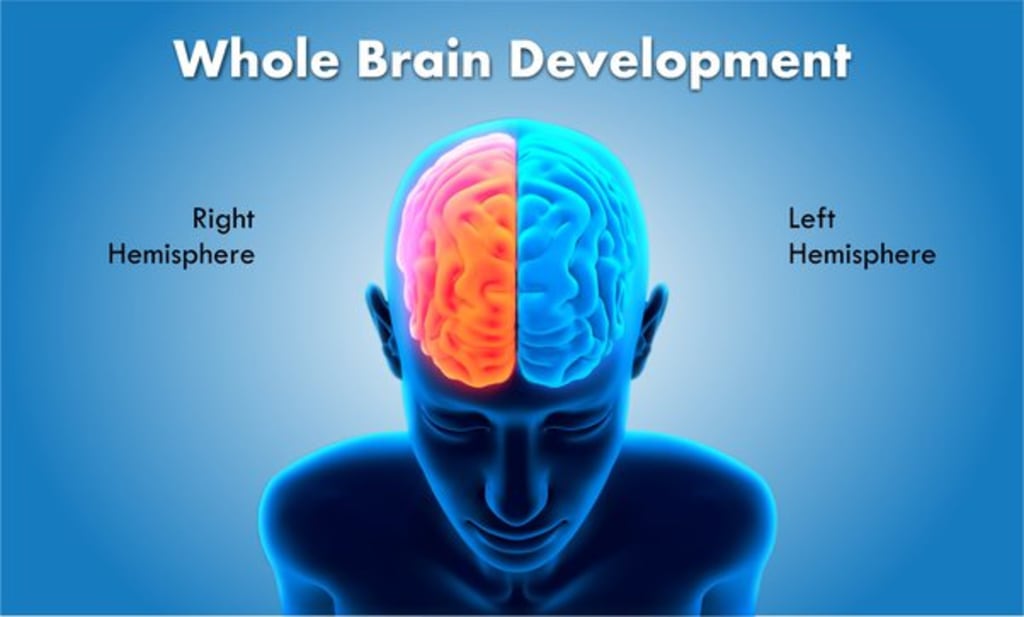
There are plenty of personality tests out there that claim to tell you which side of your brain controls how you think, what you’re good at … basically, who you are.
They might say that you’re a creative right-brainer, doomed to perform poorly in math and science. Guess you better give up on getting into MIT! Or they might tell you you’re a logical left-brainer, a regular Mr. Spock- terrible at the arts so, so much for Juilliard. But, you may have noticed that there are more than just two types of people in the world… and they’re not all either scientists or artists.
So there has to be some flaw in that whole left-brain/right-brain thing. Even if you never bought into the myth, your high school textbooks probably taught you that the right half of your brain processes creative tasks, and the left half can handle math or form language.
And that is a real thing! Different sides of the brain are often responsible for different tasks. It’s just that pop psychology has taken the idea a little too far. So it’s time to set the record straight about your brain, and you.
[Intro]
It all started way back in the 19th century, when doctors realized that the two halves of the brain might not be identical.
They noticed that when someone injured one side of their head, it affected some brain processes, like language or emotion, more than others. But it wasn’t until 1961 that a neurobiologist named Roger Wolcott Sperry set out to fill in the blanks, along with a graduate student he was working with at the time, Michael Gazzaniga. Sperry’s research over the next few years would completely change the way the neuroscience community thought about the human brain. But in the process, he also accidentally created a myth that would plague popular culture for decades.
Sperry studied patients with severe epilepsy who had elected to undergo a surgery called a commissurotomy. This involved completely severing the corpus callosum, the bundle of nerve fibers that connects the two hemispheres of the brain and allows them to communicate with each other. you’d think that effectively chopping their brains in half would be a big deal -- and it was -- but the side effects, like problems with memory, were relatively minor compared with the benefit of not having seizures anymore.
Since the brain hemispheres in these patients basically went about their business independently, Sperry figured that studying them would be a great way to find out what happened on each side of the brain. All he needed were some simple tests. He already knew that the right hemisphere controlled the left side of the body, and the left hemisphere controlled the right. So he and Gazzaniga devised an experiment in which they’d display an object on a screen to the subjects in such a way that it would only be processed by their right hemispheres. The best way to do that was just to make sure that only their left half visual field was seeing it. Because of the way the optic nerves are set up, that’s not the same as just covering the patient’s right eye.
Instead, Sperry had the patients focus on the center of a screen and then flash the
image on the left or right hand side of the screen.
The flash went by too quickly for them to follow it with both fields of vision.
So when Sperry showed a picture of an object on the left side of their screens, he found
that the subjects noticed it, but they couldn’t name it.
If that object was, let’s say, a picture of a key, their right hemispheres knew that
they were seeing a shiny object, but they couldn’t come up with the word “key”.
Since the subjects were lacking that connection between the two hemispheres, Sperry concluded
that language had to be processed by the left side of the brain, which his subjects just
couldn’t connect to.
He kept testing the patients with similar tasks that tested other basic processes, and
eventually found a pattern: language and calculation seemed to be done on the left, and spatial
reasoning on the right.
Over time, that’s been simplified to logic on the left and creativity on the right.
But simplifying is not a great idea when dealing with something as complicated as a brain.
Sperry himself described the results as “highly statistical,” just reflecting a general
pattern, and not an absolute rule.
There even turned out to be some people who show the reverse pattern -- usually left-handed
people -- and their mental capabilities aren’t any worse for wear.
Still, his research was a huge deal at the time, and Sperry was eventually awarded a
Nobel Prize for his work in understanding the specialization of the two hemispheres
of the brain.
But even though he cautioned against generalizing his research too much, an article appeared
in 1973 in the New York Times Magazine titled “We Are Left-Brained or Right-Brained,”
describing Sperry’s research in oversimplified terms.
Then there was an article in Time magazine that did the same thing.
The rest is popular psychology history.
A bevy of self-help books and personality tests soon popped up claiming that some people
were guided by the logical left brain and some by the creative right brain.
So now there were two new ideas going around: one, that different processes occurred exclusively
on different sides of the brain, and two, that people were more prone to one side’s
strengths than the other.
But only one of those concepts -- that each hemisphere controlled different processes
-- was actually based on Sperry’s research.
Known as brain lateralization, the concept basically became neuroscience canon.
And evolutionarily, there were a lot of reasons that it made sense.
Like, it’s not efficient for both hemispheres to be required for us to perform every single
task.
Split up the functions between two hemispheres, and you can multitask.
Scientists were even able to test this using baby chicks. They found that chicks that tended to use their brain hemispheres separately managed
to forage for food and keep an eye out for predators, but the ones with more distributed brain function couldn’t do both at once.
In evolutionary terms, not being able to watch your back is bad news for a species.
There’s also the matter of brain traffic jams.
The corpus callosum is something of an information bottleneck, which means that the brain has
to be selective about what information it sends back and forth between hemispheres.
Just like delegating tasks within a group of people, it’s much more efficient to let
each hemisphere take responsibility for a particular job.
And finally, putting one hemisphere in charge of certain things just helps keep the peace
in the brain.
If both sides tried to process the same situation all the time, each would come up with completely
different responses.
Which would be … confusing.
So the concept of brain lateralization itself made perfect sense.
But, turning the concept of delegating processes into the idea that some people could be left-brained
or right-brained…
Sperry never suggested that at all.
Which is why, when in 2013 a group of American researchers set out to analyze over a thousand
brain scans, they figured it might be time to debunk that myth, once and for all.
The researchers analyzed a type of brain scan called functional magnetic resonance imaging,
or fMRI.
fMRI shows the parts of the brain that are active by tracking the flow of oxygenated
blood through different regions.
The blood brings oxygen and nutrients to the more active parts of the brain, and areas
with more blood flow show up as bright webs on the scan.
So the researchers looked at scans of over a thousand healthy, uninjured brains in what’s
known as the resting state, where the subjects aren’t asked to perform any particular task,
but there’s still brain activity because… they’re not dead.
If certain areas showed up brighter on the scan, it would mean that those parts of the
brain were more active and interconnected.
And if one whole hemisphere showed more bright areas than the other while the subject was
basically doing nothing, that meant they probably had a dominant hemisphere.
It would be evidence that some people were left-brained or right-brained.
Now, the researchers were expecting that certain areas lit up more brightly than others at
rest.
There are brain regions that are associated with things like using language and paying
attention, and those did light up more.
So it seemed that, even in the resting state, specific processes were divvied up between
hemispheres, confirming Sperry’s findings.
But the scans didn’t show that one hemisphere was consistently showing up any more or less
brightly than the other in the subjects.
In over a thousand brain scans, they didn’t find a pattern of people who had more strongly
connected right hemispheres than left, or left over right.
As far as the authors of the study could tell, there are no Vulcans among us.
In other words…
there’s no such thing as an inherently left- or right-brained person.
Now, the idea of brain lateralization is still a really important development in our understanding
of our brains.
But it, too, is probably a lot more complicated than it’s often made out to be.
Like, even though particular tasks tend to be handled by different hemispheres, the whole
point is that the two are constantly talking to each other to make even simple jobs possible.
Ask someone to do something like invent a new word, for instance, and they’ll need
creativity from the right hemisphere, but also language from the left.
So, people can still have particular intellectual talents, obviously.
But being good at math doesn’t necessarily make you bad at writing fanfiction.
I mean, you can’t have Sherlock without Watson.
Or Bert without Ernie.
Your brain is a duo, and it’s incredibly versatile.
You may as well give it the credit it deserves.
About the Creator
Chris lox
advanced writter and artist ,changing the world through reading
Smart Storage & Grading for U.S. Coin Collections: a Checklist
Phase 1: First Aid for Your Collection (The 24-Hour Triage) Before buying any special supplies, you need to perform some emergency triage. Think of this as stopping the bleeding. The goal here is to prevent any active damage right now.
By Laura Bennetta day ago in Education
How Neuroscience Is Changing the Way We Learn
In recent decades, advances in neuroscience have reshaped our understanding of human learning. Rather than viewing learning as merely memorizing facts, researchers now see it as a biological process that physically and functionally changes the brain. This shift in perspective — from teaching content to understanding how the brain learns — is transforming educational theory, classroom practice, and lifelong learning strategies across the globe.
By Games Mode On3 days ago in Education



Comments
There are no comments for this story
Be the first to respond and start the conversation.