
Yellowstone Supervolcano Hidden Magma Cap Discovery Could Prevent Future Eruptions Say Scientists
Breakthrough seismic research reveals a hidden magma cap beneath Yellowstone offering new insights into eruption prevention and the supervolcano’s behavior.

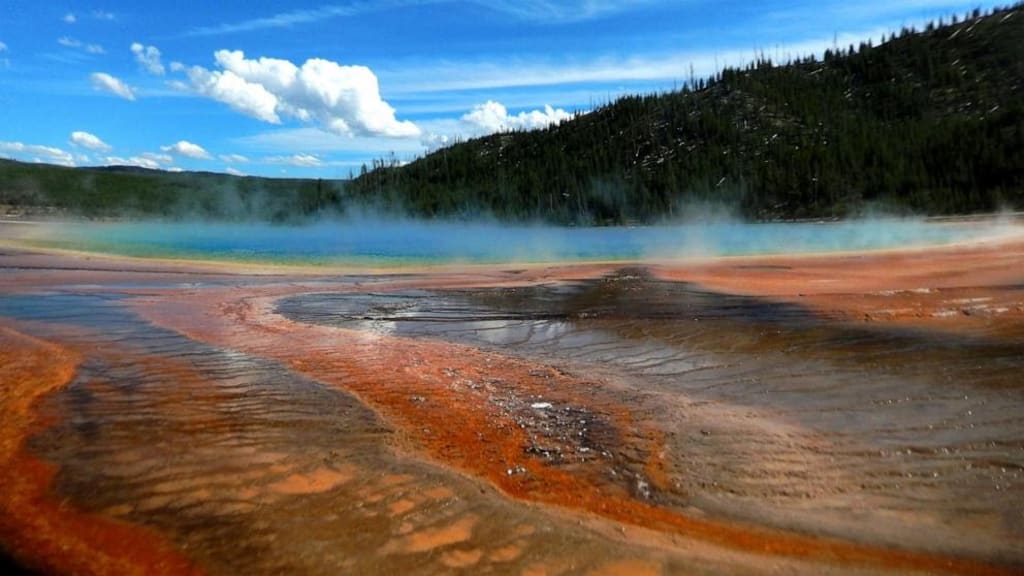
Yellowstone Supervolcano Hidden Magma Cap Discovery Could Prevent Future Eruptions Say Scientists
In a groundbreaking discovery that is reshaping our understanding of volcanic systems, scientists have uncovered a hidden magma cap beneath Yellowstone National Park. This finding offers new insights into the inner workings of one of the world’s most powerful supervolcanoes and could help scientists better predict future volcanic activity in the region.
A New Layer Beneath the Surface
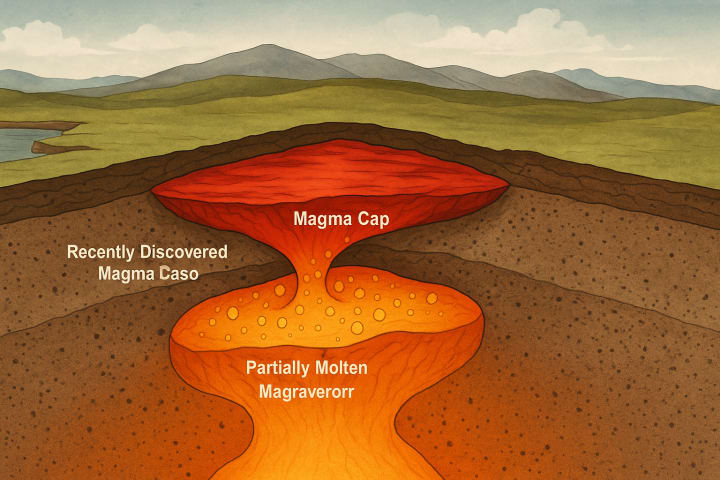
A team of geologists from multiple U.S. universities used advanced seismic imaging techniques to detect a previously unknown magma cap sitting about 3.8 kilometers 2.3 miles below the surface of Yellowstone. This cap described as a sharp volatile rich layer acts like a lid over the magma reservoir below, controlling how gases and pressure build up within the volcanic system. This discovery is significant because it changes how scientists understand the structure and behavior of Yellowstone’s volcanic plumbing system. While previous studies had already confirmed the existence of large magma chambers beneath the park the identification of this upper magma cap adds a new dimension to how eruptions might be triggered or suppressed.
Yellowstone's Explosive History
Yellowstone is no ordinary volcano. It’s classified as a supervolcano due to its capacity to produce eruptions thousands of times more powerful than regular volcanic events. The park has experienced three cataclysmic eruptions in the past 2.1 million years, with the most recent occurring approximately 640,000 years ago. These eruptions blanketed large areas of North America in volcanic ash and drastically altered the landscape. Despite its violent past Yellowstone has remained relatively quiet in recent history with activity limited to small earthquakes and geothermal changes. However the fear of a future eruption continues to capture public imagination and the attention of volcanologists worldwide.
How the Magma Cap May Prevent Eruptions
One of the most important aspects of the newly discovered magma cap is its potential role in preventing catastrophic eruptions. According to researchers the cap appears to act as a barrier that contains the pressure building within the underlying magma chamber. It allows gases to escape slowly through porous rock structures a process likened to steady breathing. This controlled release of pressure helps stabilize the system and may delay or even prevent explosive volcanic activity. This discovery could be a key reason Yellowstone has not erupted in such a long time. Rather than pressure rapidly building up and leading to a violent eruption the magma cap provides a slow release valve that moderates the volcano’s internal dynamics.
A Deeper Look into the Magma System
Further investigations revealed that the magma system beneath Yellowstone is even more complex than previously thought. Scientists have found not only the newly discovered upper magma cap but also a much larger magma reservoir located 12 to 28 miles (19 to 45 kilometers) below the surface. This lower reservoir contains hot partially molten rock and feeds the upper magma chamber. These findings suggest that the Yellowstone system operates through a multi level network of magma movement making it one of the most intricate volcanic systems on Earth. This deeper understanding could lead to more accurate predictions about the likelihood of future eruptions.
Seismic Imaging Breakthroughs
The discovery was made possible through seismic tomography a technique that uses the vibrations from earthquakes to create 3D images of the Earth's interior. Similar to a CT scan in medicine this method allows scientists to see underground structures without physically drilling into them. By combining data from thousands of earthquakes and applying advanced computer modeling the research team was able to filter out distortions and reveal the sharp outlines of the magma cap. The clarity of these new images represents a major breakthrough in geological research and opens up new possibilities for studying other volcanic systems around the world.
What Does This Mean for the Public?
Understandably the idea of a massive magma reservoir sitting beneath a popular national park might cause concern. However experts stress that this discovery does not indicate that an eruption is imminent. In fact the presence of the magma cap could mean that the risk of a catastrophic eruption is lower than previously feared. Yellowstone is one of the most closely monitored volcanic regions in the world. The U.S. Geological Survey (USGS) keeps constant watch on seismic activity ground deformation gas emissions and thermal changes in the park. No signs currently point to an increase in volcanic activity. The discovery of a hidden magma cap beneath Yellowstone National Park is a major advancement in our understanding of supervolcanoes. It provides critical information about how pressure is managed within the volcano and offers hope that future eruptions may be more predictable or even preventable. While the awe inspiring power of Yellowstone remains this new knowledge brings a reassuring message: nature often has its own safety mechanisms and science is getting better at uncovering them.
About the Creator
Adnan Rasheed
Author & Creator | Writing News , Science Fiction, and Worldwide Update| Digital Product Designer | Sharing life-changing strategies for success.
Keep reading
More stories from Adnan Rasheed and writers in Earth and other communities.
Earth’s Frozen Bacteria Discovery Sparks New Hope for Life on Mars Scientists Explain How
Earth’s Frozen Bacteria Discovery Sparks New Hope for Life on Mars Scientists Explain How In a groundbreaking discovery that could reshape our understanding of life in the universe, scientists have found ancient bacteria thriving deep within Earth's polar ice. This remarkable finding has ignited new hope in the ongoing quest for extraterrestrial life, particularly on Mars. But how exactly does frozen Earth bacteria connect to potential life on the Red Planet? Let’s dive into the science behind this thrilling possibility.
By Adnan Rasheed11 months ago in Earth
The Star That Keeps Dimming for No Known Reason
In 2015, astronomers analyzing data from NASA's Kepler Space Telescope discovered a star designated KIC 8462852, located about 1,470 light-years from Earth in the constellation Cygnus, that was exhibiting brightness fluctuations unlike anything that had been observed in over 150,000 stars surveyed by the Kepler mission, and the pattern of dimming was so unusual and irregular that it could not be explained by any known natural phenomena including planets orbiting the star, stellar pulsations, or dust clouds, leading some scientists to seriously propose that the dimming might be caused by artificial structures built by an advanced alien civilization, specifically something like a Dyson swarm of solar collectors orbiting the star to harvest its energy, though this explanation while exciting was considered a hypothesis of last resort only to be entertained after all natural explanations had been exhaustively ruled out. The star, which became known informally as Tabby's Star after astronomer Tabetha Boyajian who led the research team studying it, showed dimming events where its brightness dropped by up to 22 percent, far more than could be explained by a planet passing in front of it, which typically causes dimming of only a fraction of a percent, and the dimming events were irregular and aperiodic, meaning they did not repeat on any predictable schedule, and different dimming events had different characteristics with some showing gradual dimming over days and others showing more sudden brightness drops.
By The Curious Writerabout 10 hours ago in Earth


Comments
There are no comments for this story
Be the first to respond and start the conversation.