
World Heritage Bird Paradise | Yancheng Precious Bird Reserve
Explore the earth


In the eastern part of China, along the central coast of Jiangsu Province, there is a beautiful coastal wetland-Yancheng Wetland rare Birds National Nature Reserve, referred to as Yancheng rare Birds Reserve.
Damei wetland
Yancheng rare Bird Reserve was established in 1984, promoted to a national nature reserve in 1992, and became a world biosphere reserve in November of the same year.
In April 1996, it was included in the "Northeast Asian Crane Reserve" network.
In November 1999, it was included in the East Asia-Australia wading Bird Migration Network.
In January 2002, it became an "internationally important wetland".
Over the past 36 years, Yancheng rare Bird Reserve has recorded and written beautiful stories and people around them in the process of protecting and developing them.
A letter spawned a nature reserve
Speaking of the birth of Yancheng rare Bird Reserve, it is an unforgettable and legendary story in itself.
Letter from Comrade Hu Qiaomu to Jiangsu Provincial Party Committee
A bird, the world's rare bird, the red-crowned crane, intersected with a man at a special time. He wrote an important letter and gave birth to a nature reserve.
Yancheng is the overwintering place of red-crowned cranes in history. Yancheng County Chronicles contains:
"in the 12th year of Emperor Qianlong of the Qing Dynasty (AD 1747), cranes emerged from the depths of the reeds in the harbor."
At that time, Guangming Daily reported that "the capture of red-crowned cranes along the coast of Jiangsu Province is serious." This report attracted the attention of Hu Qiaomu, then member of the Secretariat of the CPC Central Committee, who gave instructions on March 1, 1982:
"in this matter, please stipulate practical measures, make public notices to prohibit it, and give serious publicity and education to the masses, and violators should be given disciplinary actions."
Nearly a year later, on February 21, 1983, he, who was still concerned about his hometown, asked in a letter to the Jiangsu Provincial Party Committee:
"it is notified with great fanfare that cranes travel to and fro through the counties and rural areas every year for special protection, and anyone is strictly prohibited from catching injuries, and violators must be severely punished before there is a glimmer of hope of salvation."
Between the lines, boxing love crane heart, eager to protect the crane state, over the words, jump on the paper.
Tango in the snow
The Jiangsu Provincial Party Committee and the Provincial Government immediately responded and issued a document in February 1983, agreeing to establish a coastal beach rare bird nature reserve in Yancheng area, demanding that the spirit of the document be implemented as soon as possible and do a good job in the protection of rare birds. In November 1984, Yancheng rare Bird Reserve was officially established.
A set of data tells you that one side of Damei Wetland
Functional Zoning Map of Wetland rare Bird National Nature Reserve in Yancheng, Jiangsu Province
Yancheng rare Bird Reserve faces the Yellow Sea to the east, including coastal wetlands in six coastal counties and cities under the jurisdiction of Yancheng. The total area is 247260 hectares, including 22596 hectares in the core area, 56742 hectares in the buffer zone and 167922 hectares in the experimental area.
A thousand years ago, the Yancheng seawall line was in today's Yancheng city, about 50 kilometers away from the present seawall line. From 1128 to 1855, the Yellow River seized the Huaihe River into the sea and brought a large amount of sediment, which, together with the large amount of sediment brought by the Yangtze River, gradually formed a unique muddy coastal wetland under the influence of the special convergent and divergent tide in the Yellow Sea. It has the "dual" characteristics of both land and sea, and has "double" rich resources.
Wetlands: kidney of the Earth
The Oriental White Stork
Exposure to wetlands, a cloud of thousands of changes, sometimes diffuse, sometimes concentrated, sometimes rolling, sometimes spreading elegant, let you feel is a kind of mysterious beauty
The wetland vegetation is luxuriant, the gully harbor river branch is vertical and horizontal, the distant view of wild cranes traveling in the sky, nearby startled a beach of gulls and herons, let you feel a kind of elegant Qingyuan beauty
The primitive ecology, the tide rises to see the sea, the tide falls to see the beach, the badger runs to the rabbit, the deer to run, there is not only the great scene of ten thousand birds gathering together, but also the big picture of all the birds playing, so that you can enjoy the beauty full of wild interest.
As for the sound of nature played by thousands of reeds in the autumn wind, the red carpet woven by Artemisia annua in late autumn, all birds fly together, the scene is spectacular.
A song inspires a group of ecological guardians
"walk across the river.
Have you ever heard
There was a girl who had been here before.
Walk across this Reed slope
Have you ever heard
There was a girl who left a song. "
Whenever familiar melodies ring, the listeners are all moved. Because this song is about a guardian crane angel, her name is Xu Xiujuan.
Xu Xiujuan
In April 1986, in the third year of the establishment of Yancheng rare Birds Reserve, she was born into a family of crane farmers in Qiqihar. Having just graduated from Northeast Forestry University, she came here to establish the first rare birds training farm at the invitation of Yancheng rare Birds Reserve.
She and her colleagues overcame the hot, humid and rainy natural environment, succeeded in breeding and domesticating cranes in the overwintering area, won awards for scientific research papers, and forged a sincere friendship with everyone in a difficult environment.
Unfortunately, she drowned in search of the lost swan on September 16, 1987, when she was less than 23 years old. she was the first female martyr to die in the line of duty in the work of ecological environment protection in our country.
Big swan
The film theme song "A True Story" created according to her deeds suddenly moved countless listeners at home and abroad. For more than 30 years, Xu Xiujuan's spirit has also inspired the reserve staff to work as dedicated as heaven and love cranes as self-love in ordinary posts.
Since 1985, the people's Government of Yancheng has issued a series of regulations and policies on the scope of zoning, management measures, land ownership, and so on, to carry out scientific research, and people in protected areas are gradually exploring their own ways of protection:
The comprehensive three-dimensional modern management and protection model of sea, land, air and artificial, science and technology has been realized; the basic work of scientific research has achieved fruitful results, more than 100 papers have been published in various scientific and technological journals, and more than 50 research projects have been completed; the initiative should apply for world natural heritage work, a total of 79000 mu of ecological restoration has been completed, and the illegal building area has been demolished of 138000 square meters.
In 1994, it passed the scientific and technological identification of artificial breeding and domestication of red-crowned crane, which filled the gap in China. The reserve has been actively carrying out wetland science popularization, fully exploring the connotation of Yancheng wetland, and popularizing wetland knowledge to college, primary and secondary school students.
A song, a person, a kind of crane, a protected area, a growing coastal wetland.
"Wetland Spirit-- Red-crowned Crane"
A bird gathers a protective community.
Spoon-billed snipe
A bird came out of the sky and attracted the attention of the whole world. It is the spoon-billed snipe.
The spoon-billed snipe is a kind of wading bird which is only distributed on the migration route of mi
About the Creator
Keep reading
More stories from Fwuebks Sushma and writers in Earth and other communities.
Poyang Lake, "Water" and struggle for Front
. The rainy season in the middle and lower reaches of the Yangtze River this year is particularly long and menacing. Since June 2, the Central Meteorological Observatory's rainstorm warning has been issued for more than 40 days, the longest since the rainstorm warning service was launched in 2007.
By Fwuebks Sushma3 years ago in Earth
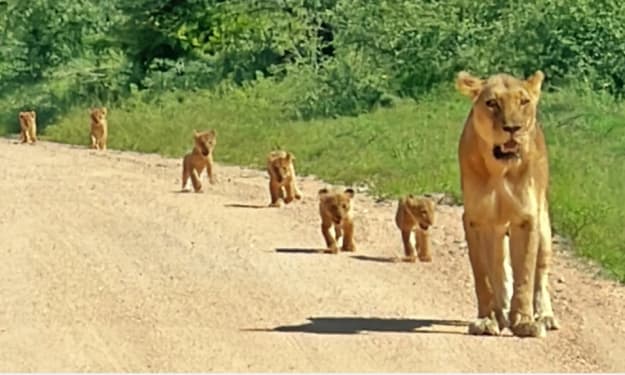
Tiny Lion Cubs Struggle To Keep Up With Mom
In the heart of the African savannah, life is a constant lesson for young animals. Few scenes are as endearing — or as heartwarming — as tiny lion cubs trying to keep pace with their mother. These little bundles of fur face a world full of challenges, from learning to hunt to avoiding dangers, all while depending on the guidance and protection of their experienced mom. Watching cubs wobble and tumble as they attempt to keep up with their mother reminds us that growing up, even in the wild, is a journey full of struggle, determination, and adorable missteps. The Early Days of Lion Cubs Lion cubs are born blind and helpless, usually in litters of two to six. For the first few weeks, they rely entirely on their mother for warmth, food, and safety. Even after opening their eyes and beginning to explore, the cubs are far from independent. The first months are crucial. Cubs learn social cues, hunting basics, and survival skills simply by watching their mother and the pride. But as anyone who has observed them knows, there’s often a huge gap between observation and action. Tiny cubs often struggle to match their mother’s pace, especially when she moves through long stretches of savannah or leads the family on patrols. A Mother’s Role in the Wild For a lioness, raising cubs is a full-time commitment. She hunts, defends her territory, and teaches her young, all while staying alert to predators such as hyenas, leopards, and even rival lions. The cubs, meanwhile, attempt to mimic her every move — often with clumsy yet charming results. A mother lion’s patience is remarkable; she frequently slows down, nudges them along, or stops to ensure no cub is left behind. These moments, while stressful for the tiny cubs, are vital learning opportunities. Struggling to Keep Up: Why It’s So Hard There are several reasons why tiny lion cubs have trouble keeping pace with their mother: Short Legs, Big Steps: Lion cubs’ legs are tiny and their coordination is limited, making it difficult to cover the same distance as an adult lioness. Curiosity: Cubs are naturally curious. A single butterfly or rustling bush can distract them, leaving mom to pause repeatedly. Energy Levels: Young lions tire quickly. Even with frequent naps, the cubs’ stamina is far lower than their mother’s. Learning Through Play: Play is not just fun; it teaches hunting, balance, and social skills. Running off to pounce on a sibling or chase an insect is all part of their education. Despite these challenges, the cubs’ determination to keep up demonstrates their resilience and growing understanding of the wild world. Lessons in Teamwork and Survival Every cub struggling to keep up is also learning crucial survival skills. The journey across the savannah is more than a test of speed — it’s a lesson in: Coordination: Cubs learn how to move efficiently across different terrains. Patience: They begin to understand the rhythms of adult life and the pace required for survival. Social Skills: Staying with the group teaches cubs how to interact with siblings and the pride, which is essential for their future roles. Observation: By following their mother, cubs study hunting techniques, territorial behavior, and predator awareness. Even the moments when cubs stumble or lag behind are essential for their development. These experiences prepare them for independence, which comes sooner than many might expect. The Cutest Moments in the Wild Anyone who has watched tiny lion cubs knows that their struggles are often irresistibly cute. Video clips from wildlife reserves frequently show cubs toddling along, tumbling over each other, or getting distracted mid-step. Observers often comment that these little stumbles reveal personality, determination, and playfulness, making them one of nature’s most heartwarming spectacles. While their mother is serious and focused, the cubs inject a sense of humor and lightness into life on the savannah. Why This Matters The struggles of lion cubs aren’t just adorable — they’re vital for understanding wildlife behavior. Conservationists and animal behaviorists use these moments to study growth patterns, social structures, and survival strategies in lion populations. These observations also highlight the importance of preserving natural habitats. Cubs must learn in a safe environment to survive; habitat loss, poaching, and climate change make these early struggles even more dangerous. Protecting the African savannah ensures that future generations of lions can experience the same lessons and playful tumbles. The Road to Independence Within a year, these tiny cubs will be more agile, faster, and more confident. By the time they reach two to three years old, males may begin to leave the pride, while females often stay and become caretakers themselves. Every misstep, tumble, and lagging moment is part of the journey toward strength, coordination, and independence. Watching them now gives us a glimpse of the challenges they will overcome, and the survival skills they will carry for life. A Celebration of Motherhood Ultimately, these scenes remind us of the incredible bond between mother and cubs. Her patience, vigilance, and teaching are the foundations of their future. The cubs’ struggles highlight the trials of growing up, while their determination showcases the resilience and beauty of wildlife. For those observing, it’s a powerful lesson in care, guidance, and perseverance, not just in lions but in the natural world as a whole. Final Thoughts Watching tiny lion cubs try to keep up with their mother is both entertaining and enlightening. It’s a story of growth, struggle, and resilience — a reminder that even the fiercest creatures start small, learning step by step. These little lions capture hearts while teaching life lessons: patience, determination, teamwork, and the importance of guidance. As they tumble and waddle across the savannah, they show us that growth is a process, one adorable misstep at a time. For wildlife enthusiasts, animal lovers, and anyone enchanted by nature, these tiny cubs are proof that even in the wild, love, care, and persistence are universal truths.
By Aarif Lashari2 days ago in Earth
Microbiota, microbiome or microflora: how to speak correctly and why it is for health.
You've probably heard the phrase, "We are what we eat." But modern science says more precisely: we are also those who live in us. Until 2016, it was believed that there are many times more bacteria in our body than our own cells. The latest calculations by mathematicians show that we divide the body with our microorganisms by about 50/50: about 30 trillion of our cells versus 38 trillion bacterial ones.
By Yaroslav Gorohov6 days ago in Earth


Comments
There are no comments for this story
Be the first to respond and start the conversation.