
Wildlife Documentaries
Technology has really Progressed

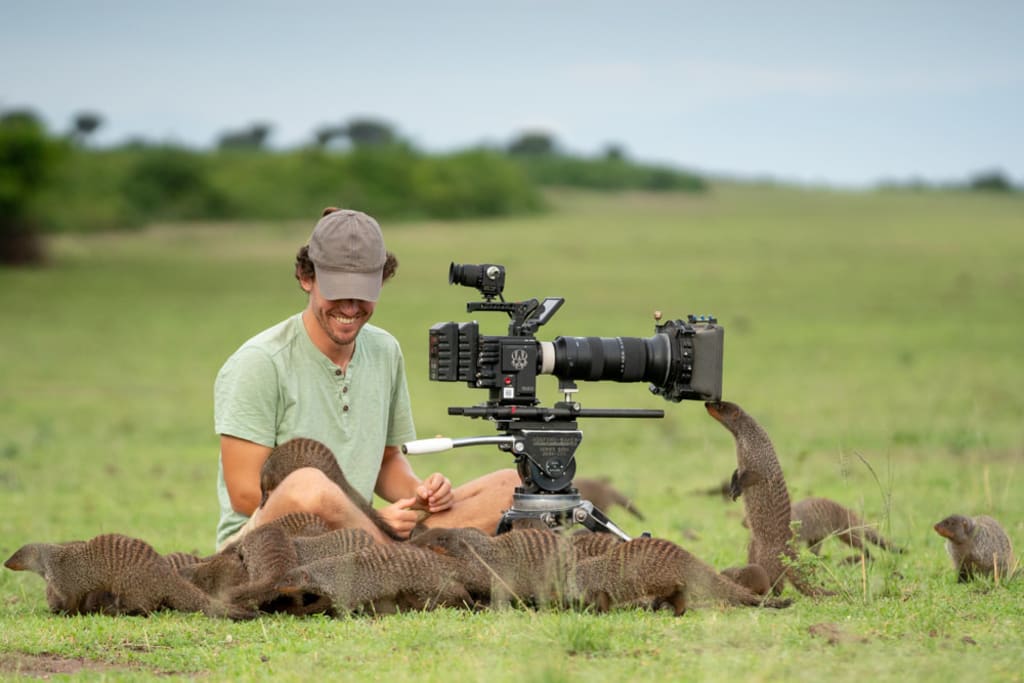
I’m actually glad that I’m living in this time (2025). Technology has advanced so quickly in such a short amount of time, with most of it benefitting us. I’m looking at this from the viewpoint of the technology that is used in Wildlife Documentaries.
When films and television first came out, everyone was curious and amazed to see the moving pictures, even though then everything was in black and white. From then, (the late 1890’s for moving pictures, the 1920’s for television), until today 2025, we are privileged to see the very best technology used for Wildlife Documentaries.
I’m not talking about CGI and the type of technology that is invented for films and programs (Game of Thrones comes to mind). I’m talking about the type of very real technology that has been invented for us to see ‘real life’, ‘real animals and their environments’. The type that records the ‘truth’ about our planet Earth.
The first Wildlife Documentary was called “Nanook of the North”, which was made by Robert J.Flaherty in 1922. It is typically cited as the first feature-length documentary. The hand-cranked Akeley 35mm Cine Camera was used, mainly for its portability and reliability. Flaherty also used a portable developing and printing machine, because he wanted to see the footage and make adjustments during the actual filming process.
An interesting fact is that the more that we learnt about animals and their environments, the better we’ve been able to adapt technology, so that we can see and learn about these creatures we share our planet with, without being too ‘intrusive’ into their worlds. It has always been important to film the ‘reality’, and this is one big area where technology has advanced. Camera angles and shots have improved so that we have a much better quality of picture today. Aerial shots and close ups, even under water, are all available to be used, so much so that now every new Wildlife Documentary appears to use brand new technology.
Over the years, these documentaries have become, not just entertainment, but educational as well. Wildlife Documentaries have become a common choice for a family evening because they offer an educational and meaningful pastime which parents feel their children would actually benefit from watching. We “trust” these documentaries because we know ‘what we’ll be getting’ when we watch them.
The more we learn about the world we live in, the animals, birds, insects and the varying environments, the more we can understand and learn ‘how’ to protect this planet Earth.
We live at a time when many may think: “I’ve seen it all!”, and the younger generation only know the advancing technological world and expect to see it. So to make everyone ‘stop and take note’, Wildlife Documentaries have to constantly advance.
Today, the stalwart ARRI film cameras and Panasonic Varocam have been succeeded by the Sony FX9 which are the ‘workhorses’ for Wildlife Cinematographers.
The RED units are very compact and versatile, with a huge amount of flexibility for framing.
The Sony FX9 is like a documentary camera, which has a very cinematic image, it records audio nicely and has variable ND.
Sometimes an Alpha A7SR camera is used, which is a small mirror-less camera. The combination is useful in low-light conditions.
“With a lot of wildlife, you sit in the hide and need the longest lens possible, once you’re in the hide, you can’t move, so the shots are very similar. But with wildlife you can get close to, I’m a great believer in working with a slider and a wide-angle lens; if you get a bit of movement on a wide you get a parallax effect, and that little extra dynamic can add drama and life to an otherwise static shot. We shot penguins in South Georgia in anamorphic on quite wide primes, and it was fabulous”, David Baillie.
Many cinematographers shoot with ‘babylegs’ tripods that allow the camera to be around a height of 40cm, which is the eye level of many animals.
Very often the environment where the animal is being filmed causes challenges for cameras. For example, in the jungles there is condensation and a build-up of mold. “We normally have a Peli case filled with silicone balls and put heated pads inside. If you get moisture in any component, whether it’s lenses or inside a camera, it goes in there overnight and the silicone sucks out all the moisture,” cinematographer Duncan Parker.
“As filmmakers, we need to make sure that animal welfare is number one”, Michael Burns.
To be honest, I have just ‘turned the first page’ on the technology used in filming Wildlife Documentaries, but even this small piece of information gives us an insight into how and why these amazing documentaries ‘capture our attention.’
“It seems to me that the natural world is the greatest source of excitement; the greatest source of visual beauty; the greatest source of intellectual interest. It is the greatest source of so much in life that makes life worth living,” David Attenborough.
About the Creator
Ruth Elizabeth Stiff
I love all things Earthy and Self-Help
History is one of my favourite subjects and I love to write short fiction
Research is so interesting for me too
Keep reading
More stories from Ruth Elizabeth Stiff and writers in Earth and other communities.
Wild Cats
I am literally nuts about Wildlife Documentaries. I have spent hours and hours watching every one I could get my hands on, as well as ‘studying’ the books that go with each documentary. So when I found the “Big Cats” series, I thought I was in heaven! The fact that “Cats”, domestic or wild, are my absolute favourite animals, just added to the excitement. I’ve still yet to find the accompanying book.
By Ruth Elizabeth Stiff8 months ago in Earth
The Most Earthquake-Prone Places in the World and Why They Shake so Often
My interest in earthquakes began when I was a little girl. I remember watching footage of the ground shaking and wondering how something as solid as the Earth could suddenly move. That early curiosity stayed with me and eventually led me to learn more about why earthquakes happen and why some places experience them far more often than others.
By Marla Samuel7 days ago in Earth


Comments
There are no comments for this story
Be the first to respond and start the conversation.