
Why Is The Bermuda Triangle No Longer Mentioned?
It turns out there was never a mystery, to begin with.

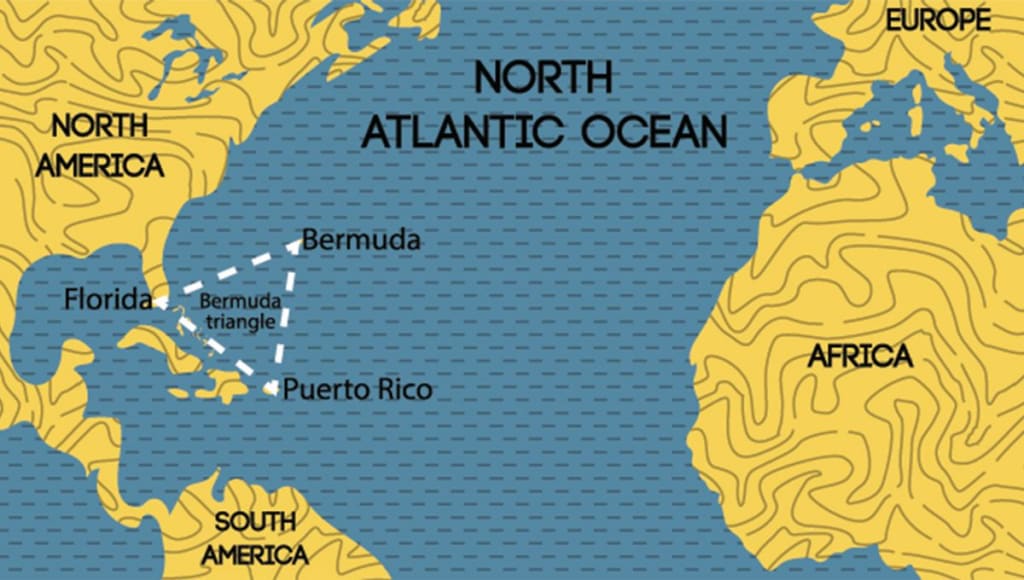
The Bermuda Triangle, a region in the Atlantic Ocean that was gobbling up ships and airplanes like they were Reese's Pieces, was the subject of at least one documentary over a good portion of the latter part of the 20th century.
But in recent years, a new type of Tweet has emerged: those that inquire as to what has become of the Bermuda Triangle enigma.
What is the reason behind the abrupt drop in Bermuda Triangle intrigue? Well, the fact that it has been solved numerous times and that there was never a mystery, to begin with, might have something to do with it. But let's go back to the beginning for those who are lacking that fascination in their lives.
A 1968 article on "Flight 19" in 1945 can be linked to interest in a hazily defined area of ocean between Florida, Puerto Rico, and Bermuda. Five US Avenger Torpedo Bombers disappeared on December 5, 1945, above the alleged Bermuda Triangle while being flown by multiple veteran pilots as well as trainees in average weather circumstances.
Around 4 o'clock in the afternoon, an overheard radio conversation between a trainee and their instructor explained that they had lost track of their location and that the aircraft's compass was broken. The planes disappeared shortly after that, somewhere east of Florida, and were never found or heard from again.
Despite how intriguing the article was, there are many different reasons why planes disappear. In this instance, the Navy posits that after getting disoriented, the crew was probably forced to attempt an unsuitable at-sea landing.
There is no evidence of odd storms at the time, but they write in a report that "it is also possible that some unexpected and unforeseen development of weather conditions may have intervened."
However, the concept of a place where things go missing somehow caught on, and over time, sinkings and missing planes in the area came to be attributed to it, while sinkings that occurred before 1945 were backdated and associated with the Triangle in hindsight, including the loss of the USS Cyclops, which vanished without a trace while returning from Brazil in 1918.
The US Coast Guard compiled logical causes for local disappearances in an information sheet.
The authors believe that "the majority of disappearances can be attributed to the area's distinctive environmental features." "First, one of the two locations on Earth where a magnetic compass does point north is the 'Devil's Triangle. It typically faces magnetic north.
Compass variation refers to the distinction between the two. As one circles the globe, the amount of fluctuation can vary by as much as 20 degrees. A navigator could get seriously off course and into difficulty if this compass variation or inaccuracy is not corrected.
They point out that the same issue also exists off the east coast of Japan in another region that fishermen refer to as the "Devil's Sea."
The Gulf Stream's characteristics are listed as "another environmental factor" by the authors. "It is extremely swift and turbulent and can quickly erase any evidence of a disaster," transforming a terrible ship loss into a mystery that may never be solved.
"The erratic weather pattern in the Caribbean and Atlantic also contributes. Pilots and seafarers frequently face tragedy as a result of sudden localized thunderstorms and water spouts.
But none of the aforementioned matters because, according to statistics, accidents do not occur more frequently in the Bermuda Triangle than in other parts of the oceans and seas. In reality, the Bermuda Triangle does not rank among the top ten in a study that examined the most hazardous maritime areas by compiling data on mishaps and incidents.
While this was going on, a UK Channel 4 investigation into accidents involving the Bermuda Triangle found that "many ships had not sunk there."
Must work harder, mysterious body of water where boats are said to sink.
Statistics show that accidents are no more likely to happen here than in other areas that ships and airplanes pass over, so the idea that there are more sinkings in the region likely stems from the media (and conspiracy theorists) focusing on any sinkings in the area due to intrigue surrounding the Bermuda Triangle and reinforcing the mystery.
So why has the Bermuda Triangle suddenly received less attention?
Most likely because those who are producing shows and articles on the purported mystery and a large enough portion of the general audience are aware that it doesn't actually exist, or isn't mysterious enough to continue attracting viewers.
About the Creator
Keep reading
More stories from Francis Dami and writers in Earth and other communities.
There Are Still Unclaimed Lands on Earth That No Country Wants, According to Terra Nullius
Today's world is made up of nation-states with clearly defined borders. Challenge those frontiers, and by noon troops and tanks will be moving in your direction. There are a few locations on Earth that no sovereign state claims as its own, despite humanity's relatively recent fascination with maps.
By Francis Dami3 years ago in Earth
Europe Draws a Red Line on Greenland After a Year of Trying to Pacify Trump
For nearly a year, European leaders walked a diplomatic tightrope. They tried calm language, quiet reassurance, and strategic patience as former U.S. President Donald Trump repeatedly revived his controversial interest in Greenland. What began as provocative rhetoric gradually evolved into something Europe could no longer ignore. Now, after months of behind-the-scenes diplomacy, Europe has drawn a clear red line on Greenland — signaling that compromise has its limits when sovereignty and regional security are at stake. This shift marks more than a response to one leader’s remarks. It reflects Europe’s growing determination to defend territorial integrity, manage Arctic competition, and assert strategic autonomy in an increasingly unpredictable geopolitical environment. How Greenland Became a Flashpoint Again Greenland, an autonomous territory within the Kingdom of Denmark, has long held strategic importance. Rich in rare earth minerals, located along key Arctic routes, and home to critical U.S. military infrastructure, the island sits at the crossroads of security, climate change, and great-power rivalry. Donald Trump’s original proposal in 2019 to “buy” Greenland was widely mocked in Europe. But as his political influence resurged, so did concerns that his renewed interest was not just symbolic. Over the past year, Trump’s rhetoric — framed around U.S. security, resource access, and countering China and Russia in the Arctic — became more persistent. European capitals initially chose restraint. Officials hoped that de-escalation, quiet diplomacy, and alliance solidarity would prevent the issue from spiraling into a transatlantic rift. A Year of European Pacification For much of the past year, Europe adopted a strategy of pacification rather than confrontation. Denmark emphasized its close defense cooperation with Washington. EU leaders reiterated NATO unity and the importance of Arctic stability. Diplomats avoided public criticism, choosing private channels instead. The goal was clear: prevent Trump’s Greenland narrative from becoming official U.S. policy while preserving transatlantic relations. However, this approach had limits. As Trump’s language grew sharper — hinting at leverage, pressure, or “strategic necessity” — European patience began to erode. What once sounded like political theater increasingly resembled a challenge to European sovereignty norms. Why Europe Finally Drew the Line Europe’s tougher stance did not emerge overnight. It was driven by several converging realities. 1. Sovereignty Is Non-Negotiable At the heart of Europe’s response is a firm principle: territorial sovereignty cannot be bargained away. Greenland is not a commodity, and its future cannot be dictated by external powers — regardless of alliance ties. European leaders made it clear that any attempt to apply pressure on Denmark or Greenland would cross a red line, undermining international law and democratic self-determination. 2. Arctic Competition Is Intensifying The Arctic is no longer a frozen backwater. Melting ice has opened new shipping routes and intensified competition over resources. Russia has militarized large parts of its Arctic territory, while China has declared itself a “near-Arctic state.” Against this backdrop, Europe fears that normalizing aggressive rhetoric over Greenland could set a dangerous precedent, encouraging other powers to challenge borders under the guise of security or economic necessity. 3. Europe’s Strategic Confidence Has Grown Compared to 2019, Europe today is less willing to absorb geopolitical shocks quietly. The war in Ukraine accelerated Europe’s defense integration and sharpened its sense of strategic responsibility. Standing firm on Greenland is part of a broader shift: Europe is signaling that being a U.S. ally does not mean surrendering political agency. Greenland’s Own Voice Matters One crucial difference between past debates and today is the prominence of Greenlandic leaders themselves. Officials in Nuuk have repeatedly emphasized that Greenland’s future will be decided by its people, not by foreign capitals. Calls for respect, partnership, and economic development — rather than transactional geopolitics — have resonated strongly in Europe. By drawing a red line, European leaders are also amplifying Greenland’s right to self-determination, reinforcing the idea that Arctic communities are stakeholders, not strategic prizes. What This Means for Transatlantic Relations Europe’s firmer stance does not signal a break with the United States. NATO cooperation in the Arctic remains strong, and U.S. military presence in Greenland continues with Danish consent. However, the message is unmistakable: allies must respect boundaries. European officials are increasingly willing to publicly disagree with Washington when core principles are threatened. This reflects a maturing alliance — one where unity does not require silence. In the long run, this clarity may actually strengthen transatlantic relations, reducing ambiguity and preventing future misunderstandings. A Signal Beyond Greenland Europe’s red line on Greenland sends a message far beyond the Arctic. It signals to Russia and China that Europe will defend its territorial order, even under pressure from powerful actors. It reassures smaller states that sovereignty remains a foundational norm. And it underscores that Europe is learning to balance diplomacy with firmness in an era of great-power competition. Conclusion: From Pacification to Principle After a year of cautious diplomacy, Europe has chosen principle over placation. The red line drawn around Greenland is not an act of hostility — it is an assertion of values. In a world where power politics are returning, Europe is making one thing clear: sovereignty is not negotiable, alliances are not blank checks, and Arctic stability requires respect — not rhetoric. Greenland may be vast and sparsely populated, but the message Europe is sending from its icy shores is unmistakably global.
By Muhammad Hassan6 days ago in Earth



Comments
There are no comments for this story
Be the first to respond and start the conversation.